
phyddle 0.3.0
Phylogenetic model exploration with deep learning.
User guide
Visit https://phyddle.org to learn how to use the software.
Overview
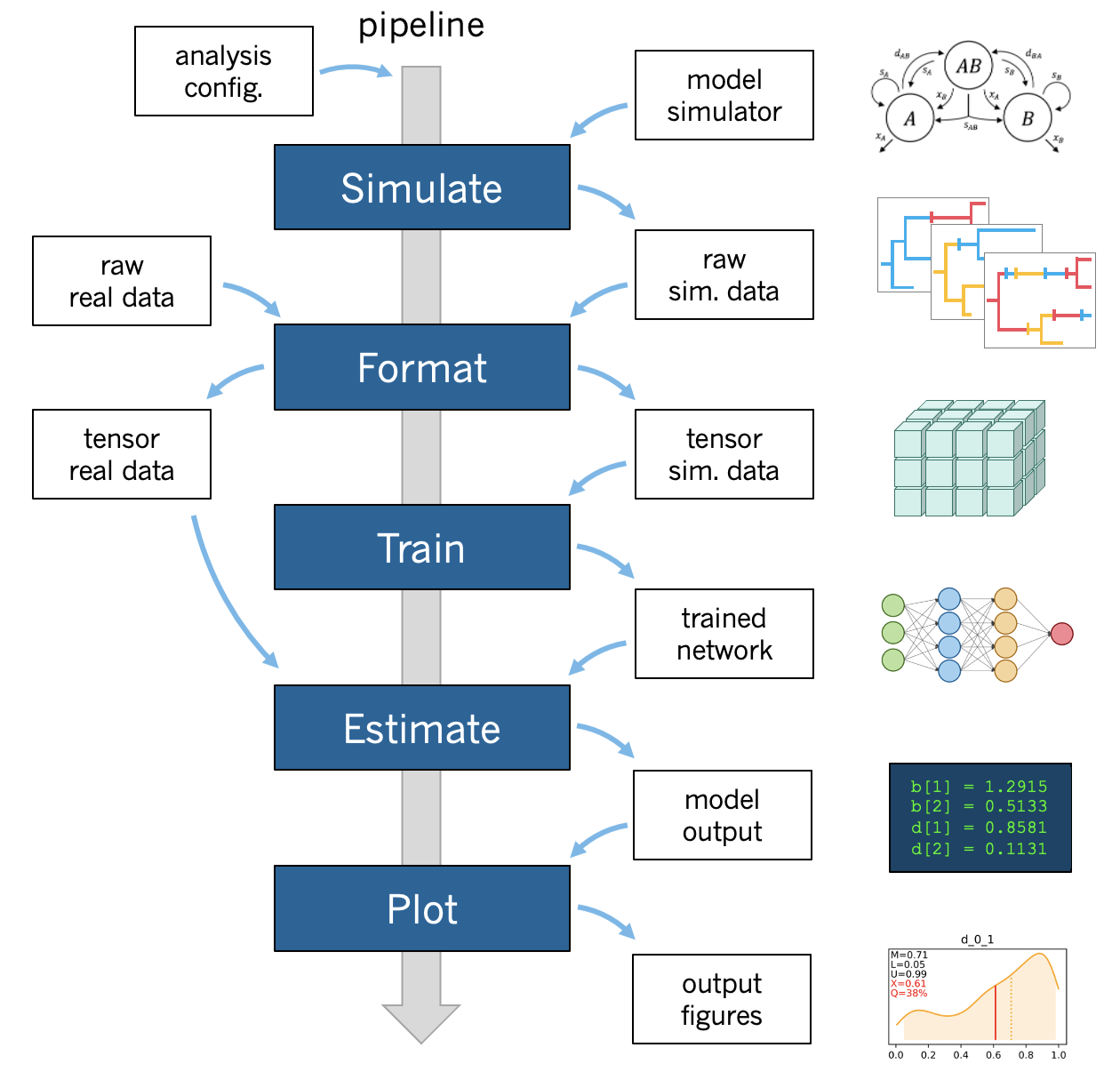
A standard phyddle analysis performs the following tasks for you:
- Pipeline configuration applies analysis settings provided through a config file and/or command line arguments.
- Simulate simulates a large training dataset using a user-designed simulator.
- Format encodes the raw simulated data (from Simulate) into tensor format for Train.
- Train loads and splits training data (from Format), builds a network, then trains and saves the network.
- Estimate estimates model parameters for a new dataset with the trained network (from Train).
- Plot generates figures that summarize the training data (Format), the network and its training (Train), and any new predictions (Estimate).
Quick start
To run a phyddle analysis enter the scripts directory:
cd ~/projects/phyddle
Then create and run a pipeline under the settings you've specified in workspace/example/config.py:
cd workspace/example
phyddle --cfg config.py
This will run a phyddle analysis with 1000 simulations using R and the castor package for a simple birth-death model with one 3-state character. In practice, you'll want to generate a larger training dataset with anywhere from 10k to 1M examples, depending on the model.
To add new examples to your training set
# simulate new training examples and store in simulate
phyddle -s S -c config.py --sim_more 14000

# encode all raw_data examples as tensors in format
phyddle -s F -c config.py

# train network with tensor data, but override batch size, then store in train
phyddle -s T -c config.py --trn_batch_size 256

# make prediction for empirical example in dataset
phyddle -s E -c config.py

# generate figures and store in plot
phyddle -s P -c config.py
To see a full list of all options currently supported by phyddle
phyddle --help
Installation
A stable version of phyddle can be installed using the Python package manager, pip:
python3 -m pip install --upgrade phyddle
# ... install ...
phyddle
...or using conda:
conda create -n phyddle_env -c bioconda -c landismj phyddle
# ... install ...
conda activate phyddle_env
phyddle
phyddle uses third-party simulators to generate training datasets. Example workflows assume that R, RevBayes, Phylojunction, or BEAST with MASTER (plugin) is installed on your machine and can be executed as a command from terminal. The documentation explains how to configure R for use with phyddle.
Note on code stability
Code on the main branch is tested and stable with respect to the standard use cases. Code on the development branch contains new features, but is not as rigorously tested. Most phyddle development occurs on a 16-core Intel Macbook Pro laptop and a 64-core Intel Ubuntu server. Any feedback is appreciated! michael.landis@wustl.edu
About
Thanks for your interest in phyddle. The phyddle project emerged from a phylogenetic deep learning study led by Ammon Thompson (paper). The goal of phyddle is to provide its users with a generalizable pipeline workflow for phylogenetic modeling and deep learning. This hopefully will make it easier for phylogenetic model enthusiasts and developers to explore and apply models that do not have tractable likelihood functions. It's also intended for use by methods developers who want to characterize how deep learning methods perform under different conditions for standard phylogenetic estimation tasks.
The phyddle project is developed by Michael Landis and Ammon Thompson.
2 maintainers


Metadata
2 maintainers
Release files for phyddle 0.3.0
For a detailed explanation of source distributions (sdists) and built distributions (wheels), please see the package formats documentation.
Source distribution (sdist)
| File | Size | Uploaded | Provenance | |
|---|---|---|---|---|
| phyddle-0.3.0.tar.gz | 82.1 kB | Without provenance | Details |
Built distribution (wheel)
| File | Interpreter | ABI | Platform | Reset |
|---|---|---|---|---|
| phyddle-0.3.0-py3-none-any.whl | Python 3 | none | any | Details |
Total release size: 162.6 kB
Release files / phyddle-0.3.0.tar.gz
| Download URL | phyddle-0.3.0.tar.gz |
|---|---|
| Size | 82.1 kB |
| Tags | Source |
|
SHA-256 checksum How to use checksums |
4a405d1d81aa27d6aa1f8d3c11559cee91146bfa14b0b7d60e19bcdcaba2c027
|
|
BLAKE2b-256 checksum How to use checksums |
acaa854684c91e83d69bebc6a9e4a65fed31ecd126beb46fc0874bccd81743b9
|
| Upload date | |
|
Uploaded using Trusted Publishing? What is trusted publishing? |
No |
| Uploaded via |
twine/6.1.0 CPython/3.12.8
|
Release files / phyddle-0.3.0-py3-none-any.whl
| Download URL | phyddle-0.3.0-py3-none-any.whl |
|---|---|
| Size | 80.5 kB |
| Tags | Python 3 |
|
SHA-256 checksum How to use checksums |
10a8d9d756a3c8f47ebc6a4c18b7f67f1c08c913379377ec7711572b8015c97c
|
|
BLAKE2b-256 checksum How to use checksums |
bebd316701fc2d1b7aadeb98d56338af09e544315b465f5cf502f7ef3837289e
|
| Upload date | |
|
Uploaded using Trusted Publishing? What is trusted publishing? |
No |
| Uploaded via |
twine/6.1.0 CPython/3.12.8
|
Security for phyddle 0.3.0
Provenance
Provenance describes where a file came from. On PyPI, provenance is shared via attestations, which provide a verifiable record of the build or publishing details. View details, limitations and caveats.
No provenance found
None of the files in this release were uploaded with provenance metadata.
A note on package security
PyPI is a repository for distributing packages, not a service for auditing them. While third-party security researchers and our staff do their best to detect and remove malicious packages, PyPI cannot guarantee the quality, security or suitability of any given package.














