

About
Orthologs are genes that are related through a speciation event, while paralogs are genes that are related through a gene duplication event. Accurate identification of orthologs is a prerequisite for phylogenomics, since including genes that diverged because of a gene duplication event for species tree inference can cause an erroneous inference of speciation nodes, due to disparencies between individual gene trees and the species tree. Unfortunately, contaminants present in even a single taxon can cause a tree-based orthology inference method to erroneuosly infer paralogy and unnecessarily exclude sequences.
PhyloPyPruner is a Python package for phylogenetic tree-based orthology inference, using the species overlap method. It uses trees and alignments inferred from the output of a graph-based orthology inference approach, such as OrthoMCL, OrthoFinder or HaMStR, in order to obtain sets of sequences that are 1:1 orthologous. In addition to algorithms seen in pre-existing tree-based tools (for example, PhyloTreePruner, UPhO, Agalma or Phylogenomic Dataset Reconstruction), this package provides new methods for reducing potential contamination.
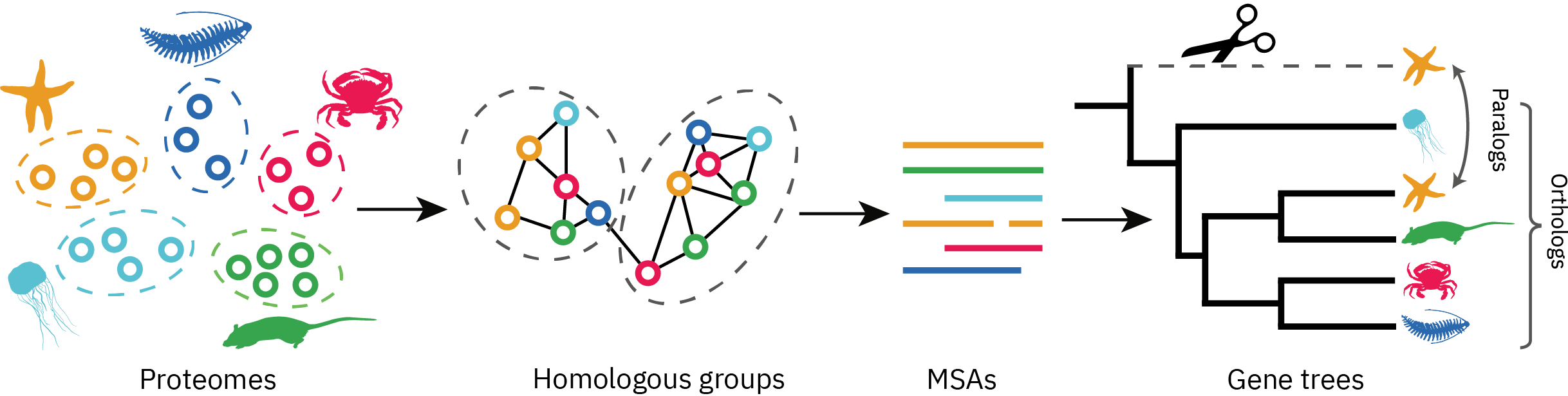
Figure 1. A rough overview of a tree-based orthology inference approach.
Quick installation
The easiest way to install PhyloPyPruner is by using the package manager for Python, pip:
pip install phylopypruner # install for all users
pip install --user phylopypruner # install for the current user only
Once installed, the program is located within $HOME/.local/bin. Depending on
your OS, you might have to add the directory to your $PATH to avoid typing
the entire path. Once in your path, you run the program like this:
phylopypruner
Documentation
Cite
Our manuscript is still in preparation, it will be posted here once a preprint of the article is available.
© Kocot Lab 2019
1 maintainer

Metadata
1 maintainer
Release files for phylopypruner 1.3.2
For a detailed explanation of source distributions (sdists) and built distributions (wheels), please see the package formats documentation.
Source distribution (sdist)
| File | Size | Uploaded | Provenance | Actions |
|---|---|---|---|---|
| phylopypruner-1.3.2.tar.gz | 74.5 kB | Without provenance | Details for phylopypruner-1.3.2.tar.gz |
Built distribution (wheel)
| File | Interpreter | ABI | Platform | Actions Reset |
|---|---|---|---|---|
| phylopypruner-1.3.2-py3-none-any.whl | Python 3 | none | any | Details for phylopypruner-1.3.2-py3-none-any.whl |
Total release size: 159.8 kB
Release files / phylopypruner-1.3.2.tar.gz
| Download URL | phylopypruner-1.3.2.tar.gz |
|---|---|
| Size | 74.5 kB |
| Tags | Source |
|
SHA-256 checksum How to use checksums |
5d6ed1e6578aafa6ada6b15e24a3b0df3a4278189350696d8be030dfb54d317c
|
|
BLAKE2b-256 checksum How to use checksums |
1690578616e19b61e6af2e117cf193a0d02f62685b1fd4933f2906b300b57d39
|
| Upload date | |
|
Uploaded using Trusted Publishing? What is trusted publishing? |
No |
| Uploaded via |
twine/6.2.0 CPython/3.13.2
|
Release files / phylopypruner-1.3.2-py3-none-any.whl
| Download URL | phylopypruner-1.3.2-py3-none-any.whl |
|---|---|
| Size | 85.3 kB |
| Tags | Python 3 |
|
SHA-256 checksum How to use checksums |
704206319a00b46d351075435d581d8635670cdf772acdc1aa38c9d270c5de6c
|
|
BLAKE2b-256 checksum How to use checksums |
b59880b959ae65495d07f761110db2d97cd4ca9c9be3c83d4f92530af46aa92e
|
| Upload date | |
|
Uploaded using Trusted Publishing? What is trusted publishing? |
No |
| Uploaded via |
twine/6.2.0 CPython/3.13.2
|
Security for phylopypruner 1.3.2
Provenance
Provenance describes where a file came from. On PyPI, provenance is shared via attestations, which provide a verifiable record of the build or publishing details. View details, limitations and caveats.
No provenance found
None of the files in this release were uploaded with provenance metadata.
A note on package security
PyPI is a repository for distributing packages, not a service for auditing them. While third-party security researchers and our staff do their best to detect and remove malicious packages, PyPI cannot guarantee the quality, security or suitability of any given package.
To learn more about protecting yourself from malicious actors, visit our package security documentation.














