



Probreg is a library that implements point cloud registration algorithms with probablistic model.
The point set registration algorithms using stochastic model are more robust than ICP(Iterative Closest Point). This package implements several algorithms using stochastic models and provides a simple interface with Open3D.
Core features
- Open3D interface
- Rigid and non-rigid transformation
Algorithms
- Maximum likelihood when the target or source point cloud is observation data
- Coherent Point Drift (2010)
- Extended Coherent Point Drift (2016) (add correspondence priors to CPD)
- Color Coherent Point Drift (2018)
- FilterReg (CVPR2019)
- Variational Bayesian inference
- Distance minimization of two probabilistic distributions
- Hierarchical Stocastic model
Transformations
| type | CPD | SVR, GMMReg | GMMTree | FilterReg | BCPD (experimental) |
|---|---|---|---|---|---|
| Rigid | Scale + 6D pose | 6D pose | 6D pose | 6D pose (Point-to-point, Point-to-plane, FPFH-based) |
- |
| NonRigid | Affine, MCT | TPS | - | Deformable Kinematic (experimental) |
Combined model (Rigid + Scale + NonRigid-term) |
CUDA support
You need to install cupy.
pip install cupy
Installation
You can install probreg using pip.
pip install probreg
Or install probreg from source.
git clone https://github.com/neka-nat/probreg.git --recursive
cd probreg
pip install -e .
Getting Started
This is a sample code that reads a PCD file and calls CPD registration. You can easily execute registrations from Open3D point cloud object and draw the results.
import copy
import numpy as np
import open3d as o3
from probreg import cpd

# load source and target point cloud
source = o3.io.read_point_cloud('bunny.pcd')
source.remove_non_finite_points()
target = copy.deepcopy(source)
# transform target point cloud
th = np.deg2rad(30.0)
target.transform(np.array([[np.cos(th), -np.sin(th), 0.0, 0.0],
                           [np.sin(th), np.cos(th), 0.0, 0.0],
                           [0.0, 0.0, 1.0, 0.0],
                           [0.0, 0.0, 0.0, 1.0]]))
source = source.voxel_down_sample(voxel_size=0.005)
target = target.voxel_down_sample(voxel_size=0.005)

# compute cpd registration
tf_param, _, _ = cpd.registration_cpd(source, target)
result = copy.deepcopy(source)
result.points = tf_param.transform(result.points)

# draw result
source.paint_uniform_color([1, 0, 0])
target.paint_uniform_color([0, 1, 0])
result.paint_uniform_color([0, 0, 1])
o3.visualization.draw_geometries([source, target, result])
Resources
Results
Compare algorithms
| CPD | SVR | GMMTree | FilterReg |
|---|---|---|---|
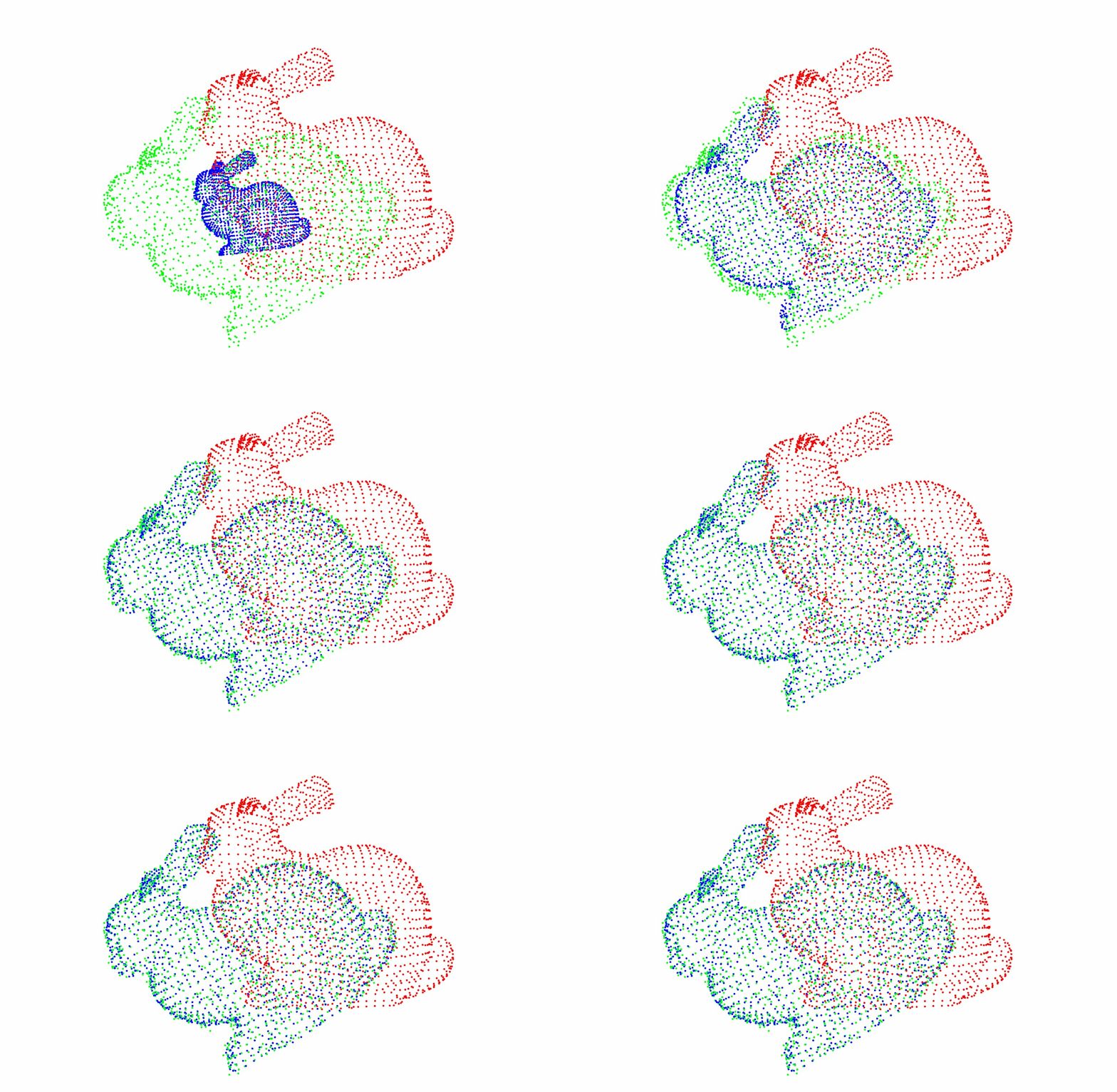 |
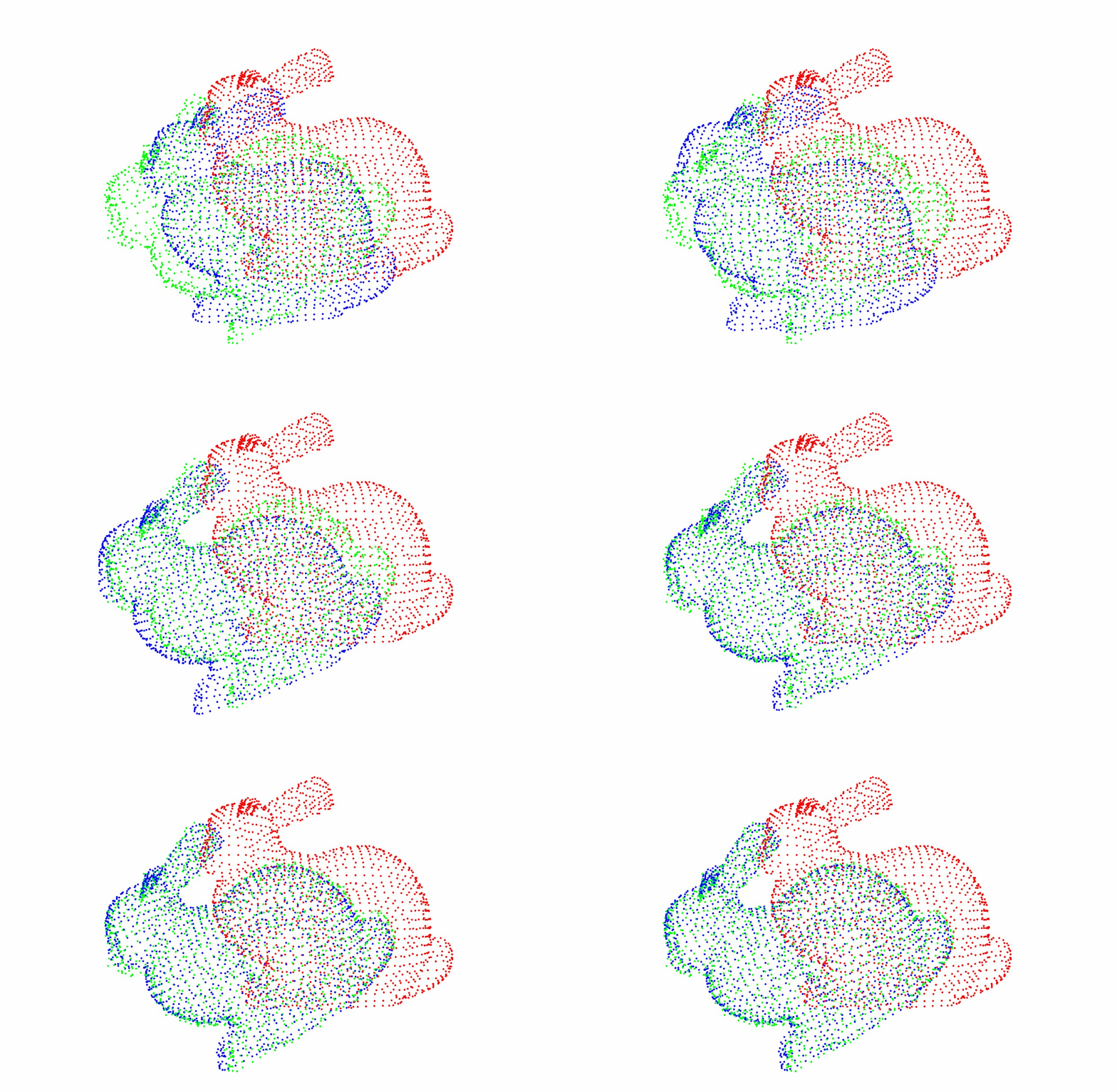 |
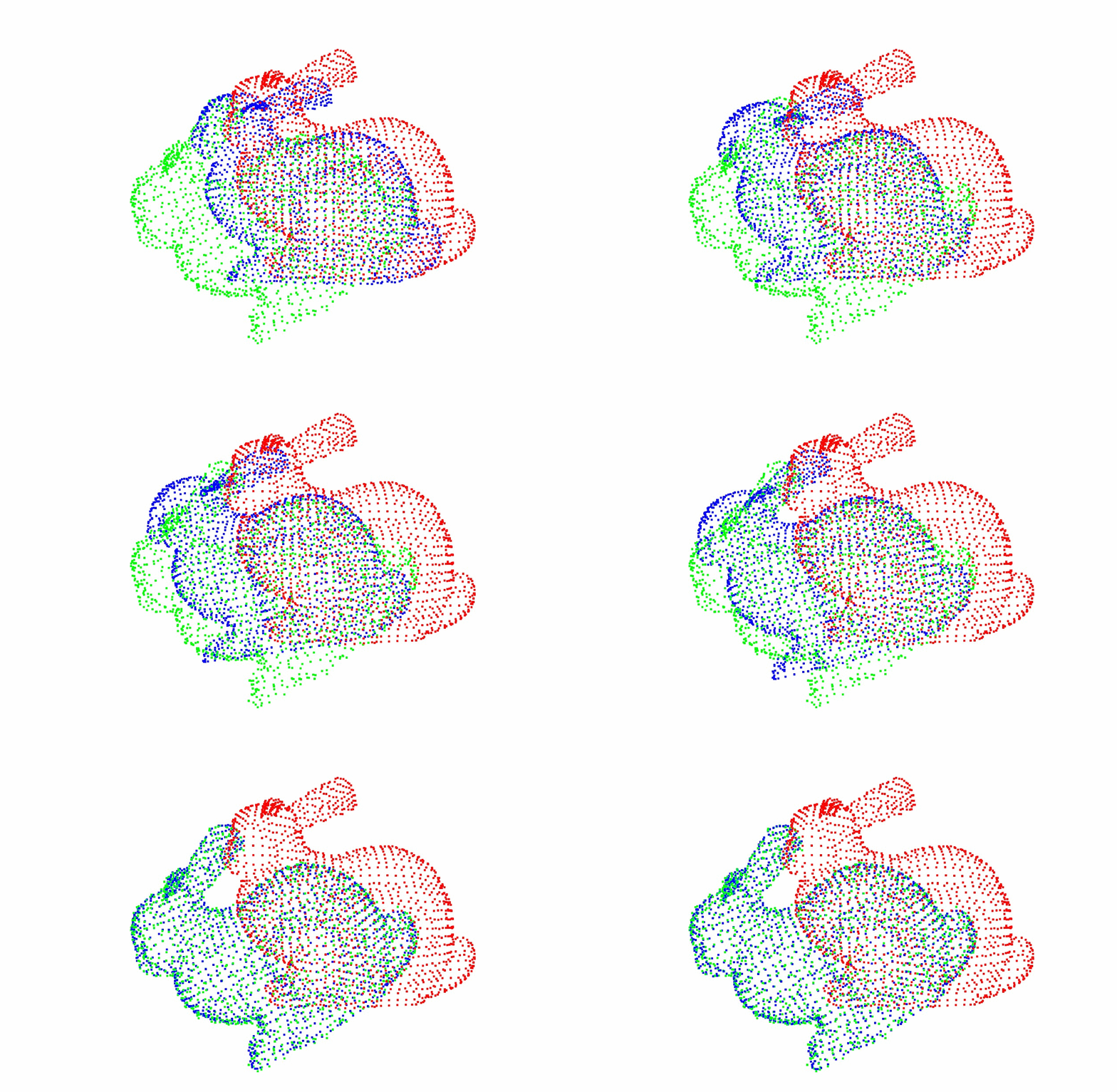 |
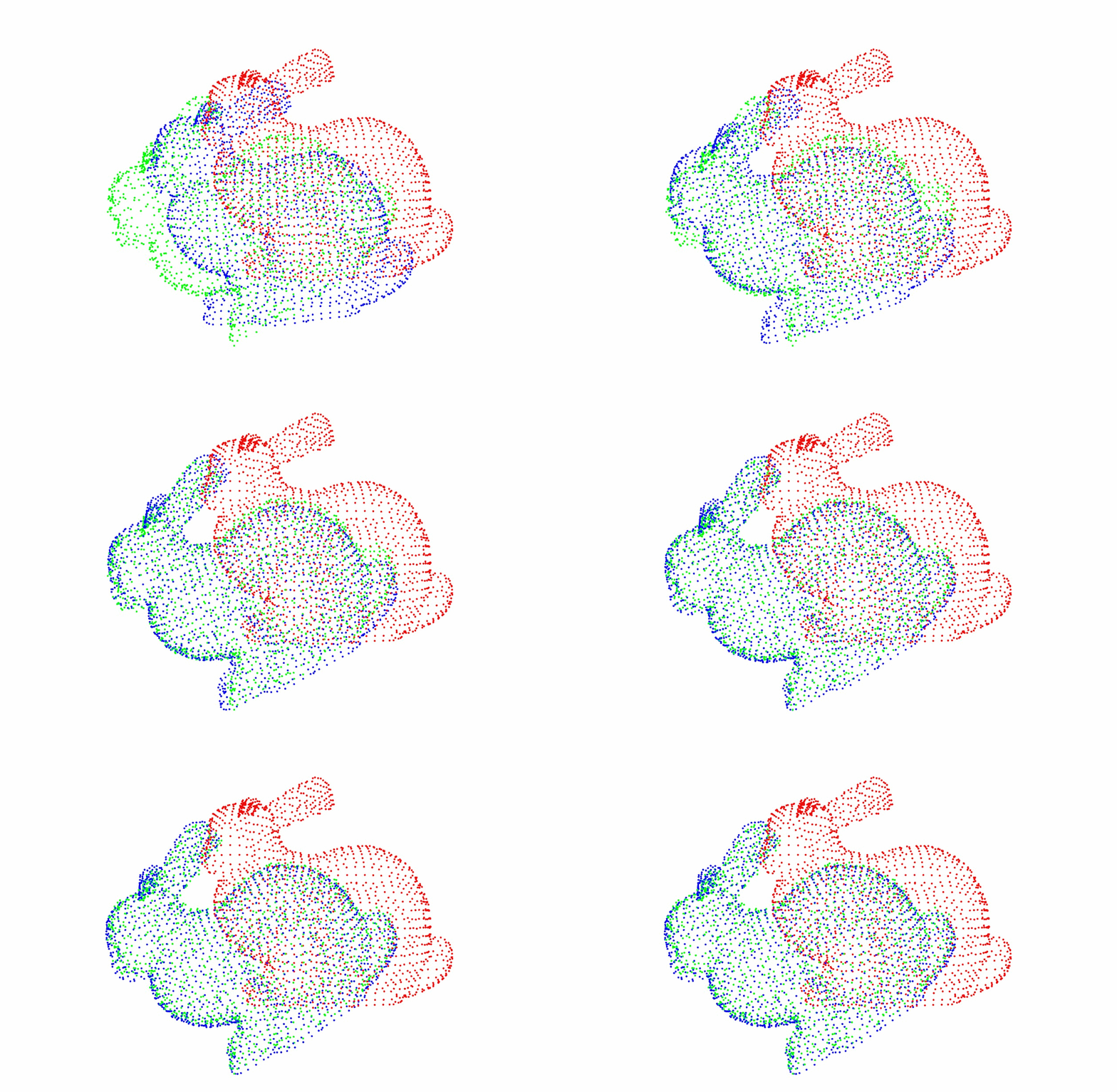 |
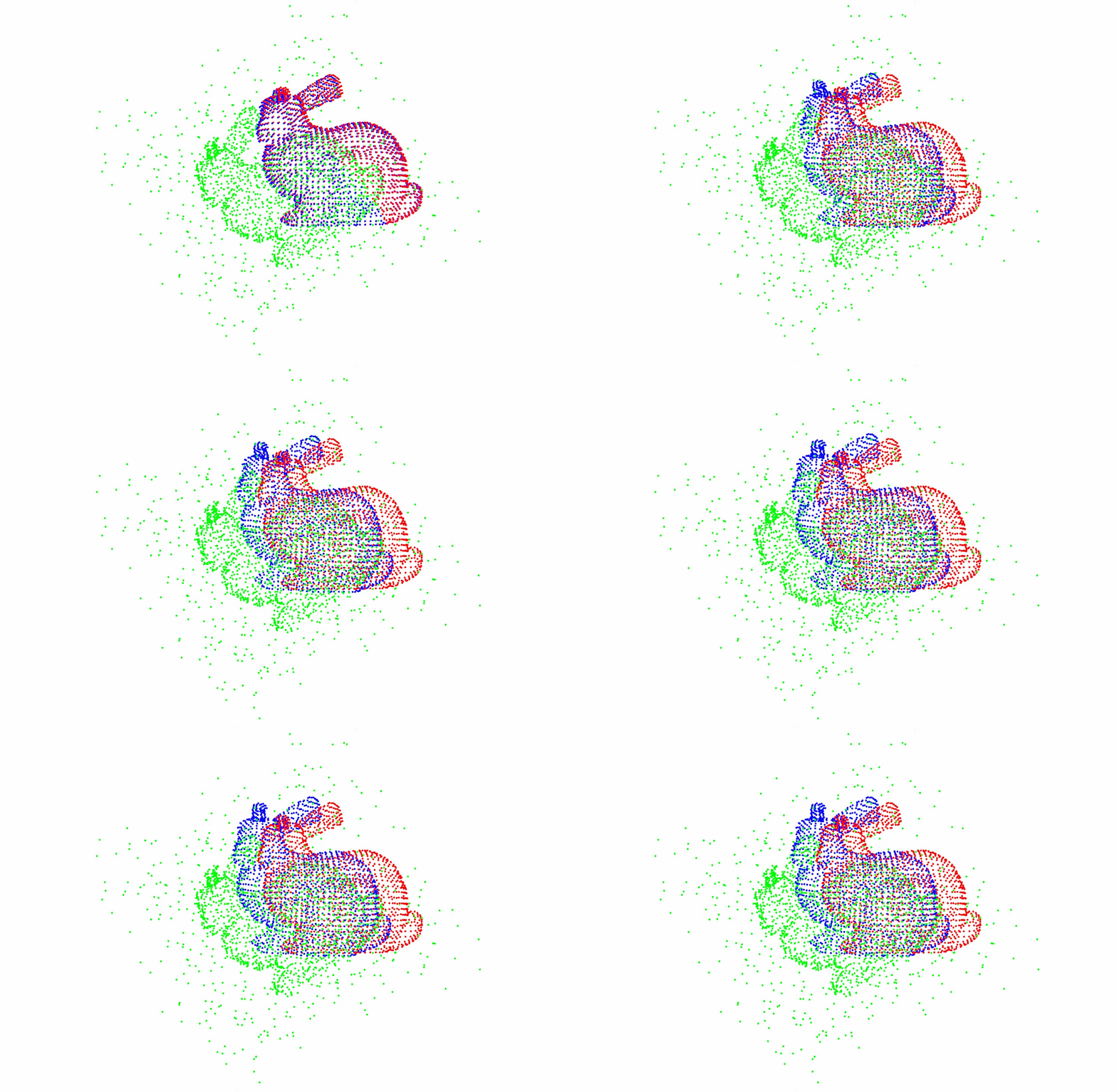
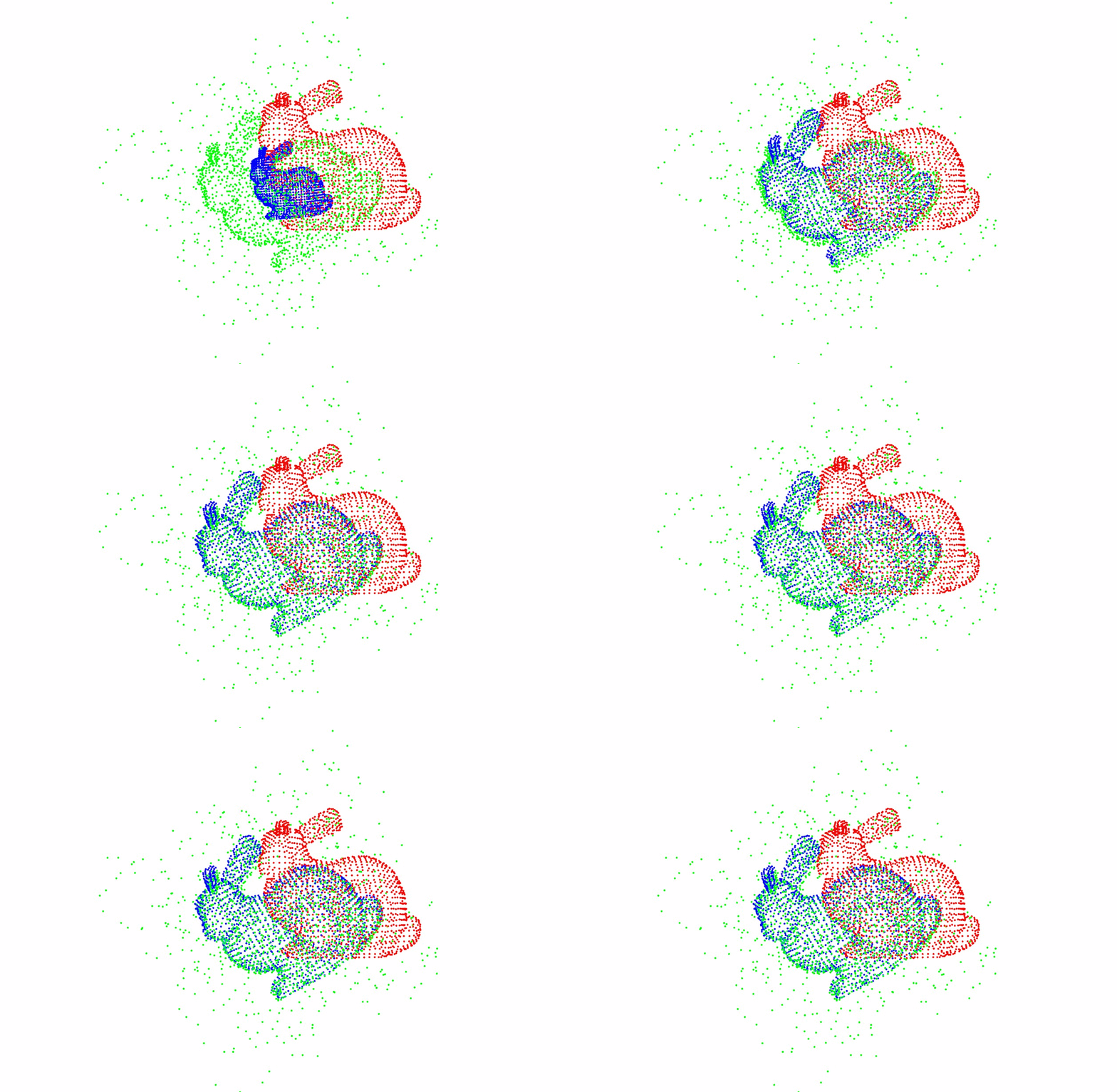
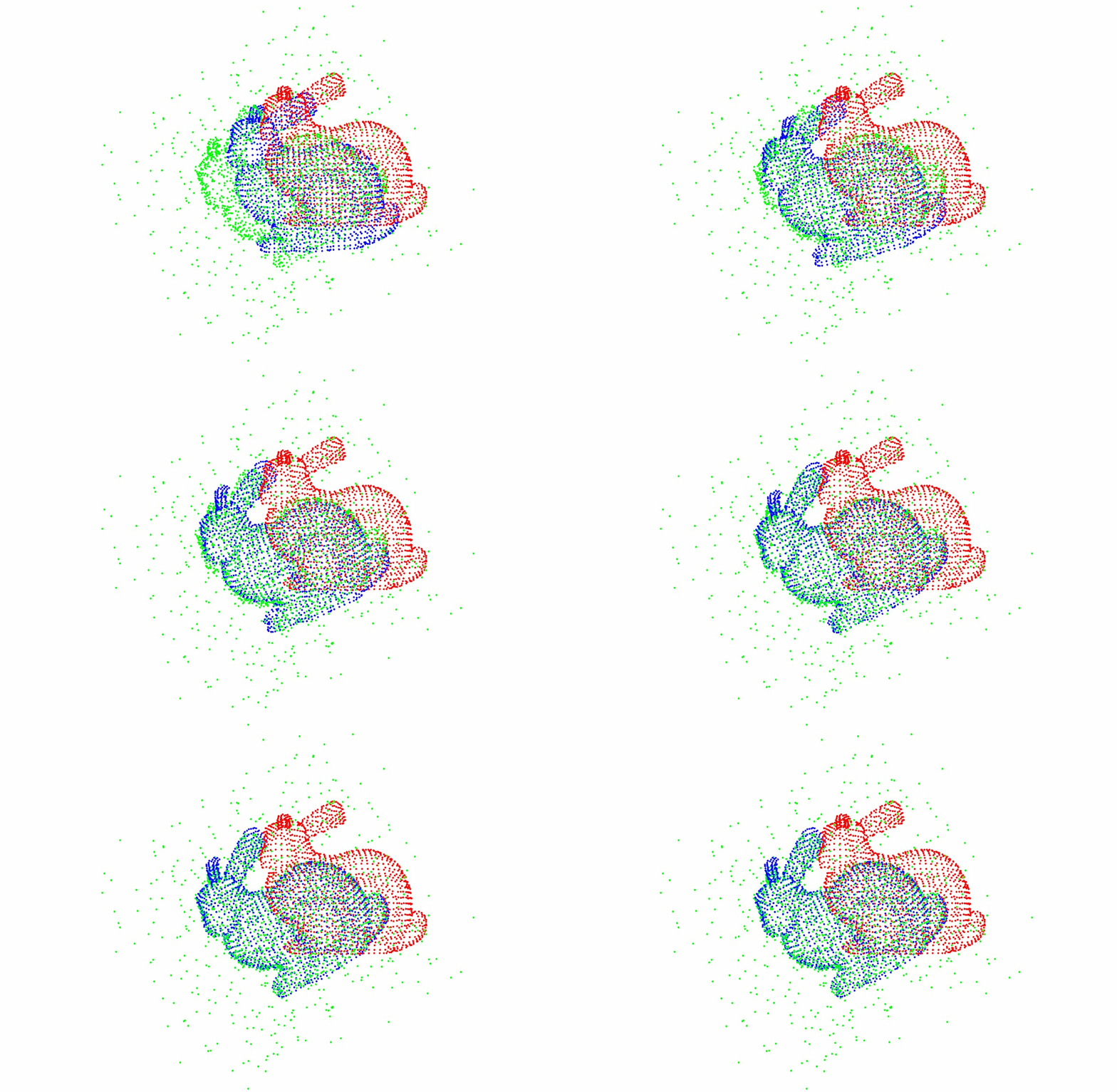
Noise test
| ICP(Open3D) | CPD | FilterReg |
|---|---|---|
 |
 |
 |
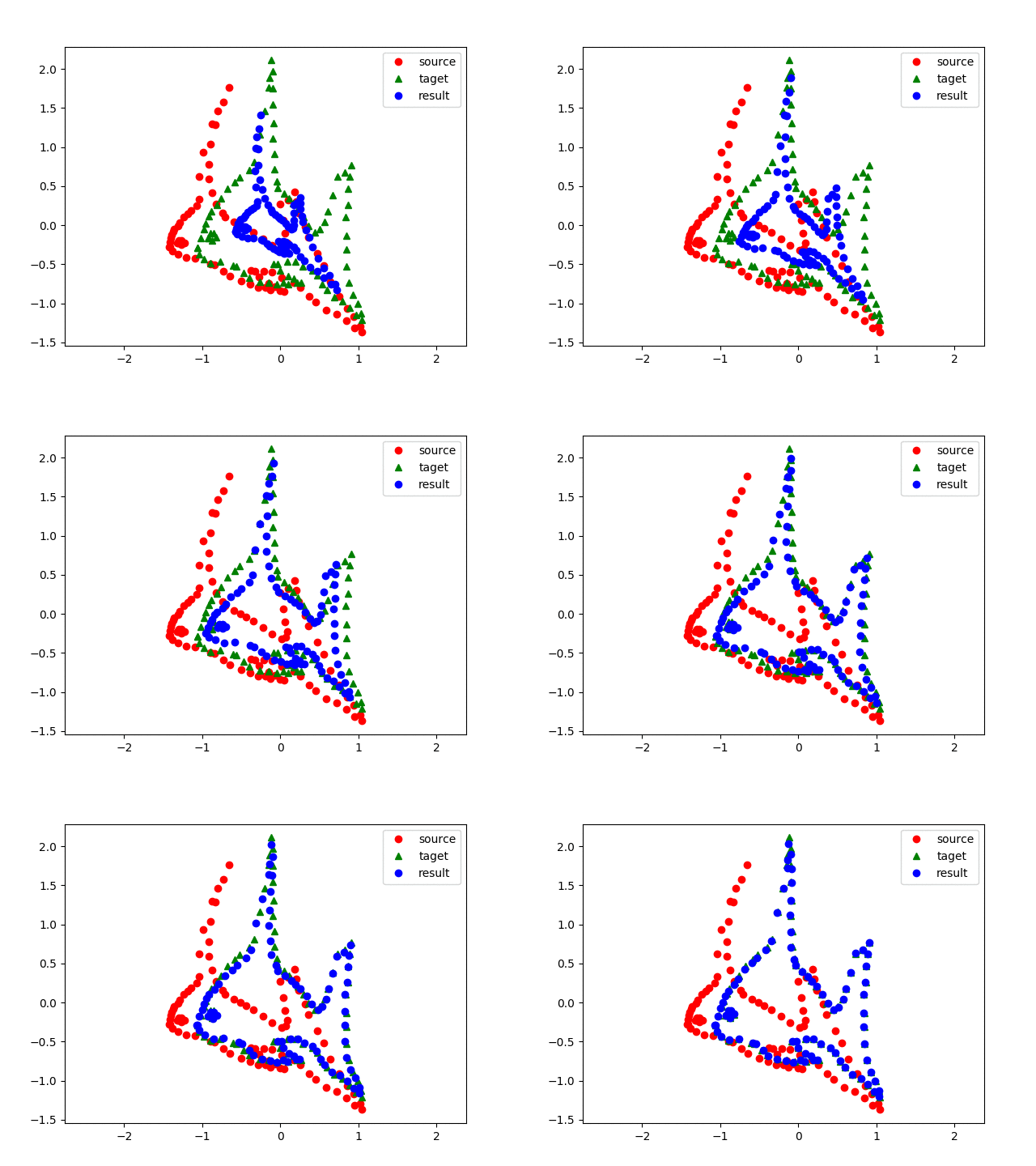
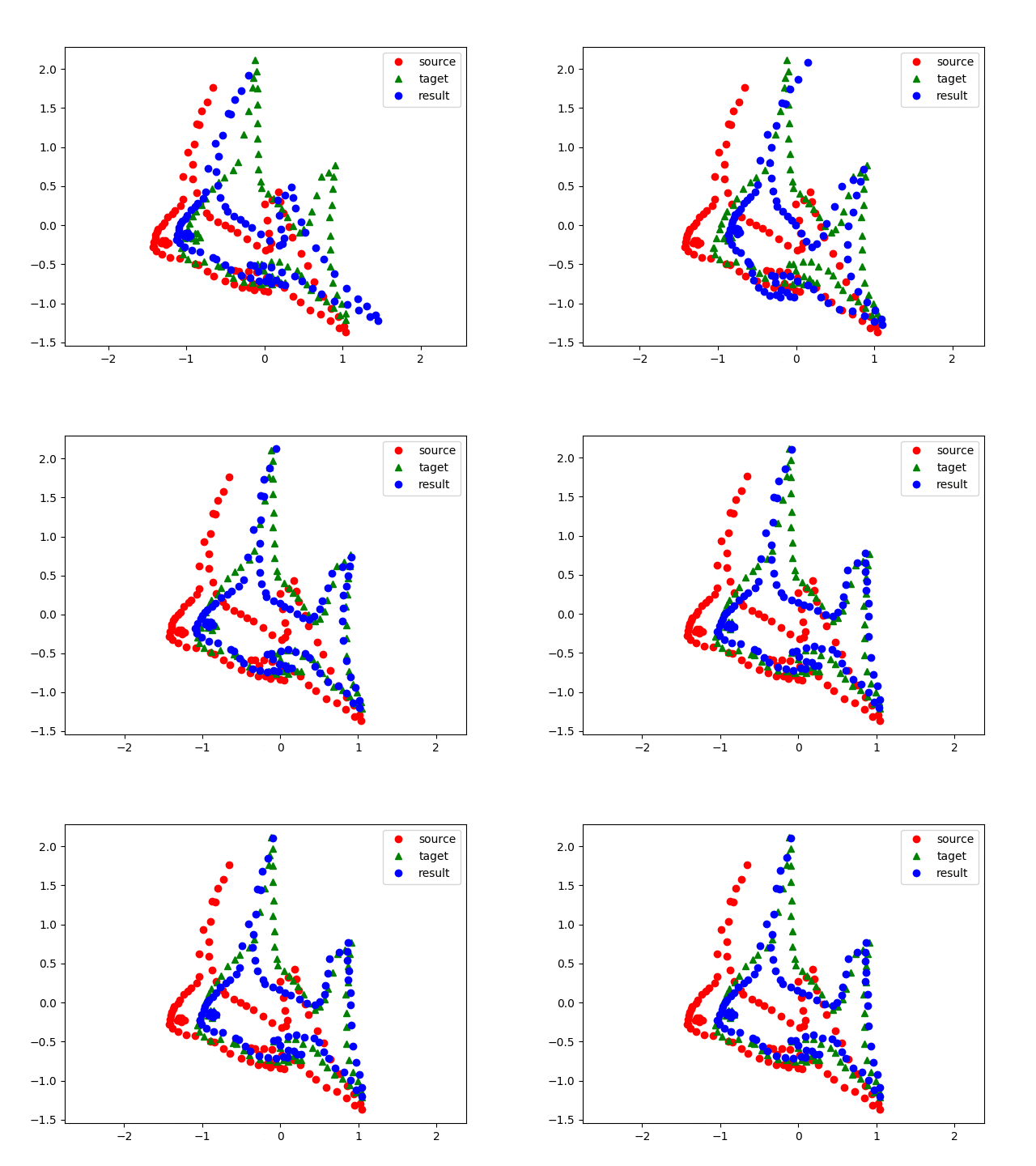
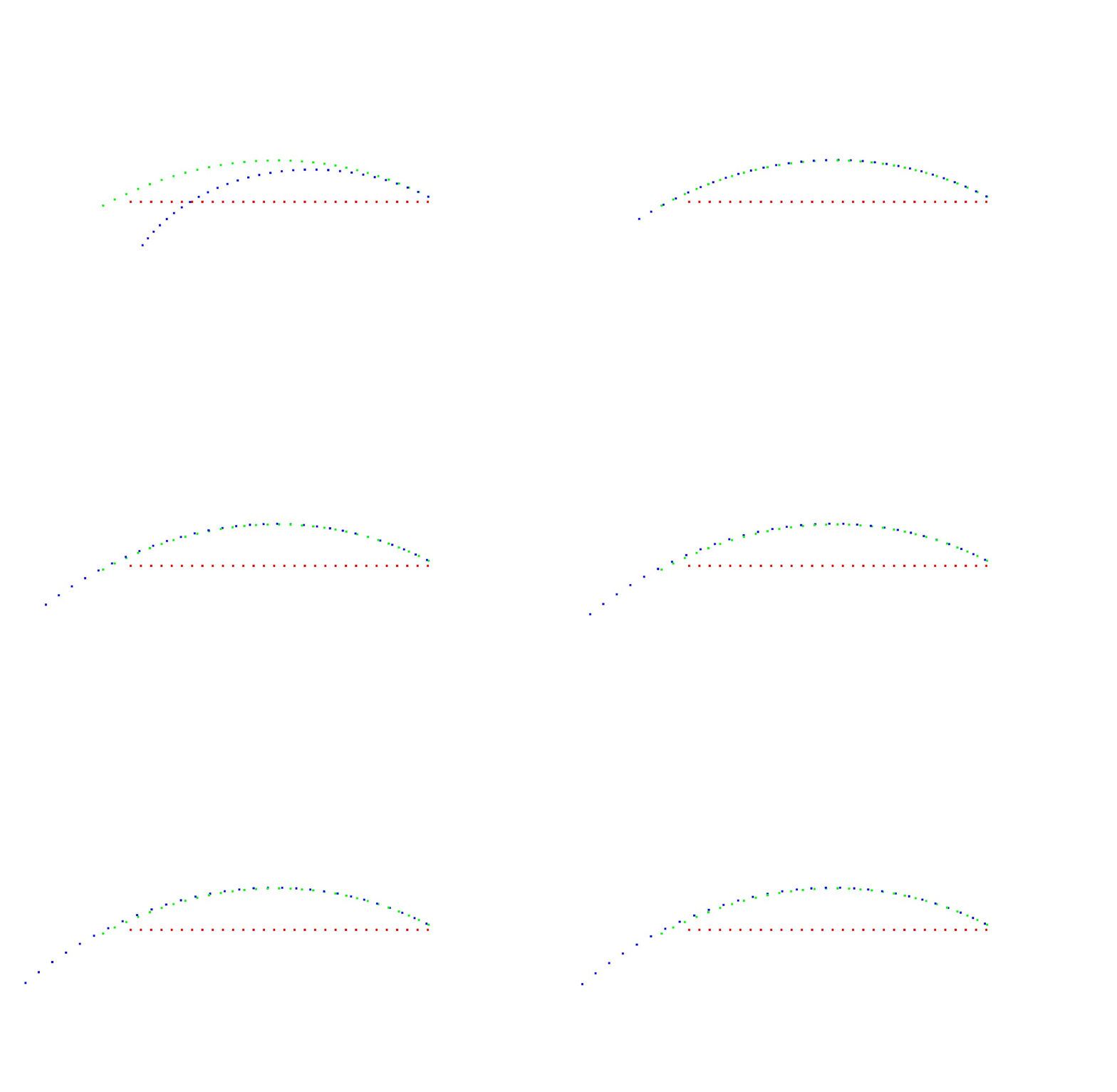
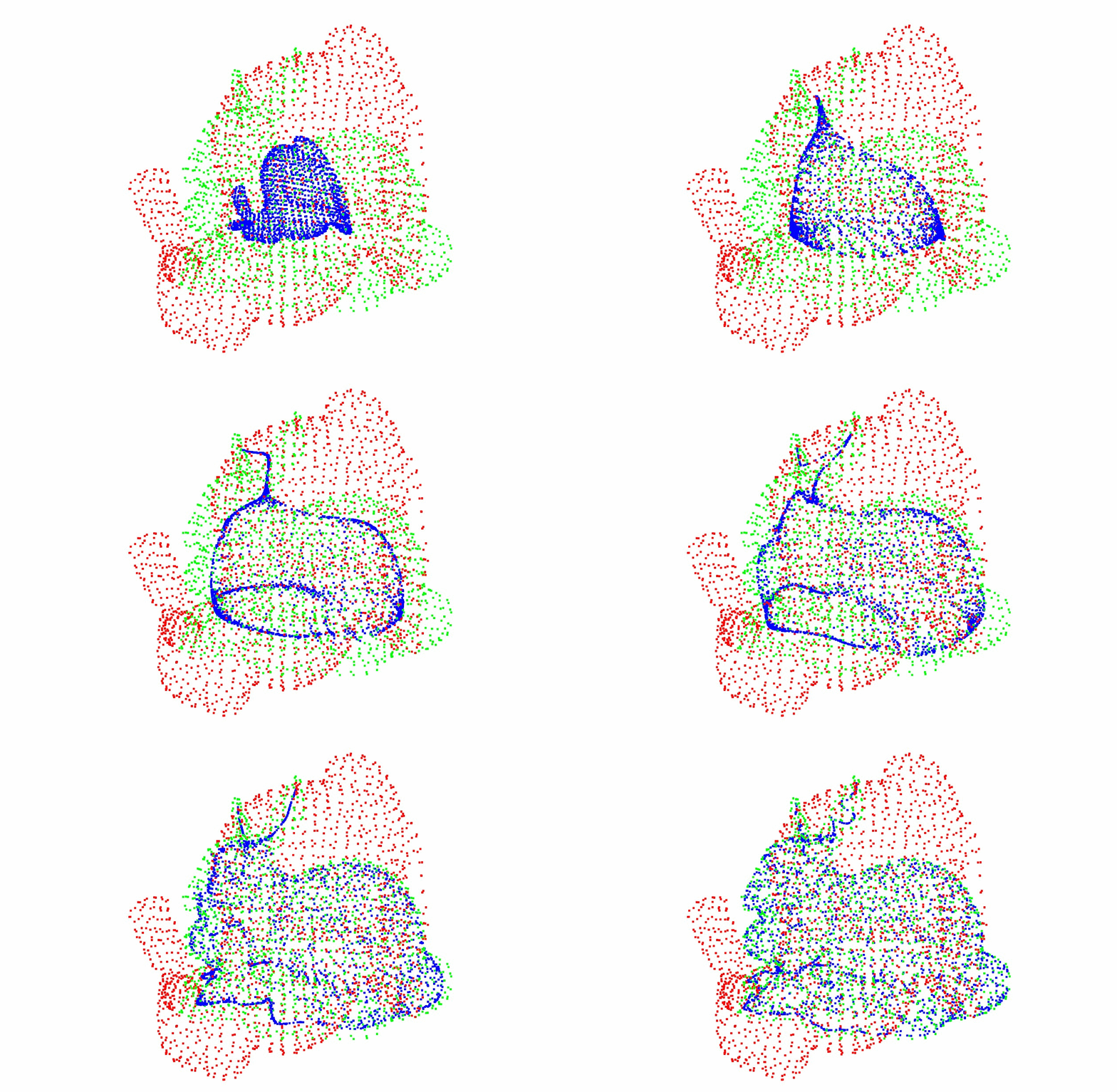
Non rigid registration
| CPD | SVR | Filterreg | BCPD |
|---|---|---|---|
 |
 |
 |
 |
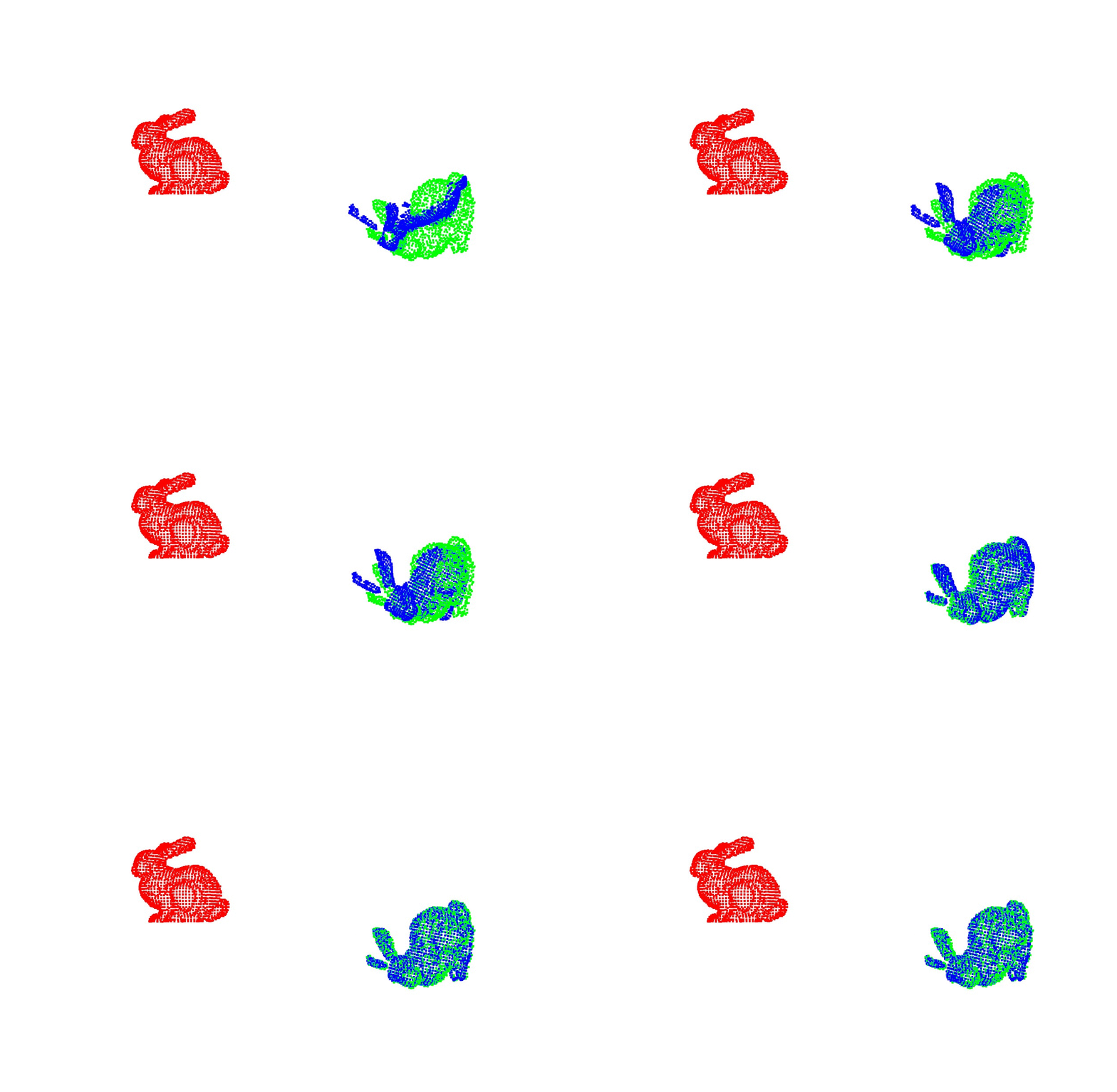
Feature based registration
| FPFH FilterReg |
|---|
 |
Time measurement
Execute an example script for measuring time.
OMP_NUM_THREADS=1 python time_measurement.py

# Results [s]
# ICP(Open3D):  0.0014092829951550812
# CPD:  0.038112225010991096
# SVR:  0.036476270004641265
# GMMTree:  0.10535842599347234
# FilterReg:  0.005098833993542939
Citing
@software{probreg,
    author = {{Kenta-Tanaka et al.}},
    title = {probreg},
    url = {https://probreg.readthedocs.io/en/latest/},
    version = {0.1.6},
    date = {2019-9-29},
}
1 maintainer

Metadata
1 maintainer
Release files for probreg 0.3.8
For a detailed explanation of source distributions (sdists) and built distributions (wheels), please see the package formats documentation.
Source distribution (sdist)
| File | Size | Uploaded | Provenance | |
|---|---|---|---|---|
| probreg-0.3.8.tar.gz | 1.0 MB | Without provenance | Details |
Release files / probreg-0.3.8.tar.gz
| Download URL | probreg-0.3.8.tar.gz |
|---|---|
| Size | 1.0 MB |
| Tags | Source |
|
SHA-256 checksum How to use checksums |
35558e43ddc68db999692818702c688a53fffb5168d535872edba890e9c6b5f8
|
|
BLAKE2b-256 checksum How to use checksums |
edf54cda3ac2e064013c293f7b405a9ed2e55f80ef802f2e7811eb6e9ef6b094
|
| Upload date | |
|
Uploaded using Trusted Publishing? What is trusted publishing? |
No |
| Uploaded via |
twine/3.8.0 pkginfo/1.9.6 readme-renderer/42.0 requests/2.31.0 requests-toolbelt/1.0.0 urllib3/2.2.0 tqdm/4.66.1 importlib-metadata/7.0.1 keyring/24.3.0 rfc3986/2.0.0 colorama/0.4.6 CPython/3.11.4
|
Security for probreg 0.3.8
Provenance
Provenance describes where a file came from. On PyPI, provenance is shared via attestations, which provide a verifiable record of the build or publishing details. View details, limitations and caveats.
No provenance found
None of the files in this release were uploaded with provenance metadata.
A note on package security
PyPI is a repository for distributing packages, not a service for auditing them. While third-party security researchers and our staff do their best to detect and remove malicious packages, PyPI cannot guarantee the quality, security or suitability of any given package.














