
ProcessPLS
An Implementation of ProcessPLS in Python

Code Writter
Implementation by Sin Yong Teng. Radboud University Nijmegen, the Netherlands.
Implementation
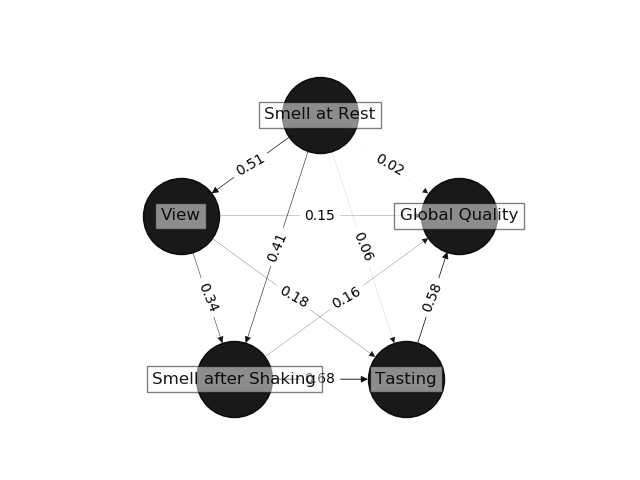
In this code implementation, the sklearn syntax is used. Furthermore, the ProcessPLS algorithm has been made to be represented in directed graphs data structure. This allows for more flexibility to be used with graph theory routines.
Functions
Install the library
pip install processPLS
Get the data
from processPLS.model import *
from processPLS.datasets import *
X,Y,matrix=ValdeLoirData() #Get the data conviniently
Alternatively, you can import the data yourself like this:
df=pd.read_csv(r'.\ValdeLoirData.csv')
df=df.drop(columns=df.columns[0])
smell_at_rest=df.iloc[:,:5]
view=df.iloc[:,5:8]
smell_after_shaking=df.iloc[:,8:18]
tasting=df.iloc[:,18:27]
global_quality=df.iloc[:,27]

X={
'Smell at Rest':smell_at_rest,
"View":view,
"Smell after Shaking":smell_after_shaking,
"Tasting":tasting,
}

Y={"Global Quality":global_quality}

matrix = pd.DataFrame(
[
[0,0,0,0,0],
[1,0,0,0,0],
[1,1,0,0,0],
[1,1,1,0,0],
[1,1,1,1,0],
],
index=list(X.keys())+list(Y.keys()),
columns=list(X.keys())+list(Y.keys())
)
Call and Fit the Process PLS model
import matplotlib.pyplot as plt
model = ProcessPLS()
model.fit(X,Y,matrix)
model.plot()
plt.show()
Main Function Arguments
Process_PLS(cv=RepeatedKFold(n_splits=5,n_repeats=2,random_state=999),scoring='neg_mean_squared_error',max_lv=30,overwrite_lv=False,inner_forced_lv=None,outer_forced_lv=None,name=None)

'''
This function sets up the processPLS model.

cv= cross validation method  (follows sklearn syntax)

scoring= loss function/ scoring function (follows sklearn syntax)

max_lv= maximum numbers of latent variable (lv) for all SIMPLS models within ProcessPLS

overwrite_LV= (True/False) A boolean to set whether inner_forced_lv and outer_forced_lv should be used instead of automatically selecting latent variables

inner_forced_lv= (dict) a specific key value combination of number of LVs to forced into the inner model. Argument overwrite_LV must be set to True for this to be used. Example input:
 inner_forced_lv={
  'Smell at Rest':None,
  "View":3,
  "Smell after Shaking":6,
  "Tasting":8,
  "Global Quality":13
  }

  inner_forced_lv= (dict) a specific key value combination of number of LVs to forced into the outer model. Argument overwrite_LV must be set to True for this to be used. Example input:

  outer_forced_lv={
  'Smell at Rest':3,
  "View":3,
  "Smell after Shaking":2,
  "Tasting":5,
  "Global Quality":3
  }

name: (string) Optional name of model.

'''

ValdeLoirData(original=False)

'''
This function gets the data for Valde Loir Dataset

original==False:  The function returns X (dataframe in dict), Y (dataframe dict), and matrix (dataframe). matrix is the adjacency matrix for the graph connections.

original==True:  The function returns the raw data (dataframe) with both X and Y combined within


'''
Inference/ Prediction for New Data
y_pred= model.predict(Xnew)
Colab Example Here
Reproducibility
This implementation provides exactly the same output as the MATLAB version of ProcessPLS.
Reference to Original Paper:
van Kollenburg, G., Bouman, R., Offermans, T., Gerretzen, J., Buydens, L., van Manen, H.J. and Jansen, J., 2021. Process PLS: Incorporating substantive knowledge into the predictive modelling of multiblock, multistep, multidimensional and multicollinear process data. Computers & Chemical Engineering, 154, p.107466.
For MATLAB Implementation, see this repository written by Tim Offermans. https://gitlab.science.ru.nl/toffermans/matlab-process-pls/-/tree/main/
How to cite this software
S.Y. Teng. (2022). tsyet12/ProcessPLS:An Implementation of ProcessPLS in Python, Zenodo Release (zenodo). Zenodo. https://doi.org/10.5281/zenodo.7074754
1 maintainer

Metadata
1 maintainer
Release files for ProcessPLS 1.9
For a detailed explanation of source distributions (sdists) and built distributions (wheels), please see the package formats documentation.
Source distribution (sdist)
| File | Size | Uploaded | Provenance | |
|---|---|---|---|---|
| ProcessPLS-1.9.tar.gz | 257.2 kB | Without provenance | Details |
Release files / ProcessPLS-1.9.tar.gz
| Download URL | ProcessPLS-1.9.tar.gz |
|---|---|
| Size | 257.2 kB |
| Tags | Source |
|
SHA-256 checksum How to use checksums |
03f1f2d1b3d3a24406d06afee77abca84fd9681c4dae431a44997d5add166d19
|
|
BLAKE2b-256 checksum How to use checksums |
56cf74c9156b779fbe5a200fd549b5d48cd51032e7df104fe9f54287f898e104
|
| Upload date | |
|
Uploaded using Trusted Publishing? What is trusted publishing? |
No |
| Uploaded via |
twine/4.0.1 CPython/3.8.7
|
Security for ProcessPLS 1.9
Provenance
Provenance describes where a file came from. On PyPI, provenance is shared via attestations, which provide a verifiable record of the build or publishing details. View details, limitations and caveats.
No provenance found
None of the files in this release were uploaded with provenance metadata.
A note on package security
PyPI is a repository for distributing packages, not a service for auditing them. While third-party security researchers and our staff do their best to detect and remove malicious packages, PyPI cannot guarantee the quality, security or suitability of any given package.














