


AMPD algorithm in Python
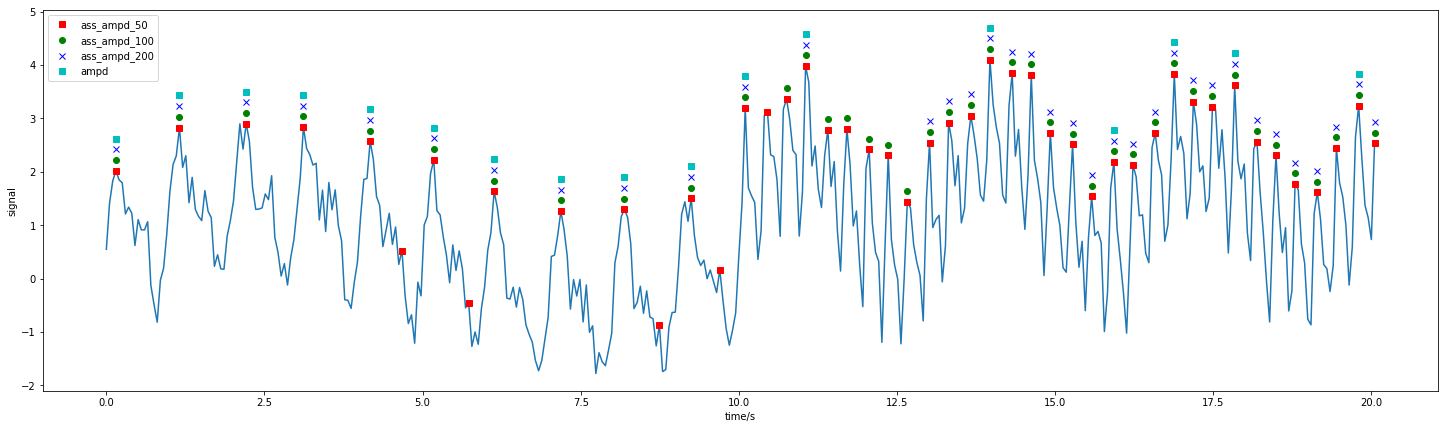
Implements a function find_peaks based on the Automatic Multi-scale
Peak Detection algorithm proposed by Felix Scholkmann et al. in
"An Efficient Algorithm for Automatic Peak Detection in
Noisy Periodic and Quasi-Periodic Signals", Algorithms 2012,
5, 588-603
Usage
Install from PyPI:
pip install pyampd
Or install from source:
pip install git+https://github.com/ig248/pyampd
Import function:
from pyampd.ampd import find_peaks
See notebooks/ampd.ipynb for usage examples.
Specifying maximum scale
To improve run-time on large time-series, it is possible to specify the maximum scale to consider:
peaks = find_peaks(x, scale=100)
will only consider windows up to +-100 point either side of peak candidates.
Adaptive Scale Selection
If the characteristic scale of the signal changes over time, a new algorithm called Adaptive Scale Selection can track the changes in optimal scales and detect peaks accordingly:
peaks = find_peaks_adaptive(x, window=200)
will select the optimal scale at each point using a 200-point running window.
Original implementation
find_peaks is not identical to the algorithm proposed in the original paper (especially near start and end of time series).
A performance-optimized version of the original implementation is provided in find_peaks_original.
Tests
Run
pytest
Other implementations
- R: https://cran.r-project.org/web/packages/ampd/index.html
- MATLAB: https://github.com/mathouse/AMPD-algorithm
- Python: https://github.com/LucaCerina/ampdLib
Improvements
This Python implementation provides significant speed-ups in two areas:
- Efficient tracking of local minima without using random numbers
- Introduction of maximum window size, reducing algorithm run-time from quadratic to linear in the number of samples.
- Better handling of peaks near start/end of the series
- Addition of new Adaptive Scale Selection
ToDo
- It may be possible to avoid repeated comparisons, and reduce worst-case
runtime from
O(n^2)toO(n log(n)). find_peaks_adaptivecould benefit from specifying bothwindowandmax_scale
References
Original paper: https://doi.org/10.1109/ICRERA.2016.7884365
1 maintainer

Metadata
1 maintainer
Release files for pyampd 0.0.1
For a detailed explanation of source distributions (sdists) and built distributions (wheels), please see the package formats documentation.
Source distribution (sdist)
| File | Size | Uploaded | Provenance | |
|---|---|---|---|---|
| pyampd-0.0.1.tar.gz | 4.6 kB | Without provenance | Details |
Built distribution (wheel)
| File | Interpreter | ABI | Platform | Reset |
|---|---|---|---|---|
| pyampd-0.0.1-py2.py3-none-any.whl | Python 3, Python 2 | none | any | Details |
Total release size: 9.7 kB
Release files / pyampd-0.0.1.tar.gz
| Download URL | pyampd-0.0.1.tar.gz |
|---|---|
| Size | 4.6 kB |
| Tags | Source |
|
SHA-256 checksum How to use checksums |
e333d00b61d2844b0ed0383b010394e0a0cb384a036dd83960cdc647cf71a755
|
|
BLAKE2b-256 checksum How to use checksums |
51976a56d7ed7d1ed5cb25c4643cb327a1903438587991fe364ac6042c2b837d
|
| Upload date | |
|
Uploaded using Trusted Publishing? What is trusted publishing? |
No |
| Uploaded via |
twine/1.12.1 pkginfo/1.4.2 requests/2.21.0 setuptools/40.4.3 requests-toolbelt/0.8.0 tqdm/4.28.1 CPython/2.7.15
|
Release files / pyampd-0.0.1-py2.py3-none-any.whl
| Download URL | pyampd-0.0.1-py2.py3-none-any.whl |
|---|---|
| Size | 5.1 kB |
| Tags | Python 2 Python 3 |
|
SHA-256 checksum How to use checksums |
d923a4372308d447b98cd80f935a059e29323777dd26c0ac131945ad84f5f89c
|
|
BLAKE2b-256 checksum How to use checksums |
53b5587d52d43aa803c20743fd23e2bcbb454a06694c5645de741311678c8750
|
| Upload date | |
|
Uploaded using Trusted Publishing? What is trusted publishing? |
No |
| Uploaded via |
twine/1.12.1 pkginfo/1.4.2 requests/2.21.0 setuptools/40.4.3 requests-toolbelt/0.8.0 tqdm/4.28.1 CPython/2.7.15
|
Security for pyampd 0.0.1
Provenance
Provenance describes where a file came from. On PyPI, provenance is shared via attestations, which provide a verifiable record of the build or publishing details. View details, limitations and caveats.
No provenance found
None of the files in this release were uploaded with provenance metadata.
A note on package security
PyPI is a repository for distributing packages, not a service for auditing them. While third-party security researchers and our staff do their best to detect and remove malicious packages, PyPI cannot guarantee the quality, security or suitability of any given package.
To learn more about protecting yourself from malicious actors, visit our package security documentation.













