
Welcome to pydrift 0.1.8
How do we measure the degradation of a machine learning process? Why does the performance of our predictive models decrease? Maybe it is that a data source has changed (one or more variables) or maybe what changes is the relationship of these variables with the target we want to predict. pydrift tries to facilitate this task to the data scientist, performing this kind of checks and somehow measuring that degradation.
Install pydrift ✌️
pip install pydrift
Structure 📐
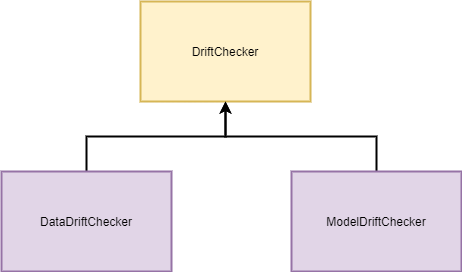
This is intended to be user-friendly. pydrift is divided into DataDriftChecker and ModelDriftChecker:
- DataDriftChecker: searches for drift in the variables, check if their distributions have changed
- ModelDriftChecker: searches for drift in the relationship of the variables with the target, checks that the model behaves the same way for both data sets
Both can use a discriminative model (defined by parent class DriftChecker), where the target would be binary in belonging to one of the two sets, 1 if it is the left one and 0 on the contrary. If the model is not able to differentiate given the two sets, there is no difference!
It also exists InterpretableDrift and DriftCheckerEstimator:
- InterpretableDrift: manages all of the stuff related to interpretability of drifting. It can show us the features distribution or the most important features when we are training a discriminative model or our predictive one
- DriftCheckerEstimator: allows
pydriftto be used as a sklearn estimator, it works lonely or in a pipeline, like any sklearn estimator
Usage 📖
You can take a look to the notebooks folder where you can find one example for generic DriftChecker, one for DataDriftCheckerand other one forModelDriftChecker`.
Correct Notebooks Render 💡
Because pydrift uses plotly and GitHub performs a static render of the notebooks figures do not show correctly. For a rich view of the notebook, you can visit nbviewer and paste the link to the notebook you want to show, for example if you want to render 1-Titanic-Drift-Demo.ipynb you have to paste https://github.com/sergiocalde94/Data-And-Model-Drift-Checker/blob/master/notebooks/1-Titanic-Drift-Demo.ipynb into nbviewer.
More Info ℹ️
For more info check the docs available here
More demos and code improvements will coming, if you want to contribute you can contact me (sergiocalde94@gmail.com), in the future I will upload a file to explain how this would work.
1 maintainer

Metadata
1 maintainer
Release files for pydrift 0.1.8
For a detailed explanation of source distributions (sdists) and built distributions (wheels), please see the package formats documentation.
Source distribution (sdist)
| File | Size | Uploaded | Provenance | Actions |
|---|---|---|---|---|
| pydrift-0.1.8.tar.gz | 12.0 kB | Without provenance | Details for pydrift-0.1.8.tar.gz |
Built distribution (wheel)
| File | Interpreter | ABI | Platform | Actions Reset |
|---|---|---|---|---|
| pydrift-0.1.8-py3-none-any.whl | Python 3 | none | any | Details for pydrift-0.1.8-py3-none-any.whl |
Total release size: 25.3 kB
Release files / pydrift-0.1.8.tar.gz
| Download URL | pydrift-0.1.8.tar.gz |
|---|---|
| Size | 12.0 kB |
| Tags | Source |
|
SHA-256 checksum How to use checksums |
572a5f5ee3cfde052ee858cc2ed741fbb5c3df9fbcd44a70fe1d208b751a163e
|
|
BLAKE2b-256 checksum How to use checksums |
cccf8d7799c72c3500e0497a85edadb93e29a74ccfccd7b187881188b980a778
|
| Upload date | |
|
Uploaded using Trusted Publishing? What is trusted publishing? |
No |
| Uploaded via |
poetry/0.12.17 CPython/3.6.8 Linux/4.15.0-1052-aws
|
Release files / pydrift-0.1.8-py3-none-any.whl
| Download URL | pydrift-0.1.8-py3-none-any.whl |
|---|---|
| Size | 13.3 kB |
| Tags | Python 3 |
|
SHA-256 checksum How to use checksums |
bd0ec552055e607e43d2b5f699d4a36c1fd26ab4adbd2306c26db7242fa387ab
|
|
BLAKE2b-256 checksum How to use checksums |
46132229912bca5dd816fc93d4326b8604b1f8a856a75830968c559ae8500678
|
| Upload date | |
|
Uploaded using Trusted Publishing? What is trusted publishing? |
No |
| Uploaded via |
poetry/0.12.17 CPython/3.6.8 Linux/4.15.0-1052-aws
|
Security for pydrift 0.1.8
Provenance
Provenance describes where a file came from. On PyPI, provenance is shared via attestations, which provide a verifiable record of the build or publishing details. View details, limitations and caveats.
No provenance found
None of the files in this release were uploaded with provenance metadata.
A note on package security
PyPI is a repository for distributing packages, not a service for auditing them. While third-party security researchers and our staff do their best to detect and remove malicious packages, PyPI cannot guarantee the quality, security or suitability of any given package.
To learn more about protecting yourself from malicious actors, visit our package security documentation.














