pyinfra automates infrastructure super fast at massive scale






Documentation • Getting Started • Examples • Help & Support • Contributing
pyinfra automates/provisions/manages/deploys infrastructure. It can be used for ad-hoc command execution, service deployment, configuration management and more. Design features include:
- 🚀 Super fast execution over thousands of hosts with predictable performance.
- 🚨 Instant debugging with stdout & stderr output on error or as required (
-v|-vv|-vvv). - 📦 Extendable with any Python package as configured & written in standard Python.
- 💻 Agentless execution against SSH/Docker/subprocess/winrm hosts.
- ❗️ Two stage process that enables
--dryruns before executing any changes. - 🔌 Integrated with Docker, Vagrant/Mech & Ansible out of the box.
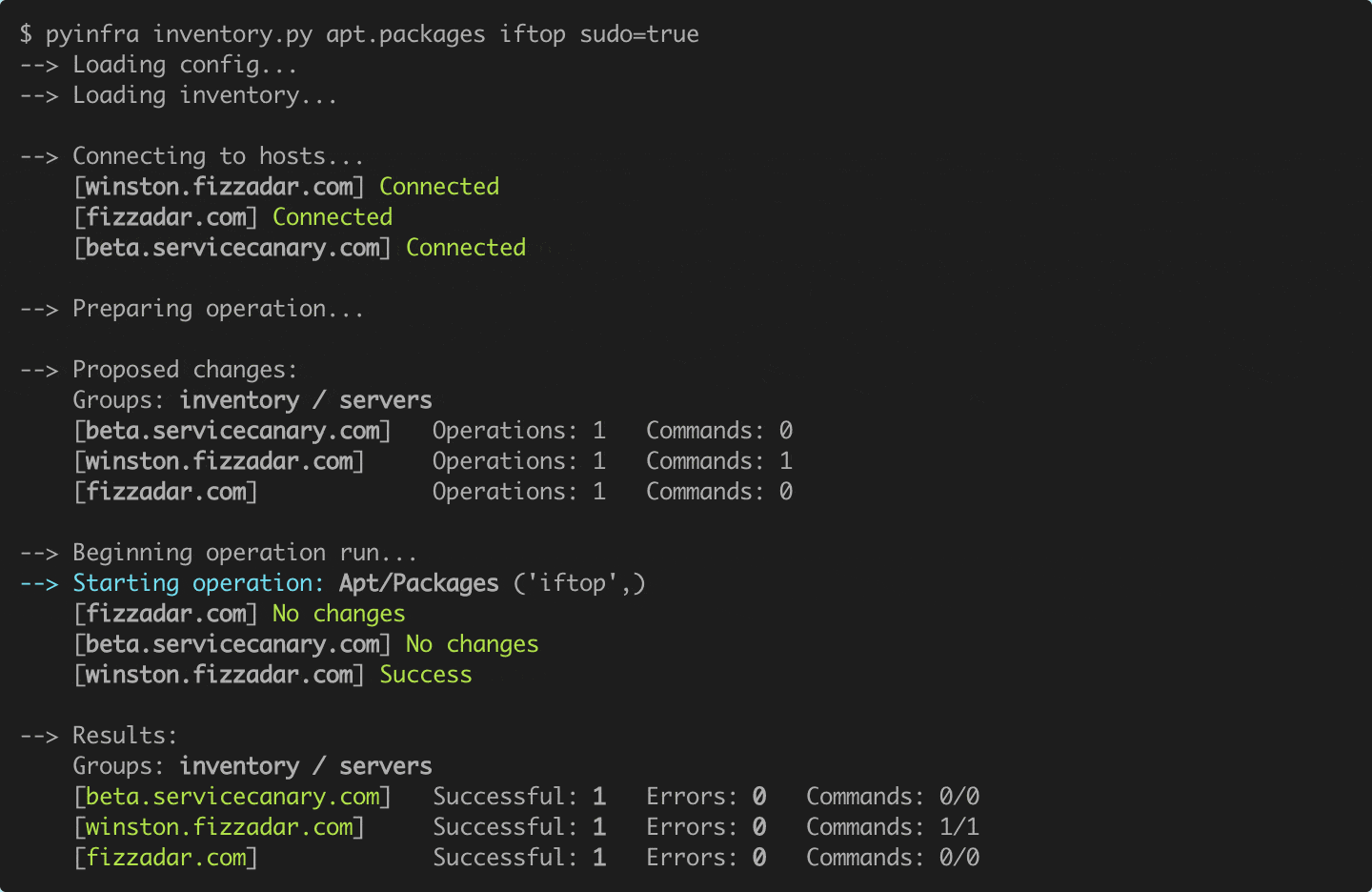
When you run pyinfra you'll see something like (non animated version):

Quickstart
Install pyinfra with pipx (recommended) or pip:
pipx install pyinfra
Now you can execute commands on hosts via SSH:
pyinfra my-server.net exec -- echo "hello world"
Or execute in Docker, on the local machine, and other connectors:
pyinfra @docker/ubuntu exec -- echo "Hello world"
pyinfra @local exec -- echo "Hello world"
As well as executing commands you can define state using operations:
# Install iftop apt package if not present
pyinfra @docker/ubuntu apt.packages iftop update=true _sudo=true
Which can then be saved as a Python file like deploy.py:
from pyinfra.operations import apt

apt.packages(
    name="Ensure iftop is installed",
    packages=['iftop'],
    update=True,
    _sudo=True,
)
The hosts can also be saved in a file, for example inventory.py:
targets = ["@docker/ubuntu", "my-test-server.net"]
And executed together:
pyinfra inventory.py deploy.py
Now you know the building blocks of pyinfra! By combining inventory, operations and Python code you can deploy anything.
See the more detailed getting started or using operations guides. See how to use inventory & data, global arguments and the CLI or check out the documented examples.
1 maintainer

Metadata
1 maintainer
Release files for pyinfra 2.5
For a detailed explanation of source distributions (sdists) and built distributions (wheels), please see the package formats documentation.
Source distribution (sdist)
| File | Size | Uploaded | Provenance | Actions |
|---|---|---|---|---|
| pyinfra-2.5.tar.gz | 191.3 kB | Without provenance | Details for pyinfra-2.5.tar.gz |
Built distribution (wheel)
| File | Interpreter | ABI | Platform | Actions Reset |
|---|---|---|---|---|
| pyinfra-2.5-py2.py3-none-any.whl | Python 2, Python 3 | none | any | Details for pyinfra-2.5-py2.py3-none-any.whl |
Total release size: 434.4 kB
Release files / pyinfra-2.5.tar.gz
| Download URL | pyinfra-2.5.tar.gz |
|---|---|
| Size | 191.3 kB |
| Tags | Source |
|
SHA-256 checksum How to use checksums |
7e60da726efb4cbe45f6ce5a483c1cf4cdc9680de3fa433dd6e2662c777decc9
|
|
BLAKE2b-256 checksum How to use checksums |
dcf50c124126d4a005ac99f5caefa285543fb7c2ed753dfb0ce5caa183dda190
|
| Upload date | |
|
Uploaded using Trusted Publishing? What is trusted publishing? |
No |
| Uploaded via |
twine/4.0.1 CPython/3.10.4
|
Release files / pyinfra-2.5-py2.py3-none-any.whl
| Download URL | pyinfra-2.5-py2.py3-none-any.whl |
|---|---|
| Size | 243.1 kB |
| Tags | Python 2 Python 3 |
|
SHA-256 checksum How to use checksums |
5cb10e92c876f7ce106e669bf359580aae65ad263a90953e6ebe315574d4297a
|
|
BLAKE2b-256 checksum How to use checksums |
0cb458424895a6169daf3ba647b2e5d20edccc1a3ff6f231d93d9dc6e97e574a
|
| Upload date | |
|
Uploaded using Trusted Publishing? What is trusted publishing? |
No |
| Uploaded via |
twine/4.0.1 CPython/3.10.4
|
Security for pyinfra 2.5
Provenance
Provenance describes where a file came from. On PyPI, provenance is shared via attestations, which provide a verifiable record of the build or publishing details. View details, limitations and caveats.
No provenance found
None of the files in this release were uploaded with provenance metadata.
A note on package security
PyPI is a repository for distributing packages, not a service for auditing them. While third-party security researchers and our staff do their best to detect and remove malicious packages, PyPI cannot guarantee the quality, security or suitability of any given package.
To learn more about protecting yourself from malicious actors, visit our package security documentation.