
pyopencl-extension
This package extends PyOpenCl by providing an object-oriented kernel programming framework and debugging capabilities.
- What makes pyopencl-extension special?
Build on top of PyOpenCl which can increase performance significantly.
Usage of this framework forces consistent code when programming for GPU.
Allows debugging of OpenCl-Programs through kernel emulation in Python using a visual debugger (tested with Pycharm).
OpenCl emulation allows to find out-of-bounds array indexing more easily.
Integrated profiling features give quick overview over performance bottlenecks.
The project is in an early development stage and actively maintained. For any feature requests/feedback/etc. you can get in touch via Github or by E-Mail (philipp.mohr@tuhh.de).
Installation
Install this library with pip install pyopencl-extension.
When automatic installation of PyOpenCl fails (happens when using Windows):
Download appropriate .whl binary from PyOpenCl binaries for Windows
Make sure to have proper OpenCl driver for your graphics card installed.
Run
pip install "pyopencl-X-cpX-cpX-X.whl"in terminal, where X must be replaced with corresponding version.
Usage
One very simple example is given below.
from pyopencl_extension import Kernel, Global, Scalar, Types, zeros
import numpy as np

ary = zeros((10,), Types.short)

knl = Kernel('some_operation',
             {'ary': Global(ary),  # notice that ary is set as default argument
              'number': Scalar(Types.short)},
             """
                ary[get_global_id(0)] = get_global_id(0) + number;
             """,
             global_size=ary.shape).compile(emulate=True)
knl(number=3)
assert np.allclose(ary.get(), np.arange(10) + 3)
By setting the argument ‘emulate=True’ the kernel will be compiled in emulation mode. This mode creates a file ‘some_operation.py’, which can be inspected using a visual debugger:
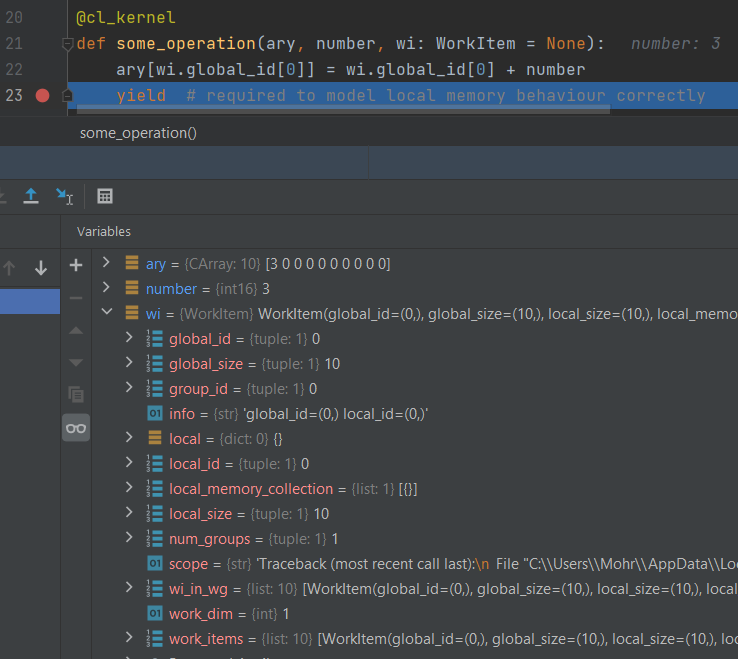
More advanced examples can by found in the tests hosted on Github.
1 maintainer

Metadata
1 maintainer
Release files for pyopencl-extension 0.2.9
For a detailed explanation of source distributions (sdists) and built distributions (wheels), please see the package formats documentation.
Source distribution (sdist)
| File | Size | Uploaded | Provenance | Actions |
|---|---|---|---|---|
| pyopencl-extension-0.2.9.tar.gz | 65.3 kB | Without provenance | Details for pyopencl-extension-0.2.9.tar.gz |
Built distribution (wheel)
| File | Interpreter | ABI | Platform | Actions Reset |
|---|---|---|---|---|
| pyopencl_extension-0.2.9-py3-none-any.whl | Python 3 | none | any | Details for pyopencl_extension-0.2.9-py3-none-any.whl |
Total release size: 124.5 kB
Release files / pyopencl-extension-0.2.9.tar.gz
| Download URL | pyopencl-extension-0.2.9.tar.gz |
|---|---|
| Size | 65.3 kB |
| Tags | Source |
|
SHA-256 checksum How to use checksums |
4c74d84bbd70bc4bb02c1e5911c2272e8ddc1f2737e9bb646f9da22fbc7094ce
|
|
BLAKE2b-256 checksum How to use checksums |
1487d8d34ffa10ffc6342f599aa68fa7f721340f4d57628b51e54e8d1d66d791
|
| Upload date | |
|
Uploaded using Trusted Publishing? What is trusted publishing? |
No |
| Uploaded via |
twine/3.6.0 importlib_metadata/4.8.2 pkginfo/1.7.1 requests/2.26.0 requests-toolbelt/0.9.1 tqdm/4.62.3 CPython/3.10.0
|
Release files / pyopencl_extension-0.2.9-py3-none-any.whl
| Download URL | pyopencl_extension-0.2.9-py3-none-any.whl |
|---|---|
| Size | 59.2 kB |
| Tags | Python 3 |
|
SHA-256 checksum How to use checksums |
090eb8ec5335dfbd307e660fd3fa39848fb1a410f6a58d7a51e89d157ce1b78f
|
|
BLAKE2b-256 checksum How to use checksums |
f18b228540030b6a72d4b2a5dd1b883815adb4249752a1da1c867832d9527095
|
| Upload date | |
|
Uploaded using Trusted Publishing? What is trusted publishing? |
No |
| Uploaded via |
twine/3.6.0 importlib_metadata/4.8.2 pkginfo/1.7.1 requests/2.26.0 requests-toolbelt/0.9.1 tqdm/4.62.3 CPython/3.10.0
|
Security for pyopencl-extension 0.2.9
Provenance
Provenance describes where a file came from. On PyPI, provenance is shared via attestations, which provide a verifiable record of the build or publishing details. View details, limitations and caveats.
No provenance found
None of the files in this release were uploaded with provenance metadata.
A note on package security
PyPI is a repository for distributing packages, not a service for auditing them. While third-party security researchers and our staff do their best to detect and remove malicious packages, PyPI cannot guarantee the quality, security or suitability of any given package.
To learn more about protecting yourself from malicious actors, visit our package security documentation.














