
pyspark-bucketmap


pyspark-bucketmap is a tiny module for pyspark which allows you to bucketize DataFrame rows and map their values easily.
Install
pip install pyspark-bucketmap
Usage
from pyspark.sql import Row

people = spark.createDataFrame(
    [
        Row(age=12, name="Damian"),
        Row(age=15, name="Jake"),
        Row(age=18, name="Dominic"),
        Row(age=20, name="John"),
        Row(age=27, name="Jerry"),
        Row(age=101, name="Jerry's Grandpa"),
    ]
)
people
Now, what we would like to do, is map each person's age to an age category.
| age range | life phase |
|---|---|
| 0 to 12 | Child |
| 12 to 18 | Teenager |
| 18 to 25 | Young adulthood |
| 25 to 70 | Adult |
| 70 and beyond | Elderly |
We can use pyspark-bucketmap for this. First, define the splits and mappings:
from typing import List

splits: List[float] = [-float("inf"), 0, 12, 18, 25, 70, float("inf")]
mapping: Dict[int, Column] = {
    0: lit("Not yet born"),
    1: lit("Child"),
    2: lit("Teenager"),
    3: lit("Young adulthood"),
    4: lit("Adult"),
    5: lit("Elderly"),
}
Then, apply BucketMap.transform(df):
from pyspark_bucketmap import BucketMap
from typing import List, Dict

bucket_mapper = BucketMap(
    splits=splits, mapping=mapping, inputCol="age", outputCol="phase"
)
phases_actual: DataFrame = bucket_mapper.transform(people).select("name", "phase")
phases_actual.show()
| name | phase |
|---|---|
| Damian | Teenager |
| Jake | Teenager |
| Dominic | Young adulthood |
| John | Young adulthood |
| Jerry | Adult |
| Jerry's Grandpa | Elderly |
Success!
✨
API
Module pyspark_bucketmap:
from pyspark.ml.feature import Bucketizer
from pyspark.sql import DataFrame
from pyspark.sql.column import Column

class BucketMap(Bucketizer):
    mapping: Dict[int, Column]

    def __init__(self, mapping: Dict[int, Column], *args, **kwargs):
        ...

    def transform(self, dataset: DataFrame, params: Optional[Any] = None) -> DataFrame:
        ...
Contributing
Under the hood, uses a combination of pyspark's Bucketizer and pyspark.sql.functions.create_map. The code is 42 lines and exists 1 in file: pyspark_bucketmap.py. To contribute, follow your preferred setup option below.
Option A: using a Devcontainer (VSCode only)
If you happen to use VSCode as your editor, you can open fseval in a Devcontainer. Devcontainers allow you to develop inside a Docker container - which means all dependencies and packages are automatically set up for you. First, make sure you have the Remote Development extension installed.
Then, you can do two things.
-
Click the following button:
-
Or, clone and open up the repo in VSCode:
git clone https://github.com/dunnkers/pyspark-bucketmap.git
code pyspark-bucketmap
(for this to work, make sure you activated VSCode's
codeCLI)Then, you should see the following notification:
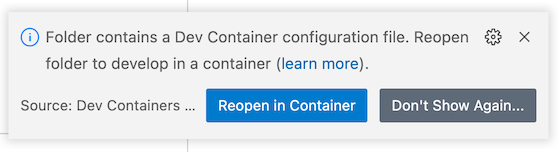
Now you should have a fully working dev environment working 🙌🏻. You can run tests, debug code, etcetera. All dependencies are automatically installed for you.
🙌🏻
Option B: installing the dependencies manually
Clone the repo and install the deps:
git clone https://github.com/dunnkers/pyspark-bucketmap.git
cd pyspark-bucketmap
pip install -r .devcontainer/requirements.txt
pip install -r .devcontainer/requirements-dev.txt
pip install .
Make sure you also have the following installed:
- Python 3.9
- OpenJDK version 11
Now, you should be able to run tests 🧪:
pytest .
🙌🏻
About
Created by Jeroen Overschie © 2022.
1 maintainer

Metadata
1 maintainer
Release files for pyspark-bucketmap 0.0.5
For a detailed explanation of source distributions (sdists) and built distributions (wheels), please see the package formats documentation.
Source distribution (sdist)
| File | Size | Uploaded | Provenance | Actions |
|---|---|---|---|---|
| pyspark-bucketmap-0.0.5.tar.gz | 4.8 kB | Without provenance | Details for pyspark-bucketmap-0.0.5.tar.gz |
Built distribution (wheel)
| File | Interpreter | ABI | Platform | Actions Reset |
|---|---|---|---|---|
| pyspark_bucketmap-0.0.5-py3-none-any.whl | Python 3 | none | any | Details for pyspark_bucketmap-0.0.5-py3-none-any.whl |
Total release size: 10.7 kB
Release files / pyspark-bucketmap-0.0.5.tar.gz
| Download URL | pyspark-bucketmap-0.0.5.tar.gz |
|---|---|
| Size | 4.8 kB |
| Tags | Source |
|
SHA-256 checksum How to use checksums |
368facb190b2b74a58b3d9ff9859f42898e19466131d2f22cca0a631a14fc351
|
|
BLAKE2b-256 checksum How to use checksums |
ab524140cd1a38466398e98e77c39fedf1429688b054dc2285fe81e11333a9cc
|
| Upload date | |
|
Uploaded using Trusted Publishing? What is trusted publishing? |
No |
| Uploaded via |
twine/4.0.1 CPython/3.10.8
|
Release files / pyspark_bucketmap-0.0.5-py3-none-any.whl
| Download URL | pyspark_bucketmap-0.0.5-py3-none-any.whl |
|---|---|
| Size | 5.9 kB |
| Tags | Python 3 |
|
SHA-256 checksum How to use checksums |
11527071cefc5386f74bcff08dd06561df99cae722de39ac7ab9c33d8f37116e
|
|
BLAKE2b-256 checksum How to use checksums |
b7325f052677284ebc620656f3b75e03663696e3be06933daf3acb5b34f6f2ca
|
| Upload date | |
|
Uploaded using Trusted Publishing? What is trusted publishing? |
No |
| Uploaded via |
twine/4.0.1 CPython/3.10.8
|
Security for pyspark-bucketmap 0.0.5
Provenance
Provenance describes where a file came from. On PyPI, provenance is shared via attestations, which provide a verifiable record of the build or publishing details. View details, limitations and caveats.
No provenance found
None of the files in this release were uploaded with provenance metadata.
A note on package security
PyPI is a repository for distributing packages, not a service for auditing them. While third-party security researchers and our staff do their best to detect and remove malicious packages, PyPI cannot guarantee the quality, security or suitability of any given package.
To learn more about protecting yourself from malicious actors, visit our package security documentation.














