

An easy to use function chaining pattern on Python.
📖 About this Project
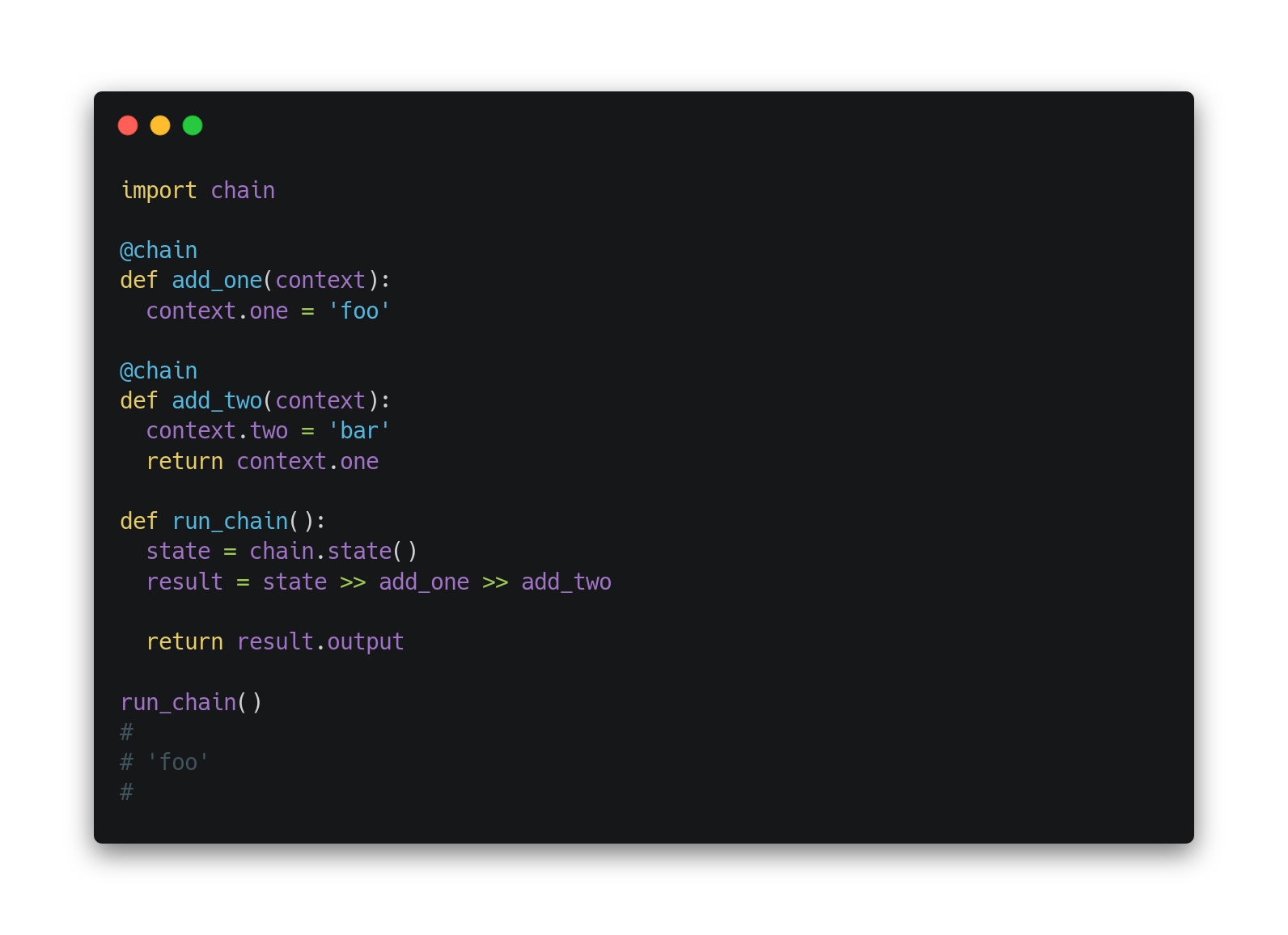
Chaining functions is a common functional development pattern that is pretty difficult on Python. Usually, we need to pass some data through a pipeline, process or series of functions in order to get a specific output. Without this lib, you would need to wrap those functions on a class or assign each result on a variable.
With python-chain you can create an initial state and execute a chain of functions, nourishing that state during the pipeline, like this:
🤖 Getting Started
On this section, you'll learn all the prerequisites and basic knowledge in order to use this library on your projects.
Installation
You can install it using pip, running:
pip install python-chain
Common Usage
Creating Chainable Functions
You can chain functions by decorating them with the @chain decorator. Like the following:
import chain


@chain
def some_pretty_func(state):
  ...

# Now you can chain that function with the operator>>
Using State
Every chain has a state. That state is an Object with immutable attributes. The current Chain state will be passed automatically on the keyword argument context. Every chain should start with a given state, even if it empty. You can create a new one by using:
import chain

state = chain.state()
If you want to feed data into your initial state, you can pass then as kwargs. The key-value pair on the kwargs of your state will be passed as attributes on your chain context. Like so:
import chain

state = chain.state(foo='bar')

@chain
def test_chain(context):
  print(context.foo)
  # bar
Using States on Chains
Every mutation that you do in a chain function will add it to the next function. You can merge what you have learned both on states and functions by following:
import chain

@chain
def calculate_average(context, type='meter'):
  nbs = [house.get(type) for house in state.houses]

  context.avg = sum(nbs) / len(nbs)

@chain
def add_houses(context):
  houses = [
    { meter: 3, },
    { meter: 10, },
  ]

  context.houses = houses

result = chain.state() >> add_houses >> calculate_average
print(result.current)
#
# {
#   avg: 6.5,
#   houses: [
#     { meter: 3 },
#     { meter: 10 },
#   ]
# }
#
If you don't return anything on your final chain function it will automatically return the Context object. They have a lot of properties, and one of them is the current attribute. That will return the current state of your given context.
Finishing a Chain
Every time a chain is finished, it will automatically return its context. You can also add an output by retuning the data that you want on the last step of the chain, like this:
import chain

@chain
def get_name(context):
  return context.name

@chain
def add_user(context):
  context.name = 'foo'

result = chain.state() >> add_user >> get_name
print(result.output)
#
# 'foo'
#
Passing arguments directly
You can pass any args or kwargs directly to the next function. They should be passed returning a tuple with all the args on the first argument and the kwargs on the second. You can do so like this:
import chain

@chain
def store_result(result, context, type=None):
  context.result = result
  context.type = type

@chain
def add_result(context):
  args = ('foo',)
  kwargs = {type: 'bar'}

  return args, kwargs

result = chain.state() >> add_result >> store_result
print(result.current)
#
# {
#   result: 'foo',
#   type: 'bar',
# }
#
Be careful. This would create a strong dependency between those two functions. Chain will always pass the args and kwargs that you've created and it will break the chain if the next function doesn't accept those params. Also, always set a state params, because it will be passed by the Chain with the current state.
✍️ Contributing
Contributions are what makes the open-source community such an amazing place to learn, inspire, and create. Any contributions you make are greatly appreciated. You can learn how to contribute to this project on the CONTRIBUTING file.
🔓 License
Distributed under the MIT License. See LICENSE for more information.
1 maintainer

Metadata
1 maintainer
Release files for python-chain 1.0.4
For a detailed explanation of source distributions (sdists) and built distributions (wheels), please see the package formats documentation.
Source distribution (sdist)
| File | Size | Uploaded | |
|---|---|---|---|
| python-chain-1.0.4.tar.gz | 8.1 kB | Details |
Built distribution (wheel)
| File | Interpreter | ABI | Platform | Reset |
|---|---|---|---|---|
| python_chain-1.0.4-py3-none-any.whl | Python 3 | none | any | Details |
Total release size: 16.6 kB
Release files / python-chain-1.0.4.tar.gz
| Download URL | python-chain-1.0.4.tar.gz |
|---|---|
| Size | 8.1 kB |
| Tags | Source |
|
SHA-256 checksum How to use checksums |
74fab622717116cfbf45f536302d6c8a1101e80f71744a620017fc8cba78e26d
|
|
BLAKE2b-256 checksum How to use checksums |
f92ed51931f395c9d9d5a43d14e344cab4dbf6d281a02dc6d86240a0f470a472
|
| Upload date | |
|
Uploaded using Trusted Publishing? What is trusted publishing? |
No |
| Uploaded via |
twine/3.1.1 pkginfo/1.5.0.1 requests/2.23.0 setuptools/46.1.3 requests-toolbelt/0.9.1 tqdm/4.45.0 CPython/3.8.2
|
Release files / python_chain-1.0.4-py3-none-any.whl
| Download URL | python_chain-1.0.4-py3-none-any.whl |
|---|---|
| Size | 8.5 kB |
| Tags | Python 3 |
|
SHA-256 checksum How to use checksums |
febb2f23e51e79169865df051ba41f583d66ad404b51bac21f5d787dbd7bdc51
|
|
BLAKE2b-256 checksum How to use checksums |
8ba8eb77d1b30bd62a34a048412602cbb0e80b4fccd7aed662f9d511d4b3491c
|
| Upload date | |
|
Uploaded using Trusted Publishing? What is trusted publishing? |
No |
| Uploaded via |
twine/3.1.1 pkginfo/1.5.0.1 requests/2.23.0 setuptools/46.1.3 requests-toolbelt/0.9.1 tqdm/4.45.0 CPython/3.8.2
|














