
docgen
Pythonista markdown document generator from a single file, intended to be used to generate documentation for Github. Included in the generated documentation are:
- Module-level docstring.
- Classes and their functions, with docstrings.
- Module-level functions and their docstrings.
- Decorators are included, with the following special cases:
- Properties are placed in a separate section, using the docstring of the getter.
on_main_threaddecorators are ignored.
- A table of contents.
Functions and methods that start with '_' are not included in the documentation.
Usage
Include this script in the Pythonista action (wrench) menu, and run it to generate documentation for the file currently open in the editor.
You can choose to just view the resulting documentation as HTML, or also save it as either README.md or <script_name>.md.
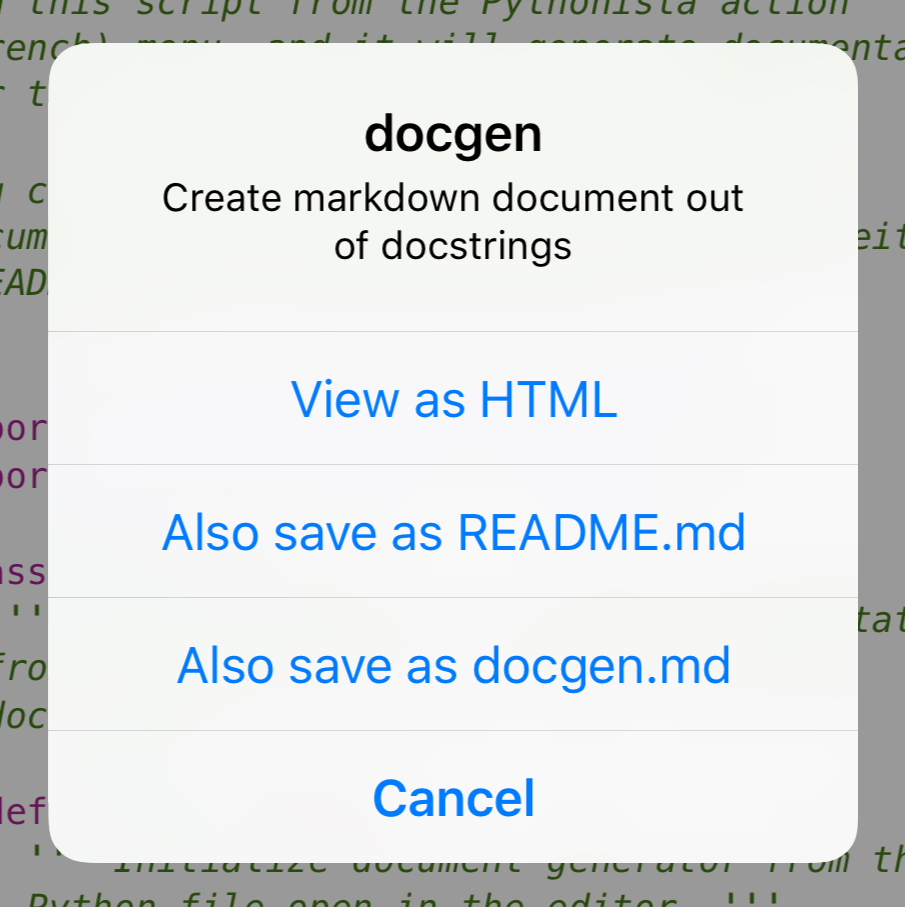
Table of contents is included after the module docstring.
There are some special directives you can use to fine-tune the output. These are magic comment strings that must be preceeded only by white space.
#docgen-toc- Table of contents will replace this string if found in the module docstring, so that you can have the ToC in the middle of it instead of at the end.#docgen:(with a space after the colon) - Use to group functions into related groups. The text you provide after the colon will be included in the table of contents.
API
Class: Processor
Methods to generate markdown documentation from source classes, functions and their docstrings.
Methods
get_markdown(self, include_undocumented=False)
Produces the markdown for the file.
Optional arguments:
include_undocumented- set toTrueto include classes and methods without a docstring.
get_sections(self)
get_section_title(self, line_no)
for_classes(self)
for_functions(self, c, heading, toc_level)
build_toc(self, toc)
Functions
UTILITY FUNCTIONS
el(parent, astdef)
eldoc(body, astdef)
slugify(s)
Simplifies ugly strings into something URL-friendly.
slugify("[Some] _ Article's Title--") --> some-articles-title
1 maintainer

Metadata
1 maintainer
Release files for pythonista-docgen 1.0
For a detailed explanation of source distributions (sdists) and built distributions (wheels), please see the package formats documentation.
Source distribution (sdist)
| File | Size | Uploaded | Provenance | Actions |
|---|---|---|---|---|
| pythonista-docgen-1.0.tar.gz | 297.2 kB | Without provenance | Details for pythonista-docgen-1.0.tar.gz |
Built distribution (wheel)
| File | Interpreter | ABI | Platform | Actions Reset |
|---|---|---|---|---|
| pythonista_docgen-1.0-py2.py3-none-any.whl | Python 3, Python 2 | none | any | Details for pythonista_docgen-1.0-py2.py3-none-any.whl |
Total release size: 302.2 kB
Release files / pythonista-docgen-1.0.tar.gz
| Download URL | pythonista-docgen-1.0.tar.gz |
|---|---|
| Size | 297.2 kB |
| Tags | Source |
|
SHA-256 checksum How to use checksums |
1ae92b520b233ad52567ad4e573318bc990bbfabb0445197148a2afdc2ebb40f
|
|
BLAKE2b-256 checksum How to use checksums |
7f6af71f0d83dc2e5dbc5eb24ba30159856a0e6e96f448c828e997a335a4d137
|
| Upload date | |
|
Uploaded using Trusted Publishing? What is trusted publishing? |
No |
| Uploaded via |
python-requests/2.22.0
|
Release files / pythonista_docgen-1.0-py2.py3-none-any.whl
| Download URL | pythonista_docgen-1.0-py2.py3-none-any.whl |
|---|---|
| Size | 5.1 kB |
| Tags | Python 2 Python 3 |
|
SHA-256 checksum How to use checksums |
d301398ecec9aa07497fd1a130e243fb67f2c304b15219aaa06d860217aace17
|
|
BLAKE2b-256 checksum How to use checksums |
77740255a4de88afb800375b93427e3ff4c6d0f24186afd00667ccd18e33930f
|
| Upload date | |
|
Uploaded using Trusted Publishing? What is trusted publishing? |
No |
| Uploaded via |
python-requests/2.22.0
|
Security for pythonista-docgen 1.0
Provenance
Provenance describes where a file came from. On PyPI, provenance is shared via attestations, which provide a verifiable record of the build or publishing details. View details, limitations and caveats.
No provenance found
None of the files in this release were uploaded with provenance metadata.
A note on package security
PyPI is a repository for distributing packages, not a service for auditing them. While third-party security researchers and our staff do their best to detect and remove malicious packages, PyPI cannot guarantee the quality, security or suitability of any given package.
To learn more about protecting yourself from malicious actors, visit our package security documentation.













