
The light Python GUI builder (currently based on PyQt6)
Simplifying the creation of common GUI applications
Description
q2gui is a lightweight Python GUI builder designed to simplify the creation of desktop applications using PyQt6. It provides a high-level API for building forms, menus, toolbars, tabbed interfaces, and various widgets with minimal code. Features include:
- Dynamic menu and toolbar creation with shortcuts and icons
- Form builder supporting labels, inputs, combo boxes, radio buttons, checkboxes, date/time pickers, and more
- Tabbed and split layouts, frames, and groupings
- Sheet/grid controls with customizable headers, sizes, and actions
- Built-in support for color modes (light/dark)
- Status bar, tool buttons, and message dialogs
- Easy event handling and validation logic
- Demo applications showcasing usage patterns
How to start
With PyPI package:
poetry new project_01 && cd project_01 && poetry shell
poetry add q2gui
cd project_01
python -m q2gui > example_app.py && python example_app.py
Explore sources:
git clone https://github.com/AndreiPuchko/q2gui.git
cd q2gui
pip3 install poetry
poetry shell
poetry install
python3 demo/demo_00.py     # All demo launcher
python3 demo/demo_01.py     # basic: main menu, form & widgets
python3 demo/demo_02.py     # forms and forms in form
python3 demo/demo_03.py     # grid form (CSV data), automatic creation of forms based on data
python3 demo/demo_04.py     # progressbar, data loading, sorting and filtering
python3 demo/demo_05.py     # nonmodal form
python3 demo/demo_06.py     # code editor
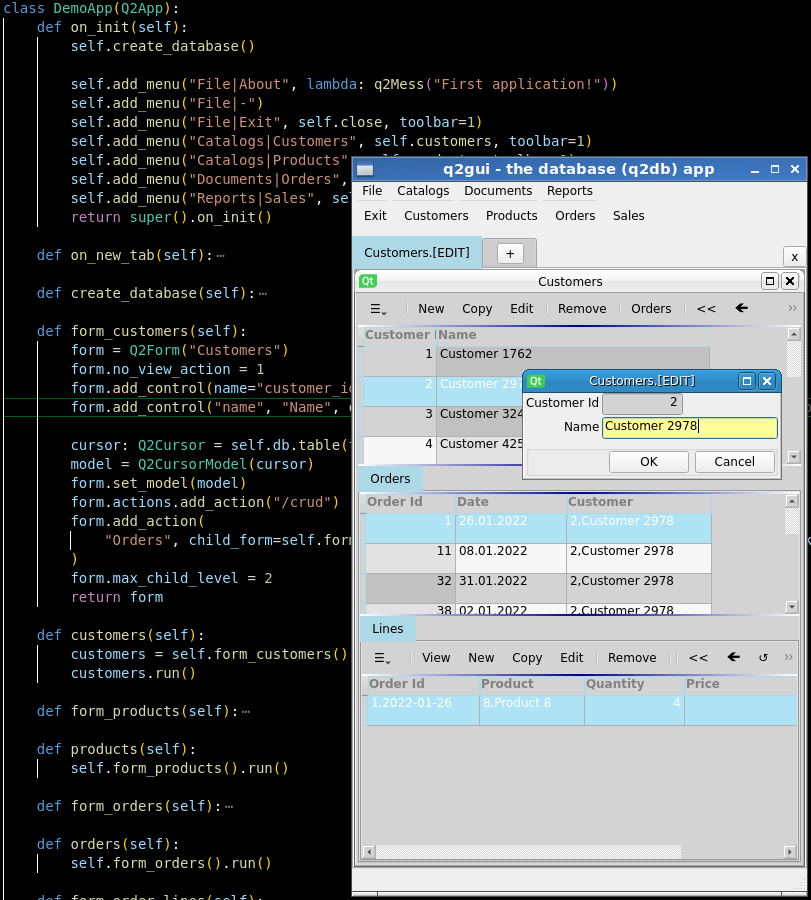
python3 demo/demo_07.py     # database app (4 tables, mock data loading) - requires a q2db package
python3 demo/demo_08.py     # database app, requires a q2db package, autoschema
demo/demo_07.py screenshot
=======
Build standalone executable
(The resulting executable file will appear in the folder dist/)
One file
pyinstaller -F demo/demo.py
One directory
pyinstaller -D demo/demo.py
1 maintainer

Metadata
1 maintainer
Release files for q2gui 0.1.235
For a detailed explanation of source distributions (sdists) and built distributions (wheels), please see the package formats documentation.
Source distribution (sdist)
| File | Size | Uploaded | Provenance | Actions |
|---|---|---|---|---|
| q2gui-0.1.235.tar.gz | 100.7 kB | Without provenance | Details for q2gui-0.1.235.tar.gz |
Built distribution (wheel)
| File | Interpreter | ABI | Platform | Actions Reset |
|---|---|---|---|---|
| q2gui-0.1.235-py3-none-any.whl | Python 3 | none | any | Details for q2gui-0.1.235-py3-none-any.whl |
Total release size: 237.0 kB
Release files / q2gui-0.1.235.tar.gz
| Download URL | q2gui-0.1.235.tar.gz |
|---|---|
| Size | 100.7 kB |
| Tags | Source |
|
SHA-256 checksum How to use checksums |
34c9c29f453ddab37adf4305261912630914792ec29b3fae93f00ff625d0e0f9
|
|
BLAKE2b-256 checksum How to use checksums |
32ed7371bb4b208dcaf11a35bf3eb8ae3c5fb85413b1deadc604a9e13e25df32
|
| Upload date | |
|
Uploaded using Trusted Publishing? What is trusted publishing? |
No |
| Uploaded via |
poetry/1.5.0 CPython/3.11.7 Windows/10
|
Release files / q2gui-0.1.235-py3-none-any.whl
| Download URL | q2gui-0.1.235-py3-none-any.whl |
|---|---|
| Size | 136.3 kB |
| Tags | Python 3 |
|
SHA-256 checksum How to use checksums |
83a10cd906be62c60a019e9b401bcd463bd606252c60a1bd1234d0e406727e6e
|
|
BLAKE2b-256 checksum How to use checksums |
f86450f7d603792f997042665141cb91853b3e7ee024fddc9528e20b1d92b27d
|
| Upload date | |
|
Uploaded using Trusted Publishing? What is trusted publishing? |
No |
| Uploaded via |
poetry/1.5.0 CPython/3.11.7 Windows/10
|
Security for q2gui 0.1.235
Provenance
Provenance describes where a file came from. On PyPI, provenance is shared via attestations, which provide a verifiable record of the build or publishing details. View details, limitations and caveats.
No provenance found
None of the files in this release were uploaded with provenance metadata.
A note on package security
PyPI is a repository for distributing packages, not a service for auditing them. While third-party security researchers and our staff do their best to detect and remove malicious packages, PyPI cannot guarantee the quality, security or suitability of any given package.
To learn more about protecting yourself from malicious actors, visit our package security documentation.














