

Quackling


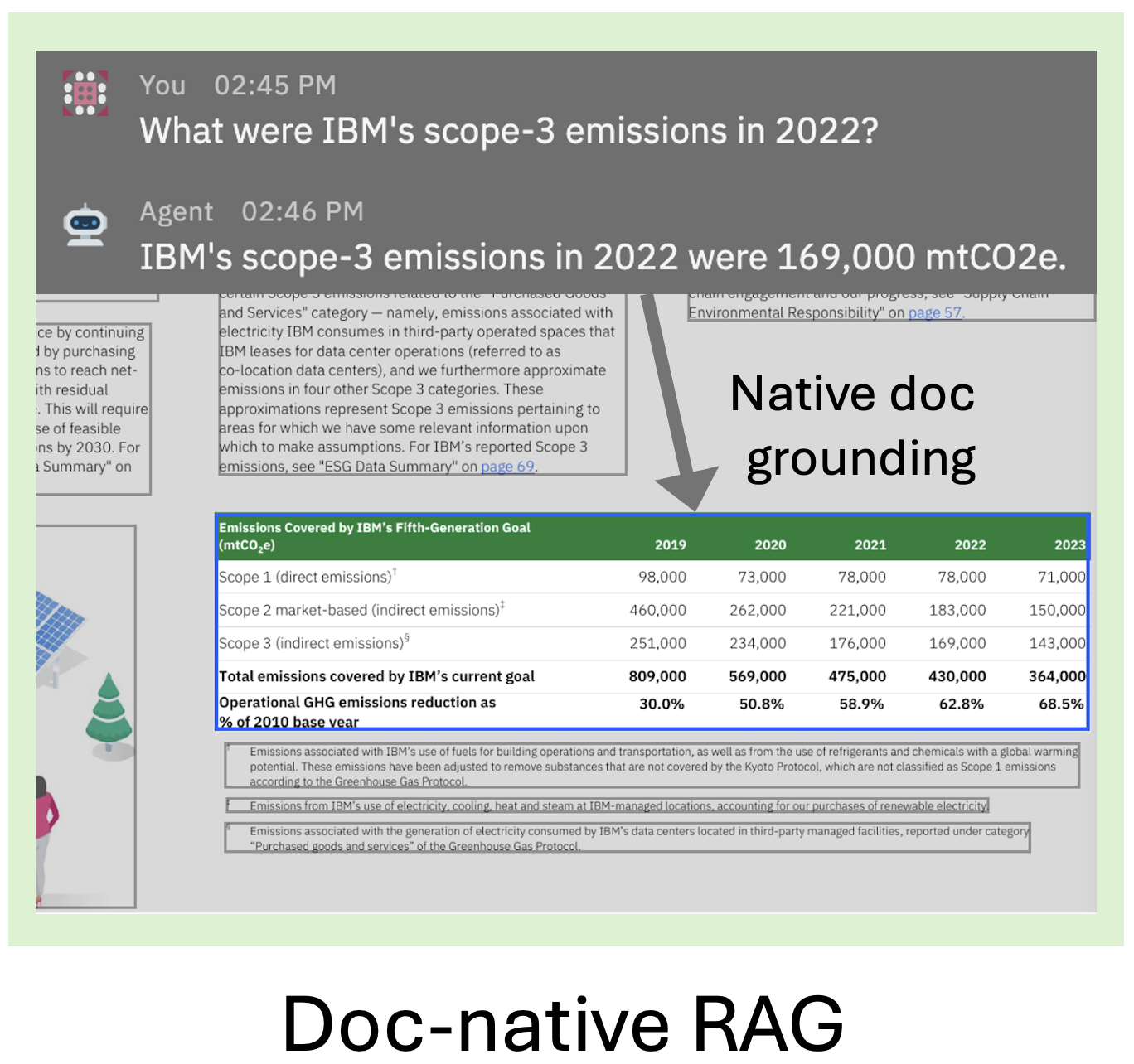
Easily build document-native generative AI applications, such as RAG, leveraging Docling's efficient PDF extraction and rich data model — while still using your favorite framework, 🦙 LlamaIndex or 🦜🔗 LangChain.
Features
- 🧠 Enables rich gen AI applications by providing capabilities on native document level — not just plain text / Markdown!
- ⚡️ Leverages Docling's conversion quality and speed.
- ⚙️ Plug-and-play integration with LlamaIndex and LangChain for building powerful applications like RAG.
Installation
To use Quackling, simply install quackling from your package manager, e.g. pip:
pip install quackling
Usage
Quackling offers core capabilities (quackling.core), as well as framework integration components (quackling.llama_index and quackling.langchain). Below you find examples of both.
Basic RAG
Here is a basic RAG pipeline using LlamaIndex:
import os

from llama_index.core import VectorStoreIndex
from llama_index.embeddings.huggingface import HuggingFaceEmbedding
from llama_index.llms.huggingface_api import HuggingFaceInferenceAPI
from quackling.llama_index.node_parsers import HierarchicalJSONNodeParser
from quackling.llama_index.readers import DoclingPDFReader

DOCS = ["https://arxiv.org/pdf/2206.01062"]
QUESTION = "How many pages were human annotated?"
EMBED_MODEL = HuggingFaceEmbedding(model_name="BAAI/bge-small-en-v1.5")
LLM = HuggingFaceInferenceAPI(
    token=os.getenv("HF_TOKEN"),
    model_name="mistralai/Mistral-7B-Instruct-v0.3",
)

index = VectorStoreIndex.from_documents(
    documents=DoclingPDFReader(parse_type=DoclingPDFReader.ParseType.JSON).load_data(DOCS),
    embed_model=EMBED_MODEL,
    transformations=[HierarchicalJSONNodeParser()],
)
query_engine = index.as_query_engine(llm=LLM)
result = query_engine.query(QUESTION)
print(result.response)
# > 80K pages were human annotated
Chunking
You can also use Quackling as a standalone with any pipeline. For instance, to split the document to chunks based on document structure and returning pointers to Docling document's nodes:
from docling.document_converter import DocumentConverter
from quackling.core.chunkers import HierarchicalChunker

doc = DocumentConverter().convert_single("https://arxiv.org/pdf/2408.09869").output
chunks = list(HierarchicalChunker().chunk(doc))
# > [
# >     ChunkWithMetadata(
# >         path='$.main-text[4]',
# >         text='Docling Technical Report\n[...]',
# >         page=1,
# >         bbox=[117.56, 439.85, 494.07, 482.42]
# >     ),
# >     [...]
# > ]
More examples
LlamaIndex
- Milvus basic RAG (dense embeddings)
- Milvus hybrid RAG (dense & sparse embeddings combined e.g. via RRF) & reranker model usage
- Milvus RAG also fetching native document metadata for search results
- Local node transformations (e.g. embeddings)
- ...
LangChain
Contributing
Please read Contributing to Quackling for details.
References
If you use Quackling in your projects, please consider citing the following:
@techreport{Docling,
  author = "Deep Search Team",
  month = 8,
  title = "Docling Technical Report",
  url = "https://arxiv.org/abs/2408.09869",
  eprint = "2408.09869",
  doi = "10.48550/arXiv.2408.09869",
  version = "1.0.0",
  year = 2024
}
License
The Quackling codebase is under MIT license. For individual component usage, please refer to the component licenses found in the original packages.
1 maintainer

Metadata
1 maintainer
Release files for quackling 0.4.1
For a detailed explanation of source distributions (sdists) and built distributions (wheels), please see the package formats documentation.
Source distribution (sdist)
| File | Size | Uploaded | Provenance | |
|---|---|---|---|---|
| quackling-0.4.1.tar.gz | 13.9 kB | Without provenance | Details |
Built distribution (wheel)
| File | Interpreter | ABI | Platform | Reset |
|---|---|---|---|---|
| quackling-0.4.1-py3-none-any.whl | Python 3 | none | any | Details |
Total release size: 31.5 kB
Release files / quackling-0.4.1.tar.gz
| Download URL | quackling-0.4.1.tar.gz |
|---|---|
| Size | 13.9 kB |
| Tags | Source |
|
SHA-256 checksum How to use checksums |
9f3be8538c89258c774b047f762d71f92f5a0a776bab7630e81a9b0eb041d4a2
|
|
BLAKE2b-256 checksum How to use checksums |
315842f51fb771fe4d7602a31074736aa12aea560cfe548d30abd9497e2e9279
|
| Upload date | |
|
Uploaded using Trusted Publishing? What is trusted publishing? |
No |
| Uploaded via |
poetry/1.8.3 CPython/3.10.12 Linux/6.5.0-1025-azure
|
Release files / quackling-0.4.1-py3-none-any.whl
| Download URL | quackling-0.4.1-py3-none-any.whl |
|---|---|
| Size | 17.5 kB |
| Tags | Python 3 |
|
SHA-256 checksum How to use checksums |
e1e07fcbb964e7e2a96f68bd4ce6b432a341b61f1c0ea1ca298e61e85b14e9a2
|
|
BLAKE2b-256 checksum How to use checksums |
80980f5892f4d9c9c7dc6956f4b3a5315f81ee5b1acf5b7d1fb0f99fd22b0d64
|
| Upload date | |
|
Uploaded using Trusted Publishing? What is trusted publishing? |
No |
| Uploaded via |
poetry/1.8.3 CPython/3.10.12 Linux/6.5.0-1025-azure
|
Security for quackling 0.4.1
Provenance
Provenance describes where a file came from. On PyPI, provenance is shared via attestations, which provide a verifiable record of the build or publishing details. View details, limitations and caveats.
No provenance found
None of the files in this release were uploaded with provenance metadata.
A note on package security
PyPI is a repository for distributing packages, not a service for auditing them. While third-party security researchers and our staff do their best to detect and remove malicious packages, PyPI cannot guarantee the quality, security or suitability of any given package.
To learn more about protecting yourself from malicious actors, visit our package security documentation.














