


Reinforcement learning algorithms in RLlib and PyTorch.
Installation
pip install raylabQuickstart
Raylab provides agents and environments to be used with a normal RLlib/Tune setup.
You can an agent’s name (from the Algorithms section) to raylab info list to list its top-level configurations:
raylab info list SoftAClearning_starts: 0
Hold this number of timesteps before first training operation.
policy: {}
Sub-configurations for the policy class.
wandb: {}
Configs for integration with Weights & Biases.
Accepts arbitrary keyword arguments to pass to `wandb.init`.
The defaults for `wandb.init` are:
* name: `_name` property of the trainer.
* config: full `config` attribute of the trainer
* config_exclude_keys: `wandb` and `callbacks` configs
* reinit: True
Don't forget to:
* install `wandb` via pip
* login to W&B with the appropriate API key for your
team/project.
* set the `wandb/project` name in the config dict
Check out the Quickstart for more information:
`https://docs.wandb.com/quickstart`You can add the --rllib flag to get the descriptions for all the options common to RLlib agents
(or Trainers)
Launching experiments can be done via the command line using raylab experiment passing a file path
with an agent’s configuration through the --config flag.
The following command uses the cartpole example configuration file
to launch an experiment using the vanilla Policy Gradient agent from the RLlib library.
raylab experiment PG --name PG -s training_iteration 10 --config examples/PG/cartpole_defaults.pyYou can also launch an experiment from a Python script normally using Ray and Tune. The following shows how you may use Raylab to perform an experiment comparing different types of exploration for the NAF agent.
import ray
from ray import tune
import raylab

def main():
    raylab.register_all_agents()
    raylab.register_all_environments()
    ray.init()
    tune.run(
        "NAF",
        local_dir="data/NAF",
        stop={"timesteps_total": 100000},
        config={
            "env": "CartPoleSwingUp-v0",
            "exploration_config": {
                "type": tune.grid_search([
                    "raylab.utils.exploration.GaussianNoise",
                    "raylab.utils.exploration.ParameterNoise"
                ])
            }
        },
        num_samples=10,
    )

if __name__ == "__main__":
    main()
One can then visualize the results using raylab dashboard, passing the local_dir used in the
experiment. The dashboard lets you filter and group results in a quick way.
raylab dashboard data/NAF/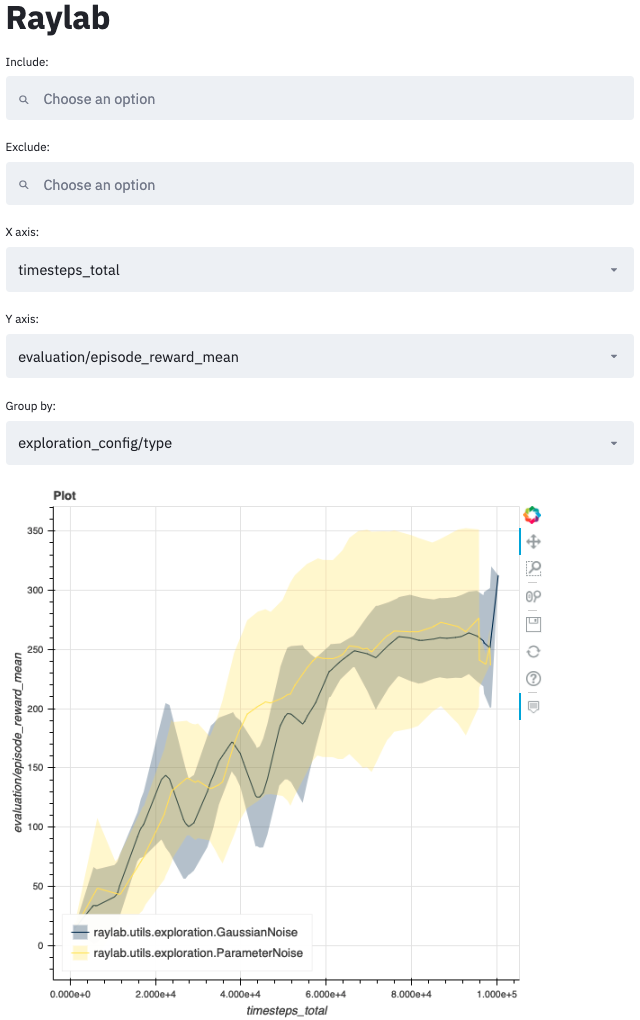
You can find the best checkpoint according to a metric (episode_reward_mean by default)
using raylab find-best.
raylab find-best data/NAF/Finally, you can pass a checkpoint to raylab rollout to see the returns collected by the agent and
render it if the environment supports a visual render() method. For example, you
can use the output of the find-best command to see the best agent in action.
raylab rollout $(raylab find-best data/NAF/) --agent NAFAlgorithms
Paper |
Agent Name |
ACKTR |
|
TRPO |
|
NAF |
|
SVG(inf)/SVG(1)/SoftSVG |
|
SoftAC |
|
Streamlined Off-Policy (DDPG) |
SOP |
MBPO |
|
MAGE |
Command-line interface
For a high-level description of the available utilities, run raylab --help
Usage: raylab [OPTIONS] COMMAND [ARGS]...

  RayLab: Reinforcement learning algorithms in RLlib.

Options:
  --help  Show this message and exit.

Commands:
  dashboard    Launch the experiment dashboard to monitor training progress.
  episodes     Launch the episode dashboard to monitor state and action...
  experiment   Launch a Tune experiment from a config file.
  find-best    Find the best experiment checkpoint as measured by a metric.
  info         View information about an agent's config parameters.
  rollout      Wrap `rllib rollout` with customized options.
  test-module  Launch dashboard to test generative models from a checkpoint.
Packages
The project is structured as follows
raylab
|-- agents            # Trainer and Policy classes
|-- cli               # Command line utilities
|-- envs              # Gym environment registry and utilities
|-- logger            # Tune loggers
|-- policy            # Extensions and customizations of RLlib's policy API
|   |-- losses        # RL loss functions
|   |-- modules       # PyTorch neural network modules for TorchPolicy
|-- pytorch           # PyTorch extensions
|-- utils             # miscellaneous utilities
1 maintainer

Metadata
1 maintainer
Release files for raylab 0.16.1
For a detailed explanation of source distributions (sdists) and built distributions (wheels), please see the package formats documentation.
Source distribution (sdist)
| File | Size | Uploaded | Provenance | Actions |
|---|---|---|---|---|
| raylab-0.16.1.tar.gz | 104.5 kB | Without provenance | Details for raylab-0.16.1.tar.gz |
Built distribution (wheel)
| File | Interpreter | ABI | Platform | Actions Reset |
|---|---|---|---|---|
| raylab-0.16.1-py3-none-any.whl | Python 3 | none | any | Details for raylab-0.16.1-py3-none-any.whl |
Total release size: 261.9 kB
Release files / raylab-0.16.1.tar.gz
| Download URL | raylab-0.16.1.tar.gz |
|---|---|
| Size | 104.5 kB |
| Tags | Source |
|
SHA-256 checksum How to use checksums |
fb5751d488c698ba9e4ff2ba9406241b69f96c9e71dbe6ca6ab2d3a20f200790
|
|
BLAKE2b-256 checksum How to use checksums |
75dd1ee92842de44cbae3a00e510e92e775a3634cd39bd9487063345e085f2d2
|
| Upload date | |
|
Uploaded using Trusted Publishing? What is trusted publishing? |
No |
| Uploaded via |
poetry/1.1.13 CPython/3.8.12 Linux/5.11.0-1028-azure
|
Release files / raylab-0.16.1-py3-none-any.whl
| Download URL | raylab-0.16.1-py3-none-any.whl |
|---|---|
| Size | 157.4 kB |
| Tags | Python 3 |
|
SHA-256 checksum How to use checksums |
574d8bdbd5d50438bbdc36a0e003aa059ec4218d2ffd1fd864b47b0fa7fd1238
|
|
BLAKE2b-256 checksum How to use checksums |
1923457325d3a123c1b80a89e011a421e151e9fe5e79b2fffd9edceca280fdc5
|
| Upload date | |
|
Uploaded using Trusted Publishing? What is trusted publishing? |
No |
| Uploaded via |
poetry/1.1.13 CPython/3.8.12 Linux/5.11.0-1028-azure
|
Security for raylab 0.16.1
Provenance
Provenance describes where a file came from. On PyPI, provenance is shared via attestations, which provide a verifiable record of the build or publishing details. View details, limitations and caveats.
No provenance found
None of the files in this release were uploaded with provenance metadata.
A note on package security
PyPI is a repository for distributing packages, not a service for auditing them. While third-party security researchers and our staff do their best to detect and remove malicious packages, PyPI cannot guarantee the quality, security or suitability of any given package.
To learn more about protecting yourself from malicious actors, visit our package security documentation.














