








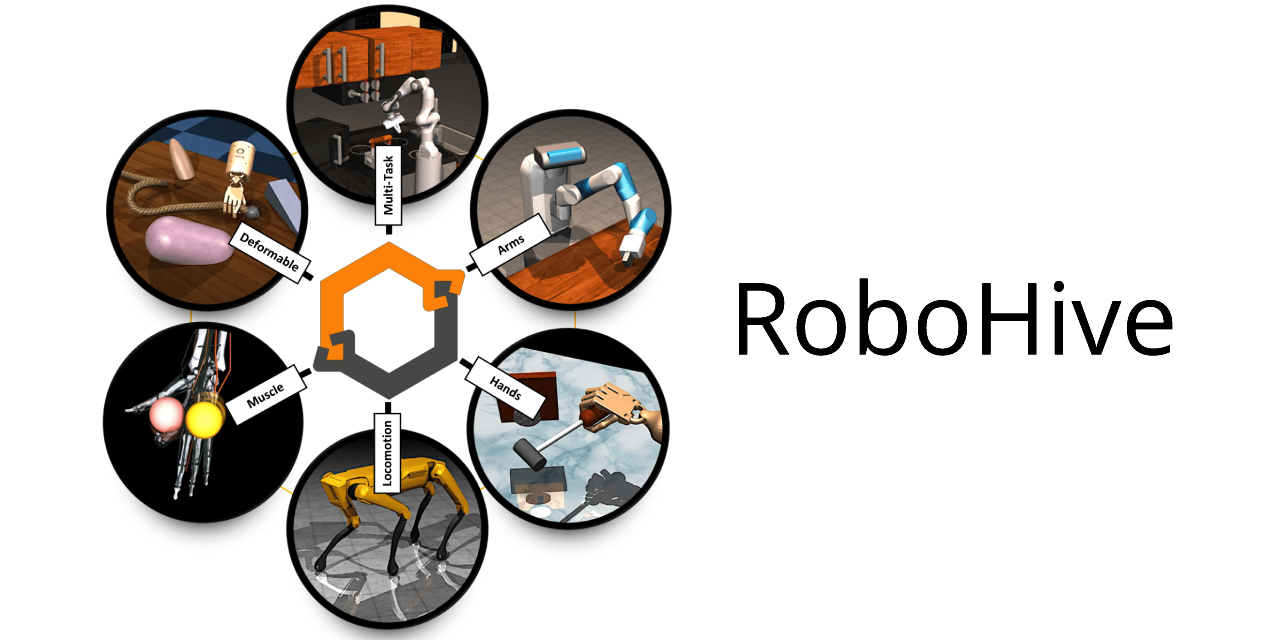
RoboHive is a collection of environments/tasks simulated with the MuJoCo physics engine exposed using the OpenAI-Gym API. Its compatible with any gym-compatible agents training framework (Stable Baselines, RLlib, TorchRL, AgentHive, etc)
Getting Started
Getting started with RoboHive is as simple as -
# Install RoboHive
pip install robohive
# Initialize RoboHive
robohive_init
# Demo an environment
python -m robohive.utils.examine_env -e FrankaReachRandom-v0
or, alternatively for editable installation -
# Clone RoboHive
git clone --recursive https://github.com/vikashplus/robohive.git; cd robohive
# Install (editable) RoboHive
pip install -e .
# Demo an environment
python -m robohive.utils.examine_env -e FrankaReachRandom-v0
See detailed installation instructions for options on mujoco-python-bindings and visual-encoders (R3M, RRL, VC), and frequently asked questions for more details.
Suites
RoboHive contains a variety of environments, which are organized as suites. Each suite is a collection of loosely related environments. The following suites are provided at the moment with plans to improve the diversity of the collection.
| Hand-Manipulation-Suite (video) |
|---|
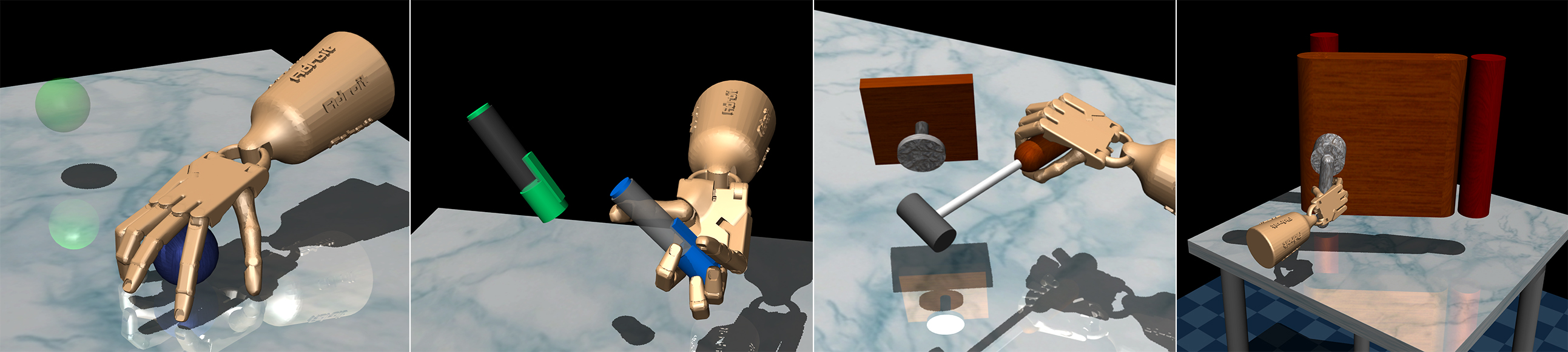 A collection of environments centered around dexterous manipulation. Standard ADROIT benchmarks introduced in Learning Complex Dexterous Manipulation with Deep Reinforcement Learning and Demonstrations, RSS2018.) are a part of this suite |
| Arm-Manipulation-Suite |
|---|
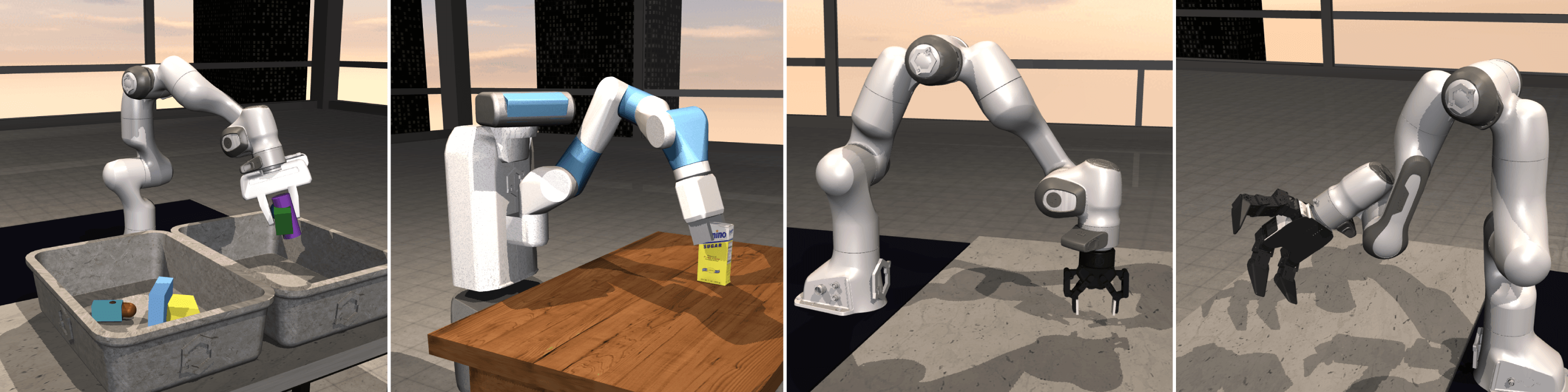 A collection of environments centered around Arm manipulation. |
| Myo-Suite (website) |
|---|
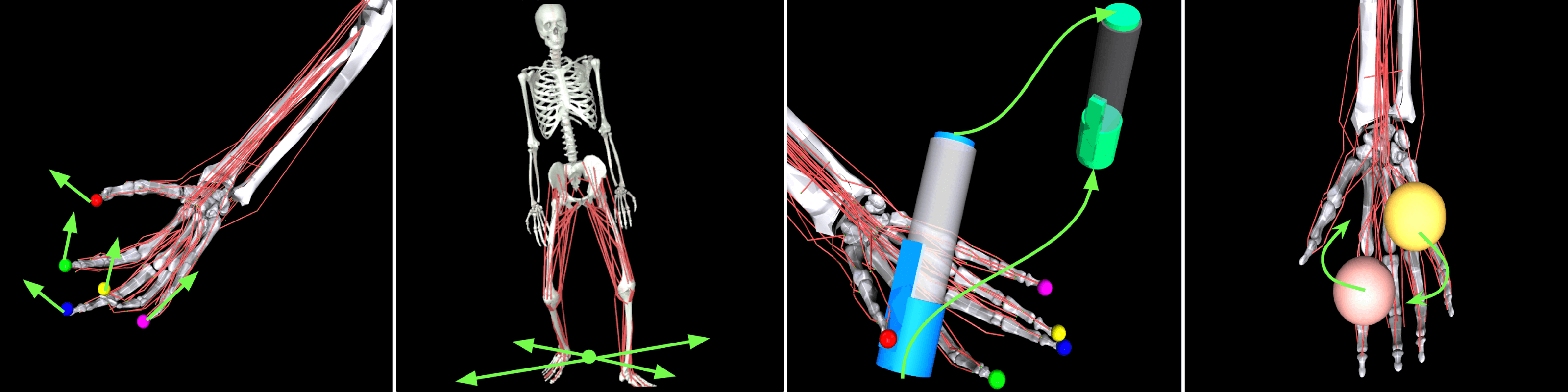 A collection of environments centered around Musculoskeletal control. |
| Myo/MyoDM-Suite (Website) |
|---|
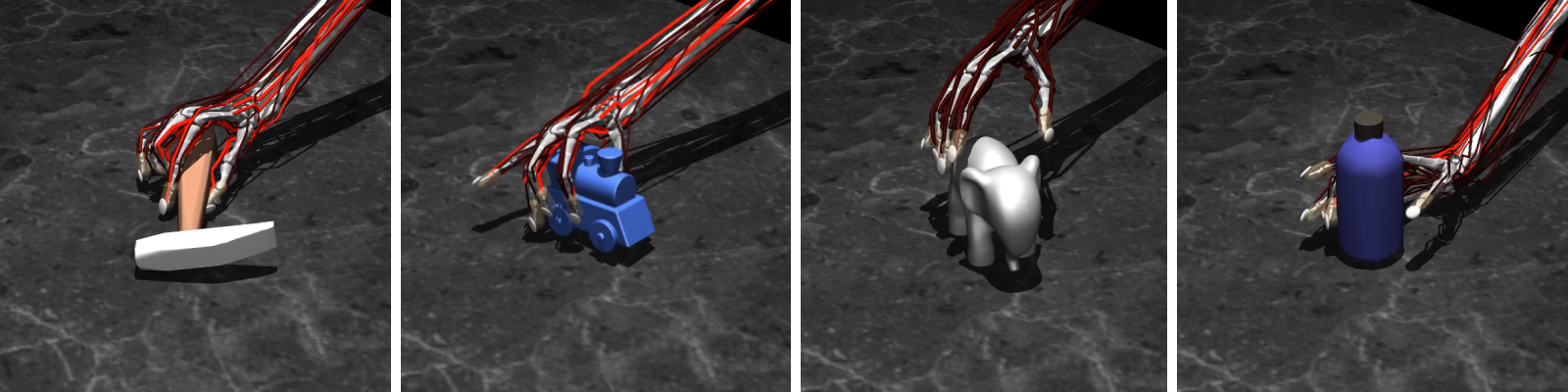 A collection of musculoskeletal environments for dexterous manipulation introduced as MyoDM in MyoDeX. |
| MultiTask Suite |
|---|
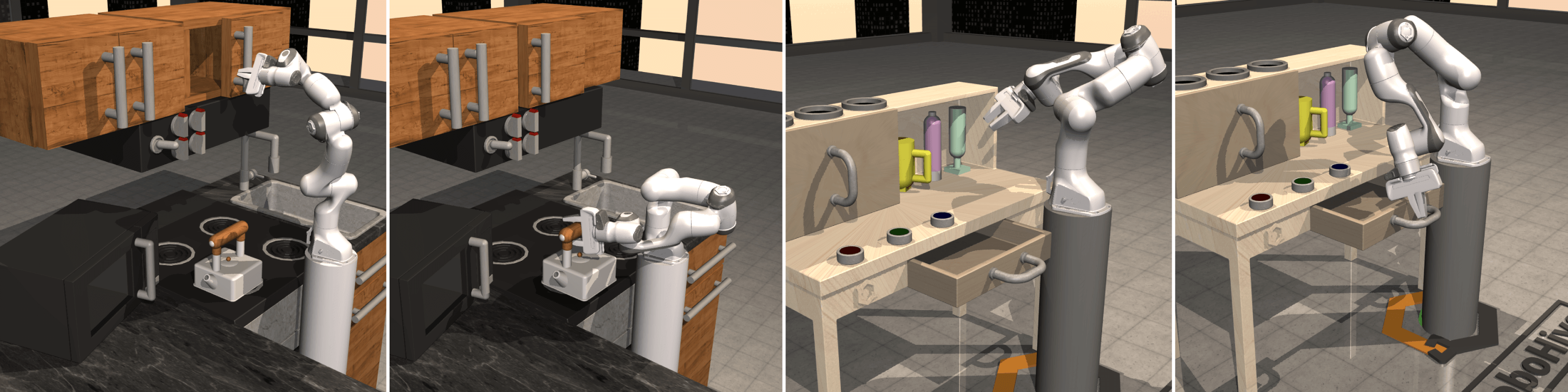 A collection of environments centered around multi-task. Standard RelayKitchen benchmarks are a part of this suite. |
- TCDM Suite (WIP)
This suite contains a collection of environments centered around dexterous manipulation. Standard TCDM benchmarks are a part of this suite
- ROBEL Suite (Coming soon)
This suite contains a collection of environments centered around real-world locomotion and manipulation. Standard ROBEL benchmarks are a part of this suite
Citation
If you find RoboHive useful in your research,
- please consider supporting the project by providing a star ⭐
- please consider citing our project by using the following BibTeX entry:
@Misc{RoboHive2020,
  title = {RoboHive -- A Unified Framework for Robot Learning},
  howpublished = {\url{https://sites.google.com/view/robohive}},
  year = {2020},
  url = {https://sites.google.com/view/robohive},
}
2 maintainers


Metadata
2 maintainers
Release files for robohive 0.7.0
For a detailed explanation of source distributions (sdists) and built distributions (wheels), please see the package formats documentation.
Built distribution (wheel)
| File | Interpreter | ABI | Platform | Actions Reset |
|---|---|---|---|---|
| robohive-0.7.0-py2.py3-none-any.whl | Python 3, Python 2 | none | any | Details for robohive-0.7.0-py2.py3-none-any.whl |
Release files / robohive-0.7.0-py2.py3-none-any.whl
| Download URL | robohive-0.7.0-py2.py3-none-any.whl |
|---|---|
| Size | 13.5 MB |
| Tags | Python 2 Python 3 |
|
SHA-256 checksum How to use checksums |
7bf4edb1fa923288cb207a786331e267b19cf2f84470061a46a0c7ac890f6a23
|
|
BLAKE2b-256 checksum How to use checksums |
d300fc79392323e981f61a4563f01dcccf0ada435f269d431bd19162cc7fa5c5
|
| Upload date | |
|
Uploaded using Trusted Publishing? What is trusted publishing? |
No |
| Uploaded via |
twine/5.0.0 CPython/3.9.18
|
Security for robohive 0.7.0
Provenance
Provenance describes where a file came from. On PyPI, provenance is shared via attestations, which provide a verifiable record of the build or publishing details. View details, limitations and caveats.
No provenance found
None of the files in this release were uploaded with provenance metadata.
A note on package security
PyPI is a repository for distributing packages, not a service for auditing them. While third-party security researchers and our staff do their best to detect and remove malicious packages, PyPI cannot guarantee the quality, security or suitability of any given package.
To learn more about protecting yourself from malicious actors, visit our package security documentation.














