
Run Jupyter notebooks quietly from command-line




runPyNB is a quick and dirty utility to run (and time) Jupyter notebooks from command-line and makefiles.
Quickstart
Install from PyPI
pip install runpynb
General usage: runpynb <notebook(s)> [options] (".ipynb" not required)
-
runpynb: Run all notebooks in directory.$ runpynb
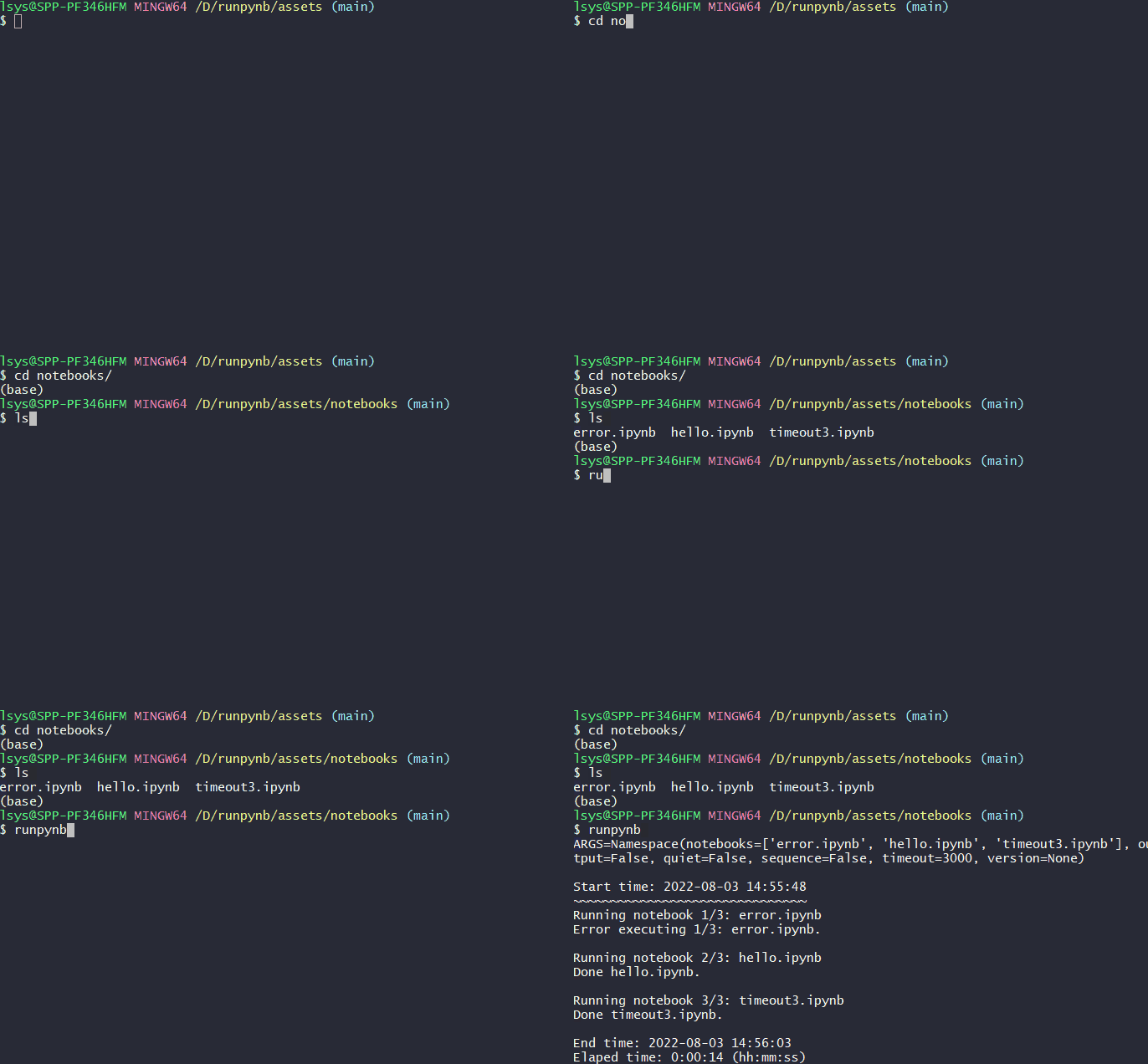
Usage
-
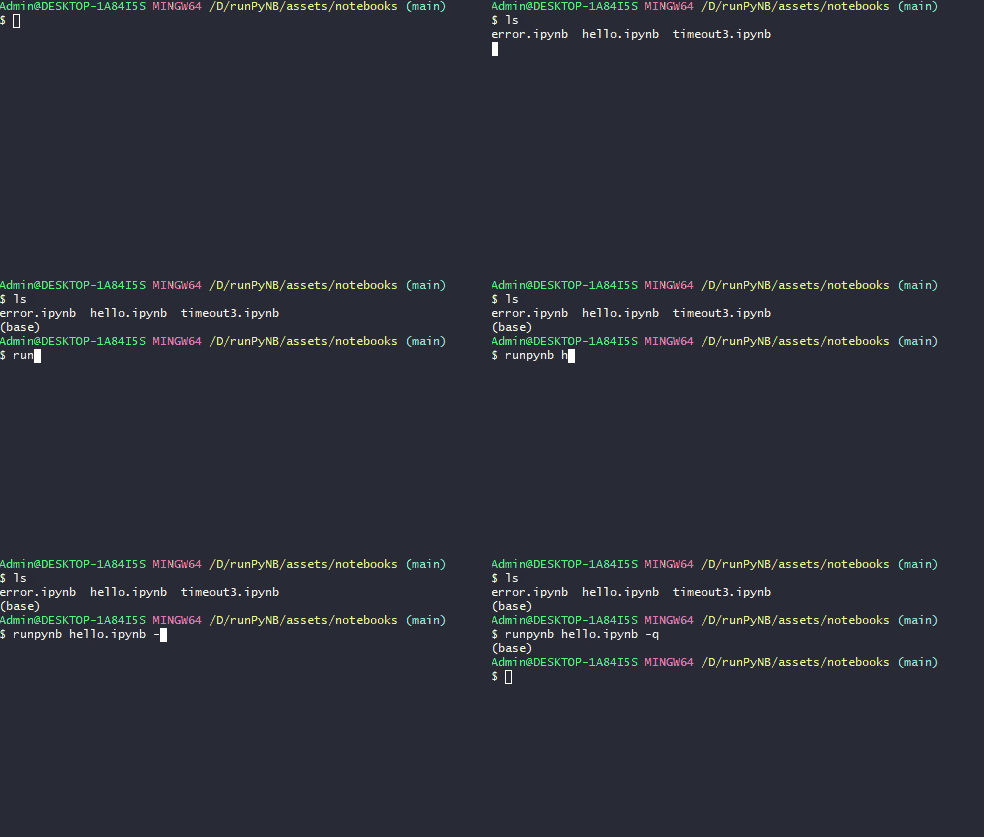
runpynb <notebook(s)> -q: Run quietly (-q).$ runpynb hello.ipynb -q
-
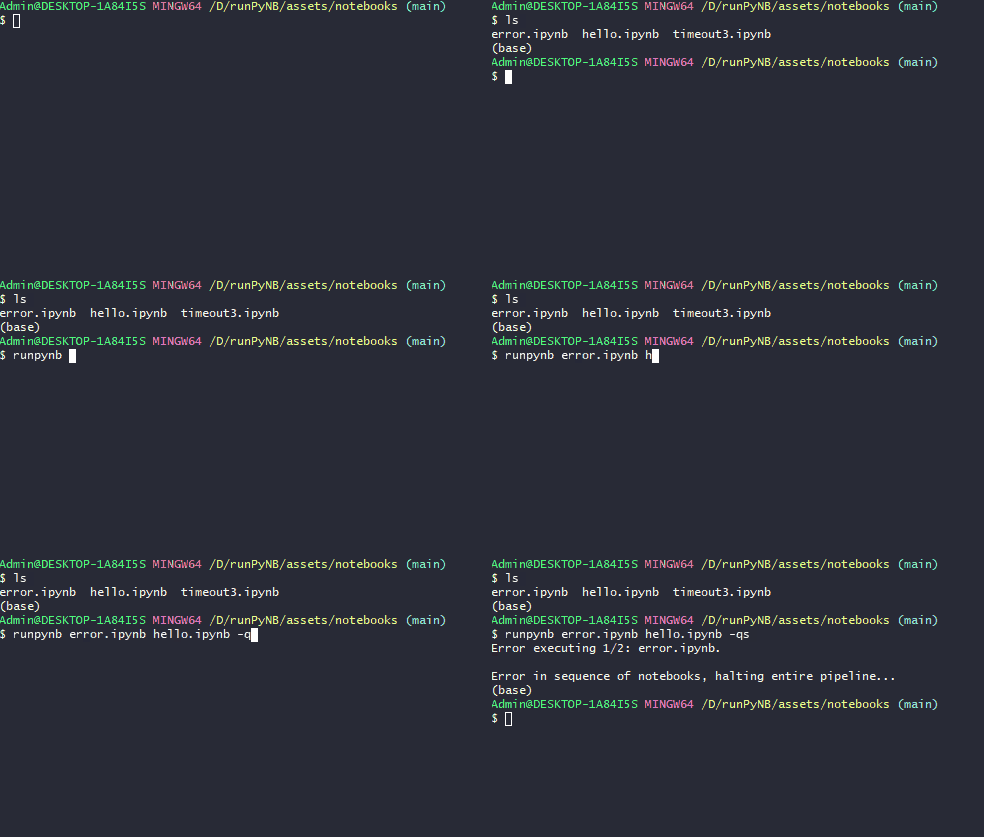
runpynb <notebook(s)> -qs: Run quietly (-q) as a sequence of workflow (-s). Errors (eg inerror.ipynb) will break the workflow.$ runpynb error.ipynb hello.ipynb -qs
-
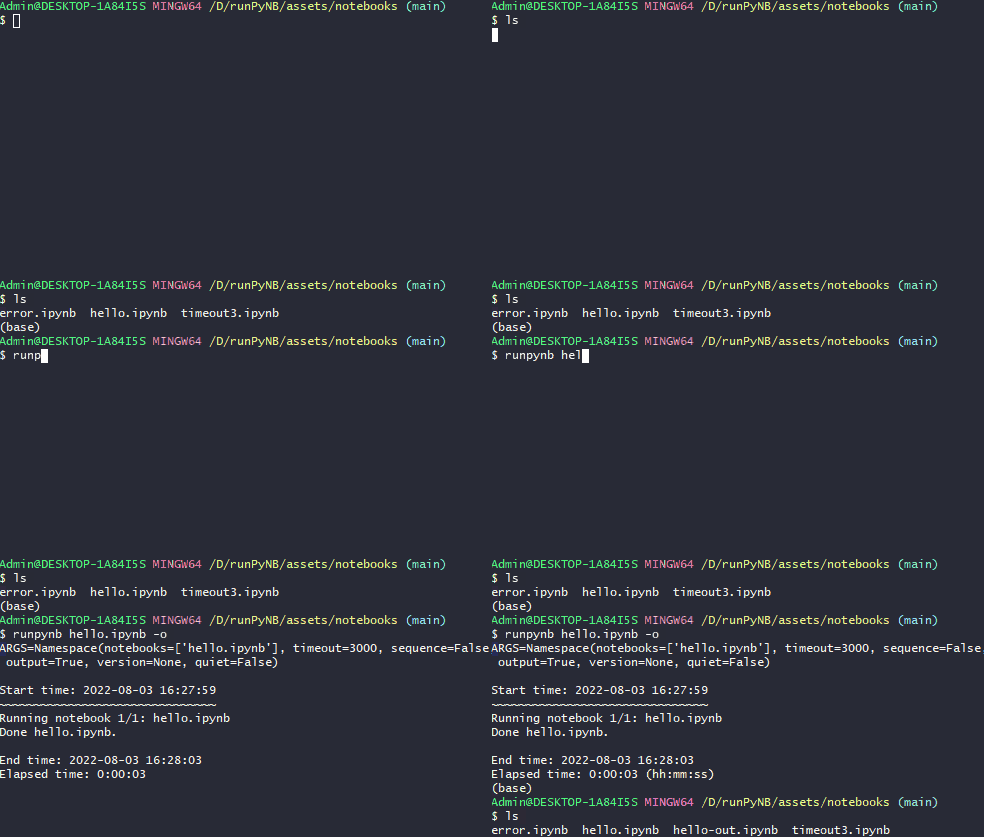
runpynb <notebook(s)> -o: Save output as separate notebook (-o), instead of overwriting existing notebook(s).$ runpynb hello.ipynb -o
Options
usage: runpynb [-h] [-t TIMEOUT] [-s] [-o] [-v VERSION] [-q] [notebooks ...]

Run (and time) Jupyter notebooks silently in command-line.

positional arguments:
  notebooks             List of Jupyter notebooks (*.ipynb) to be run
                        (default=all notebooks in path).

optional arguments:
  -h, --help            show this help message and exit
  -t TIMEOUT, --timeout TIMEOUT
                        Seconds until a cell in the notebook timesout, which
                        raises a Timeouterror exception (default is 3000=5
                        mins).
  -s, --sequence        Sequence implicit in notebook lists. If error occurs
                        somewhere, stop entire pipeline.
  -o, --output          Save output as a separate notebook with "-out"-suffix
                        (e.g. *-out.ipynb) instead of overwriting existing
                        file.
  -v VERSION, --version VERSION
                        Version of notebook to return (Default=No conversion).
                        Notebook will be converted if necessary.
  -q, --quiet           Be quiet and don't print messages (including run
                        time). Caution: Does not suppress error messages.
Status







This is a lightweight package that wraps around the official Jupyter nbformat and nbconvert modules.
My workflow involves using Jupyter notebooks to clean, and analyze data.
I use this utility to run notebooks silently from the command-line and Makefiles (without converting from .ipynb files to .py files).
Related packages are guoquan/runnb and vinayak-mehta/nbcommands with a planned enhancement nbtime to run Jupyter notebooks from command-line.
Usage with Makefiles
A minimal workflow where get-data.ipynb takes 5000 seconds to prepare data.csv.
And where analyze.ipynb uses data.csv to produce output.png.
.DEFAULT_GOAL := output.png

data.csv: get-data.ipynb
	runpynb $^ -t 5000

output.png: analyze.ipynb data.csv
	runpynb $<
License
This package is licensed under the MIT License.
1 maintainer

Metadata
1 maintainer
Release files for runpynb 0.3.0
For a detailed explanation of source distributions (sdists) and built distributions (wheels), please see the package formats documentation.
Source distribution (sdist)
| File | Size | Uploaded | Provenance | Actions |
|---|---|---|---|---|
| runpynb-0.3.0.tar.gz | 6.2 kB | Without provenance | Details for runpynb-0.3.0.tar.gz |
Release files / runpynb-0.3.0.tar.gz
| Download URL | runpynb-0.3.0.tar.gz |
|---|---|
| Size | 6.2 kB |
| Tags | Source |
|
SHA-256 checksum How to use checksums |
e6cc75b365acbac68949c53b23ccaf7ee588299a90c418d925d260ed8368031a
|
|
BLAKE2b-256 checksum How to use checksums |
6ccabfe18173e778350e837ef4b2bcdf1c67381e7c93a99e8682a37279d38bfb
|
| Upload date | |
|
Uploaded using Trusted Publishing? What is trusted publishing? |
No |
| Uploaded via |
twine/4.0.2 CPython/3.10.11
|
Security for runpynb 0.3.0
Provenance
Provenance describes where a file came from. On PyPI, provenance is shared via attestations, which provide a verifiable record of the build or publishing details. View details, limitations and caveats.
No provenance found
None of the files in this release were uploaded with provenance metadata.
A note on package security
PyPI is a repository for distributing packages, not a service for auditing them. While third-party security researchers and our staff do their best to detect and remove malicious packages, PyPI cannot guarantee the quality, security or suitability of any given package.
To learn more about protecting yourself from malicious actors, visit our package security documentation.














