
SAVIS: Sentence-Level Attention Visualization for Large Language Models
SAVIS (Sentence-level Attention VISualization) is a Python library for visualizing inter-sentence attention in large language models (LLMs). This tool enhances the interpretability of LLMs by providing an intuitive visualization of how attention is distributed across sentences in generated text.
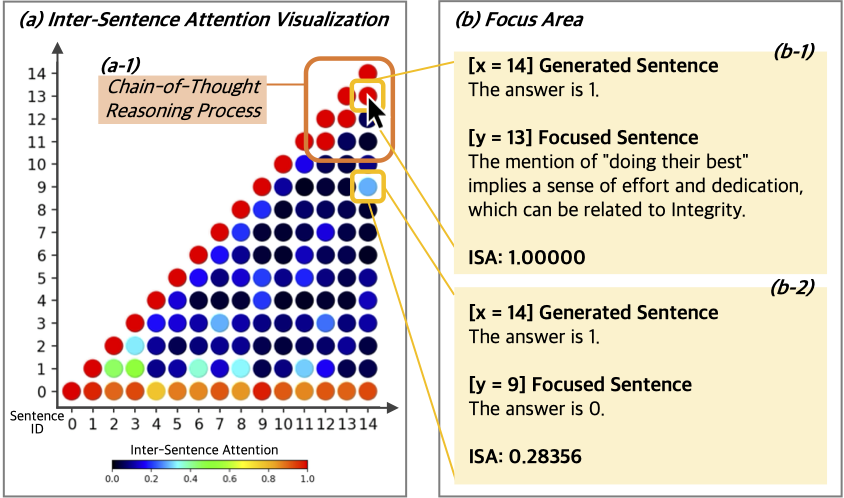
Features
- Inter-sentence attention calculation
- Interactive visualization of attention patterns
- Support for various LLMs through Hugging Face's
transformerslibrary
Installation
pip install savis
Quick Start
from savis import TextGenerator, ISA, ISAVisualization

# Initialize the text generator with your chosen model
generator = TextGenerator("Model name")

# Generate text and get attention data
input_text = "Your input prompt here"
generated_text, attentions, tokenizer, input_ids, outputs = generator.generate_text(input_text)

# Calculate inter-sentence attention
isa = ISA(outputs.sequences[0], attentions, tokenizer)

# Visualize the attention patterns
vis = ISAVisualization(isa.sentence_attention, isa.sentences)
vis.visualize_sentence_attention()
Key Components
TextGenerator: Interfaces with the LLM to generate text and extract attention information.Attention: Manages the underlying LLM and provides methods for obtaining attention data from the model.ISA(Inter-Sentence Attention): Processes raw attention data to compute attention between sentences.ISAVisualization: Creates interactive visualizations of the computed inter-sentence attention.
These components work together to provide a comprehensive pipeline from text generation to attention visualization:
TextGeneratoruses the LLM to generate text based on input prompts.Attentionhandles the interaction with the LLM, extracting detailed attention information.ISAtakes the raw attention data and computes meaningful inter-sentence attention scores.ISAVisualizationtakes these scores and creates interactive visualizations.
License
SAVIS is released under the MIT License. See the LICENSE file for more details.
1 maintainer

Metadata
1 maintainer
Release files for savis 0.4.3
For a detailed explanation of source distributions (sdists) and built distributions (wheels), please see the package formats documentation.
Source distribution (sdist)
| File | Size | Uploaded | Provenance | |
|---|---|---|---|---|
| savis-0.4.3.tar.gz | 4.9 MB | Without provenance | Details |
Built distribution (wheel)
| File | Interpreter | ABI | Platform | Reset |
|---|---|---|---|---|
| savis-0.4.3-py3-none-any.whl | Python 3 | none | any | Details |
Total release size: 4.9 MB
Release files / savis-0.4.3.tar.gz
| Download URL | savis-0.4.3.tar.gz |
|---|---|
| Size | 4.9 MB |
| Tags | Source |
|
SHA-256 checksum How to use checksums |
4a0f8ef6fd59db83d781f11524e0726f4ead38ba901c49b699a1ce19efd27bb6
|
|
BLAKE2b-256 checksum How to use checksums |
7938df1fce6641e4e7826cb3ed09d555d2bef7cf5f24e01065eb3d7e862b697d
|
| Upload date | |
|
Uploaded using Trusted Publishing? What is trusted publishing? |
No |
| Uploaded via |
twine/6.0.1 CPython/3.10.13
|
Release files / savis-0.4.3-py3-none-any.whl
| Download URL | savis-0.4.3-py3-none-any.whl |
|---|---|
| Size | 12.2 kB |
| Tags | Python 3 |
|
SHA-256 checksum How to use checksums |
f19e432aa2b9972d93a50d1fae9bc14c6f3e55aad813142705eb0aae4c55cd02
|
|
BLAKE2b-256 checksum How to use checksums |
cb2ec9b1af7e7dfdfa5a393f81440b02f86efa05918556df405e8192e397208b
|
| Upload date | |
|
Uploaded using Trusted Publishing? What is trusted publishing? |
No |
| Uploaded via |
twine/6.0.1 CPython/3.10.13
|
Security for savis 0.4.3
Provenance
Provenance describes where a file came from. On PyPI, provenance is shared via attestations, which provide a verifiable record of the build or publishing details. View details, limitations and caveats.
No provenance found
None of the files in this release were uploaded with provenance metadata.
A note on package security
PyPI is a repository for distributing packages, not a service for auditing them. While third-party security researchers and our staff do their best to detect and remove malicious packages, PyPI cannot guarantee the quality, security or suitability of any given package.














