
A Scheil-Gulliver simulation tool using pycalphad.

import matplotlib.pyplot as plt
from pycalphad import Database, variables as v
from scheil import simulate_scheil_solidification

# setup the simulation parameters
dbf = Database('alzn_mey.tdb')
comps = ['AL', 'ZN', 'VA']
phases = sorted(dbf.phases.keys())

liquid_phase_name = 'LIQUID'
initial_composition = {v.X('ZN'): 0.3}
start_temperature = 850

# perform the simulation
sol_res = simulate_scheil_solidification(dbf, comps, phases, initial_composition, start_temperature, step_temperature=1.0)

# plot the result
for phase_name, amounts in sol_res.cum_phase_amounts.items():
    plt.plot(sol_res.temperatures, amounts, label=phase_name)
plt.plot(sol_res.temperatures, sol_res.fraction_liquid, label='LIQUID')
plt.ylabel('Phase Fraction')
plt.xlabel('Temperature (K)')
plt.title('Al-30Zn Scheil simulation, phase fractions')
plt.legend(loc='best')
plt.show()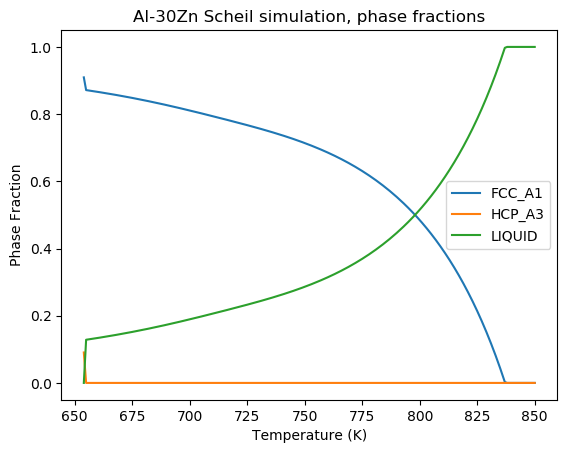
Installation
pip (recommended)
scheil is suggested to be installed from PyPI.
pip install scheilAnaconda
conda install -c conda-forge scheilDevelopment versions
To install an editable development version with pip:
git clone https://github.com/pycalphad/scheil.git
cd scheil
pip install --editable .[dev]
Upgrading scheil later requires you to run git pull in this directory.
Run the automated tests using
pytestTheory
Uses classic Scheil-Gulliver theory (see G.H. Gulliver, J. Inst. Met. 9 (1913) 120–157 and Scheil, Zeitschrift Für Met. 34 (1942) 70–72.) with assumptions of
Perfect mixing in the liquid
Local equilibrium between solid and liquid
No diffusion in the solid
Getting Help
For help on installing and using scheil, please join the pycalphad/pycalphad Gitter room.
Bugs and software issues should be reported on GitHub.
License
scheil is MIT licensed. See LICENSE.
Citing
If you use the scheil package in your work, please cite the relevant version.
The following DOI, doi:10.5281/zenodo.3630656, will link to the latest released version of the code on Zenodo where you can cite the specific version that you haved used. For example, version 0.1.2 can be cited as:
Bocklund, Brandon, Bobbio, Lourdes D., Otis, Richard A., Beese, Allison M., & Liu, Zi-Kui. (2020, January 29). pycalphad-scheil: 0.1.2 (Version 0.1.2). Zenodo. http://doi.org/10.5281/zenodo.3630657
@software{bocklund_brandon_2020_3630657,
  author       = {Bocklund, Brandon and
                  Bobbio, Lourdes D. and
                  Otis, Richard A. and
                  Beese, Allison M. and
                  Liu, Zi-Kui},
  title        = {pycalphad-scheil: 0.1.2},
  month        = jan,
  year         = 2020,
  publisher    = {Zenodo},
  version      = {0.1.2},
  doi          = {10.5281/zenodo.3630657},
  url          = {https://doi.org/10.5281/zenodo.3630657}
}
1 maintainer

Metadata
1 maintainer
Release files for scheil 0.3.0
For a detailed explanation of source distributions (sdists) and built distributions (wheels), please see the package formats documentation.
Source distribution (sdist)
| File | Size | Uploaded | Provenance | |
|---|---|---|---|---|
| scheil-0.3.0.tar.gz | 68.1 kB | Without provenance | Details |
Built distribution (wheel)
| File | Interpreter | ABI | Platform | Reset |
|---|---|---|---|---|
| scheil-0.3.0-py3-none-any.whl | Python 3 | none | any | Details |
Total release size: 84.8 kB
Release files / scheil-0.3.0.tar.gz
| Download URL | scheil-0.3.0.tar.gz |
|---|---|
| Size | 68.1 kB |
| Tags | Source |
|
SHA-256 checksum How to use checksums |
f029d19f22c073f47440189c335f4fd9dd3fc6eb8a00acf726d80d7b9da14e1a
|
|
BLAKE2b-256 checksum How to use checksums |
5178c79abf878bed9ae07b935a883d4bd00d81fdc5e54bb547a8b073c5654d81
|
| Upload date | |
|
Uploaded using Trusted Publishing? What is trusted publishing? |
No |
| Uploaded via |
twine/6.1.0 CPython/3.13.7
|
Release files / scheil-0.3.0-py3-none-any.whl
| Download URL | scheil-0.3.0-py3-none-any.whl |
|---|---|
| Size | 16.7 kB |
| Tags | Python 3 |
|
SHA-256 checksum How to use checksums |
f4d086f35d863147b534941077bbd8931bb82bf5b04306bc2a68d601737a4fd5
|
|
BLAKE2b-256 checksum How to use checksums |
a6b70ab68bc15b9fa18627bbe02d8d03312e523e6f0d0034c1aa91410d4f90d2
|
| Upload date | |
|
Uploaded using Trusted Publishing? What is trusted publishing? |
No |
| Uploaded via |
twine/6.1.0 CPython/3.13.7
|
Security for scheil 0.3.0
Provenance
Provenance describes where a file came from. On PyPI, provenance is shared via attestations, which provide a verifiable record of the build or publishing details. View details, limitations and caveats.
No provenance found
None of the files in this release were uploaded with provenance metadata.
A note on package security
PyPI is a repository for distributing packages, not a service for auditing them. While third-party security researchers and our staff do their best to detect and remove malicious packages, PyPI cannot guarantee the quality, security or suitability of any given package.
To learn more about protecting yourself from malicious actors, visit our package security documentation.














