
Trigger ATF Test / Suite from another instance
ServiceNow - Start and Schedule Multiple ATF test runners in browser
What does servicenow-test-runner-scheduler do?
- Start
NUM_INSTANCE(default: 6) instances of the client test runner concurrently - After
RESTART_INTERVAL // NUM_INSTANCE(default:7200 // 6 = 1200) seconds, the first runner will be restarted, and after another 1200 seconds, the seconds runner will be restarted, and so on. - After all the runner have been restarted once, all the 6 runners will be scheduled to restarted every
RESTART_INTERVAL(default:7200) seconds.
Installation
Install python3 and chromedriver first.
pipx
This is the recommended installation method.
$ pipx install servicenow-test-runner-scheduler
pip
$ pip install servicenow-test-runner-scheduler
Configure
-
Create a
.envfile and put it in the same directory as thetrigger_test_zipapp.pyzfile. -
Edit the
.envfiles, so it looks like this:# required fields instance=https://dev105825.service-now.com userid=admin password=admin_pw # optional fields, the value shown here are the default values RESTART_INTERVAL=7200 TOLERANCE=300 NUM_INSTANCE=6 CHECKING_INTERVAL=300
Usage
$ snowtrs --help # or servicenow-test-runner-scheduler --help

Loading settings for:
usage: servicenow-test-runner-scheduler [-h] [-V] [-n] [-s]

ServiceNow - Start ATF test runner in browser

options:
  -h, --help            show this help message and exit
  -V, --version         show program's version number and exit
  -n, --dry-run         Dry run (default: False)
  -s, --scheduled-runner
                        Start a scheduled runner (default: Client test runner) (default: False)
  --headless            Run browser instances in headless mode (default: False)
Demo
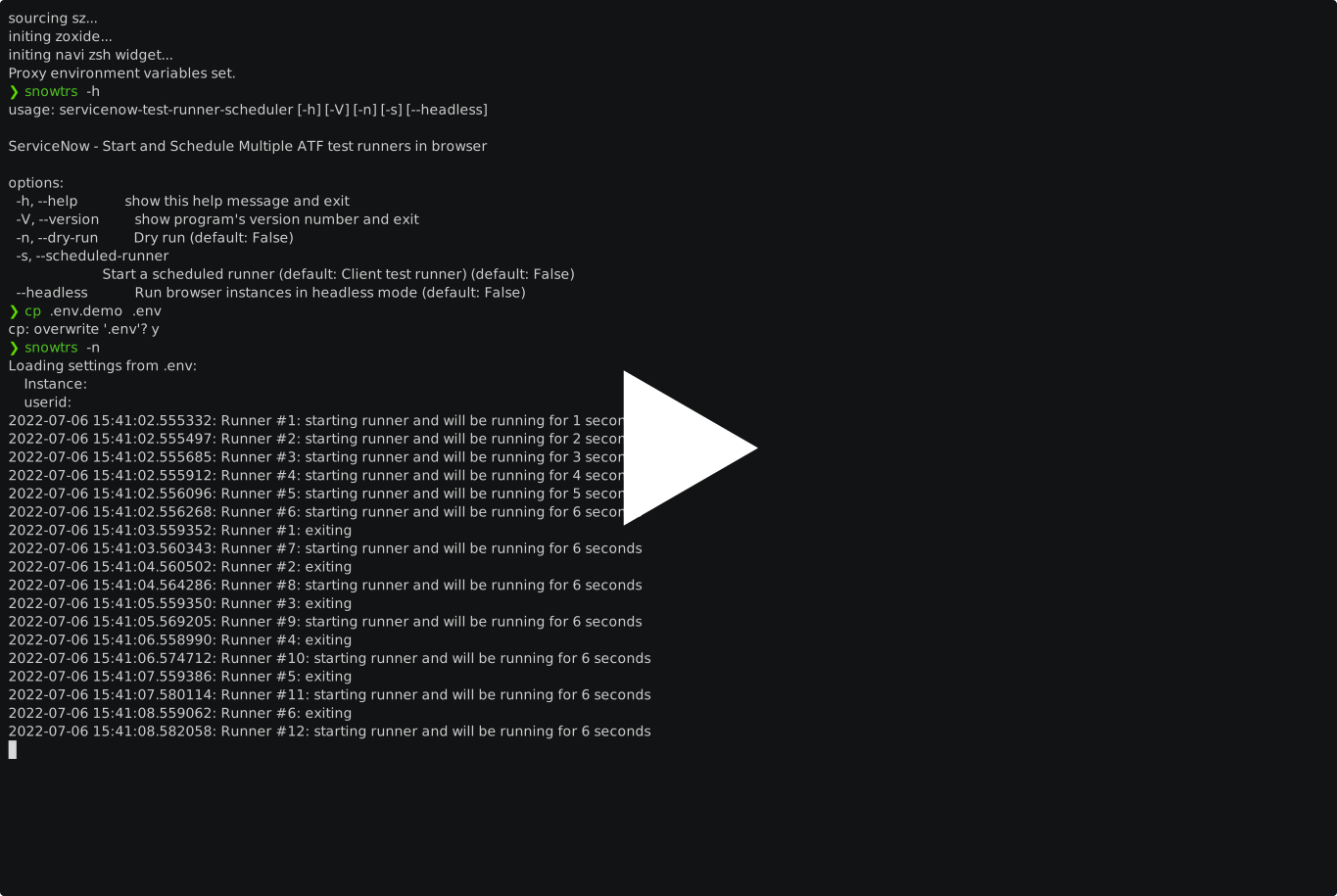
Configuration of this demo:
# .env
RESTART_INTERVAL=6
TOLERANCE=1
NUM_INSTANCE=6
CHECKING_INTERVAL=1
Run servicenow-test-runner-scheduler --dryrun.

1 maintainer

Metadata
1 maintainer
Release files for servicenow-test-runner-scheduler 0.1.4
For a detailed explanation of source distributions (sdists) and built distributions (wheels), please see the package formats documentation.
Source distribution (sdist)
| File | Size | Uploaded | Provenance | Actions |
|---|---|---|---|---|
| servicenow-test-runner-scheduler-0.1.4.tar.gz | 5.9 kB | Without provenance | Details for servicenow-test-runner-scheduler-0.1.4.tar.gz |
Built distribution (wheel)
| File | Interpreter | ABI | Platform | Actions Reset |
|---|---|---|---|---|
| servicenow_test_runner_scheduler-0.1.4-py3-none-any.whl | Python 3 | none | any | Details for servicenow_test_runner_scheduler-0.1.4-py3-none-any.whl |
Total release size: 12.9 kB
Release files / servicenow-test-runner-scheduler-0.1.4.tar.gz
| Download URL | servicenow-test-runner-scheduler-0.1.4.tar.gz |
|---|---|
| Size | 5.9 kB |
| Tags | Source |
|
SHA-256 checksum How to use checksums |
6ece5f7db0703fbdc7d4f315a8aede6b72267a1dc9be2748e5f13f4ae33734b2
|
|
BLAKE2b-256 checksum How to use checksums |
cb59f956b97717eb94bd751b1cc1496cafc76ac6858af1381f988f74fd1d5bf1
|
| Upload date | |
|
Uploaded using Trusted Publishing? What is trusted publishing? |
No |
| Uploaded via |
poetry/1.2.0b2 CPython/3.10.4 Darwin/21.5.0
|
Release files / servicenow_test_runner_scheduler-0.1.4-py3-none-any.whl
| Download URL | servicenow_test_runner_scheduler-0.1.4-py3-none-any.whl |
|---|---|
| Size | 6.9 kB |
| Tags | Python 3 |
|
SHA-256 checksum How to use checksums |
80992a081ecd2f8db70e86aa378d2d87634f4dd08eef143f2a9cfaf7fd1e7ffe
|
|
BLAKE2b-256 checksum How to use checksums |
c17a2073549c3a06882f886d235edd96693f35f399be85147b92b48ed79336f1
|
| Upload date | |
|
Uploaded using Trusted Publishing? What is trusted publishing? |
No |
| Uploaded via |
poetry/1.2.0b2 CPython/3.10.4 Darwin/21.5.0
|
Security for servicenow-test-runner-scheduler 0.1.4
Provenance
Provenance describes where a file came from. On PyPI, provenance is shared via attestations, which provide a verifiable record of the build or publishing details. View details, limitations and caveats.
No provenance found
None of the files in this release were uploaded with provenance metadata.
A note on package security
PyPI is a repository for distributing packages, not a service for auditing them. While third-party security researchers and our staff do their best to detect and remove malicious packages, PyPI cannot guarantee the quality, security or suitability of any given package.
To learn more about protecting yourself from malicious actors, visit our package security documentation.














