
Scikit-Learn Compiled Trees


Installation
Released under the MIT License.
pip install sklearn-compiledtreesRationale
In some use cases, predicting given a model is in the hot-path, so speeding up decision tree evaluation is very useful.
An effective way of speeding up evaluation of decision trees can be to generate code representing the evaluation of the tree, compile that to optimized object code, and dynamically load that file via dlopen/dlsym or equivalent.
See https://courses.cs.washington.edu/courses/cse501/10au/compile-machlearn.pdf for a detailed discussion, and http://tullo.ch/articles/decision-tree-evaluation/ for a more pedagogical explanation and more benchmarks in C++.
This package implements compiled decision tree evaluation for the simple case of a single-output regression tree or ensemble.
It has been tested to work on both OS X and Linux. We do not currently support Windows platforms for compiled evaluation, although this should not be a signficant amount of work.
Usage
import compiledtrees
import sklearn.ensemble

X_train, y_train, X_test, y_test = ...

clf = ensemble.GradientBoostingRegressor()
clf.fit(X_train, y_train)

compiled_predictor = compiledtrees.CompiledRegressionPredictor(clf)
predictions = compiled_predictor.predict(X_test)
Benchmarks
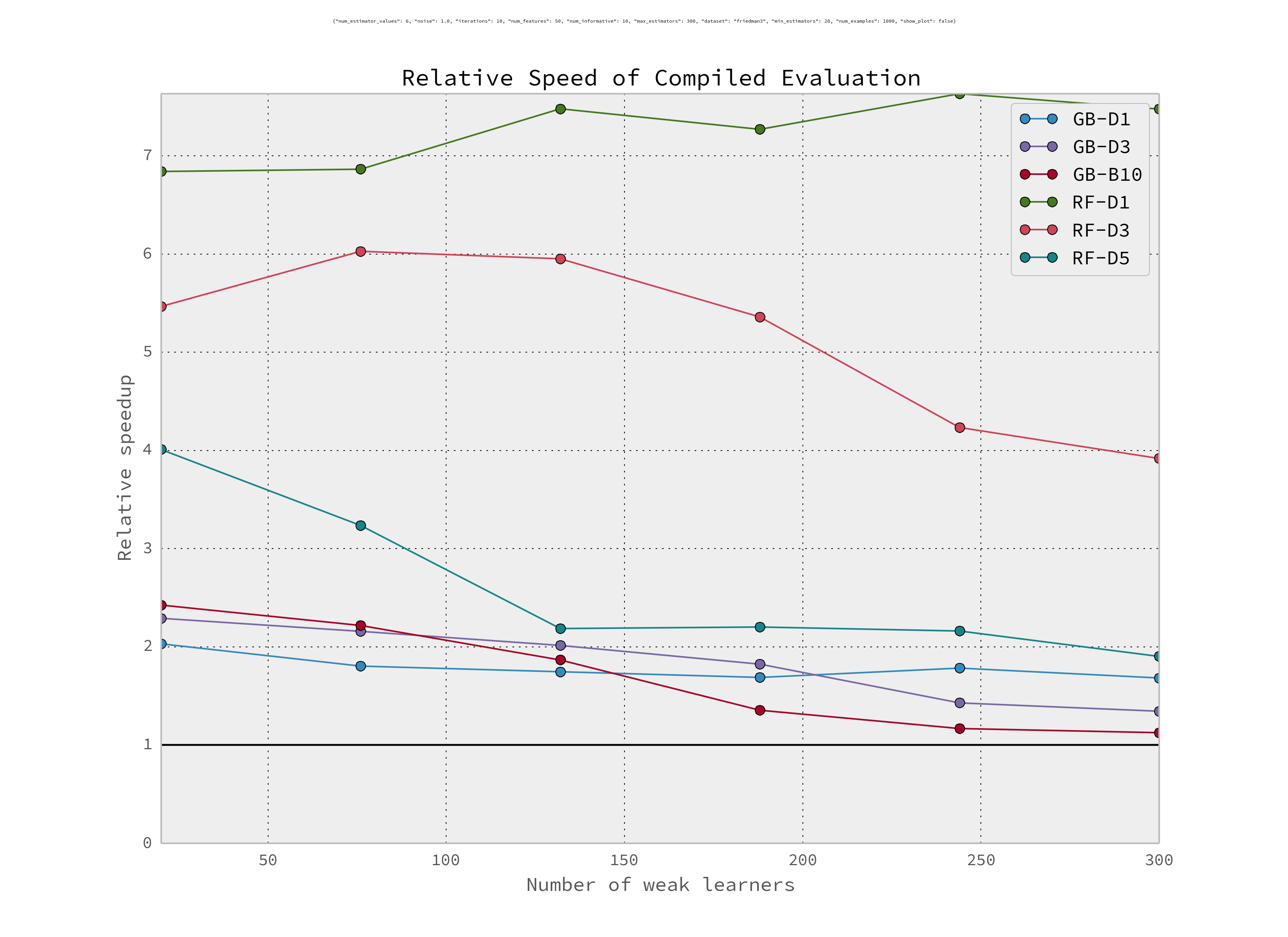
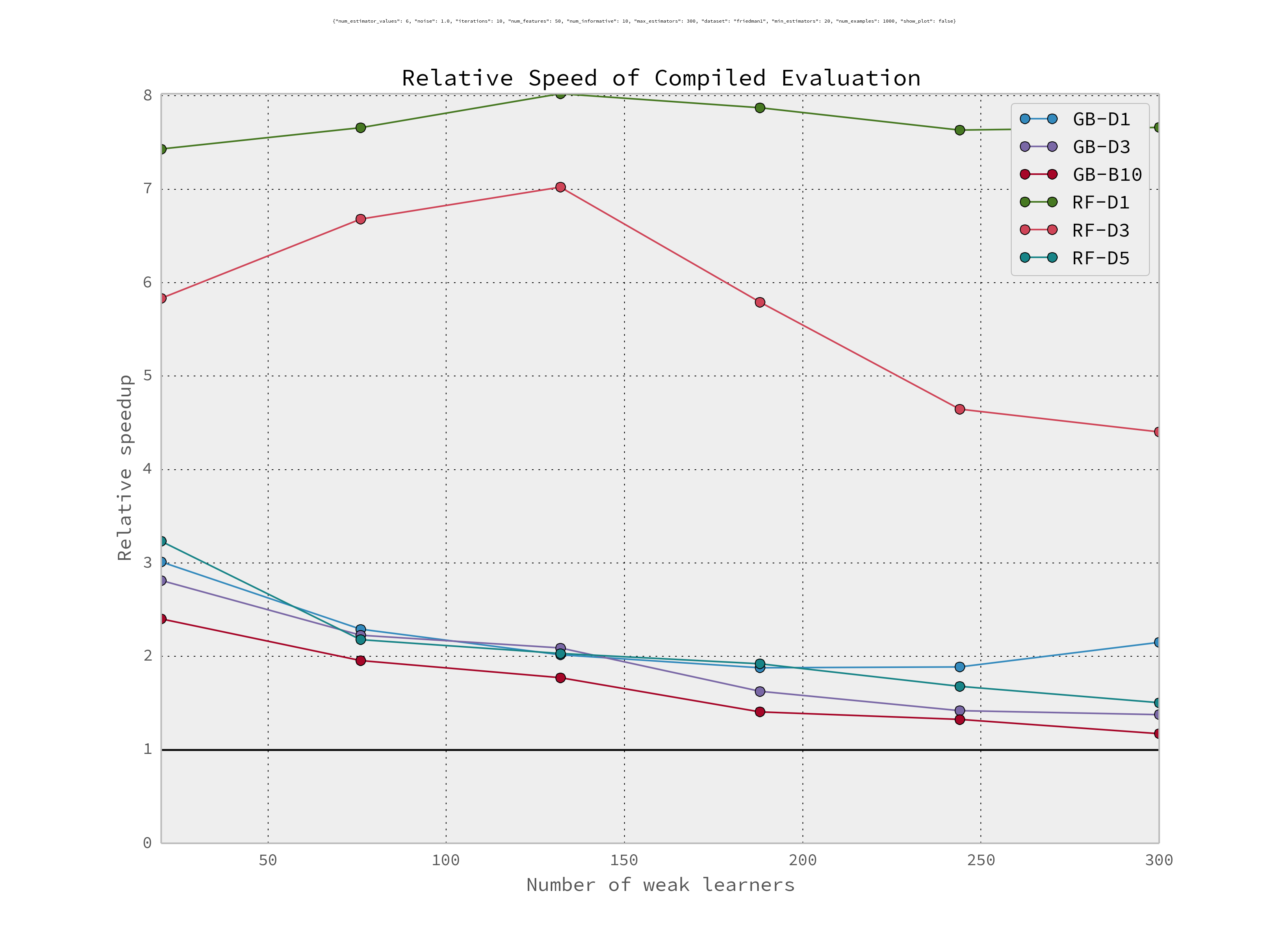
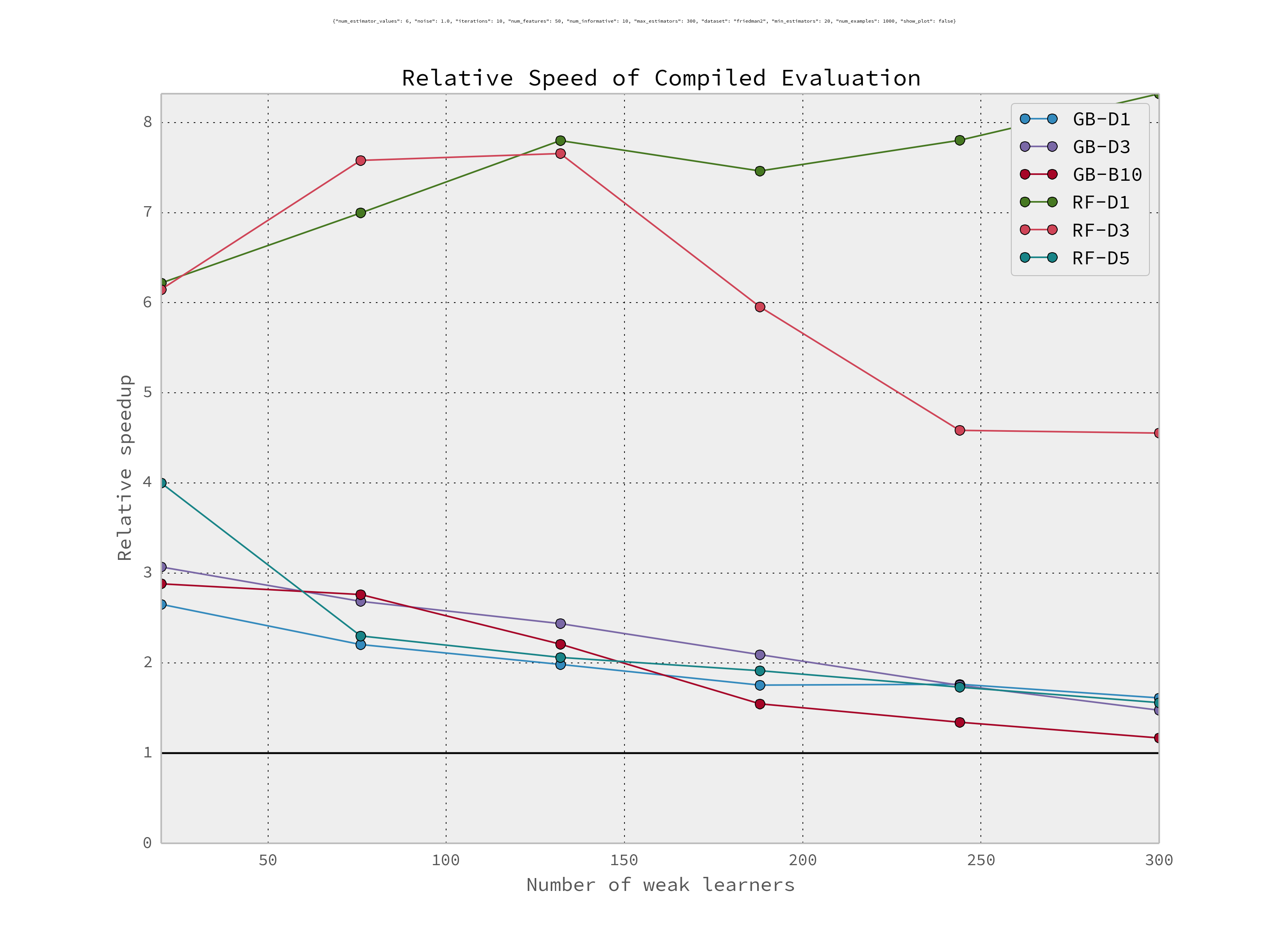
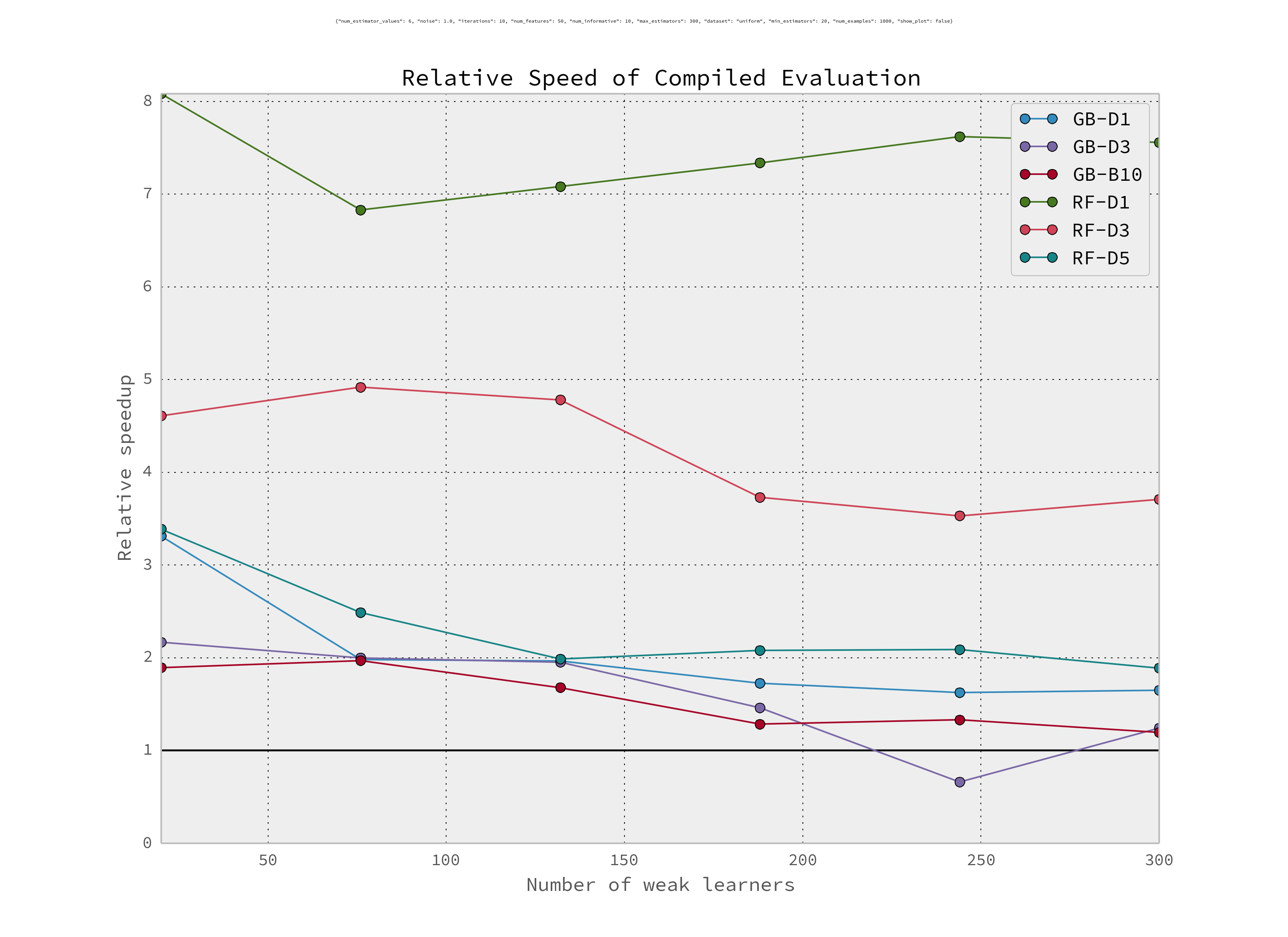
For random forests, we see 5x to 8x speedup in evaluation. For gradient boosted ensembles, it’s between a 1.5x and 3x speedup in evaluation. This is due to the fact that gradient boosted trees already have an optimized prediction implementation.
There is a benchmark script attached that allows us to examine the performance of evaluation across a range of ensemble configurations and datasets.
In the graphs attached, GB is Gradient Boosted, RF is Random Forest, D1, etc correspond to setting max-depth=1, and B10 corresponds to setting max_leaf_nodes=10.
Graphs
for dataset in friedman1 friedman2 friedman3 uniform hastie; do
    python ../benchmarks/bench_compiled_tree.py \
        --iterations=10 \
        --num_examples=1000 \
        --num_features=50 \
        --dataset=$dataset \
        --max_estimators=300 \
        --num_estimator_values=6
done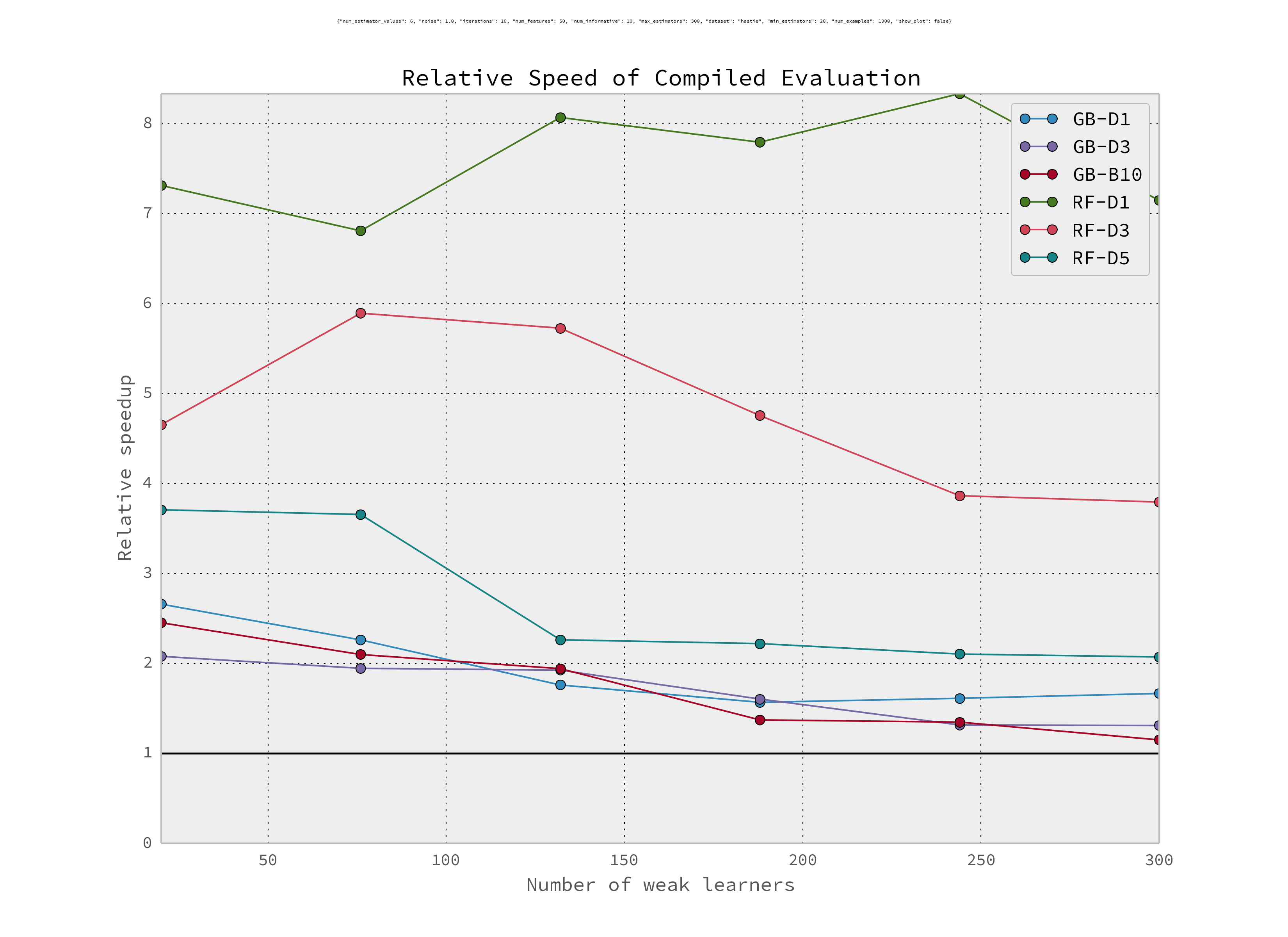
1 maintainer

Metadata
1 maintainer
Release files for sklearn-compiledtrees 1.2
For a detailed explanation of source distributions (sdists) and built distributions (wheels), please see the package formats documentation.
Source distribution (sdist)
| File | Size | Uploaded | Provenance | |
|---|---|---|---|---|
| sklearn-compiledtrees-1.2.tar.gz | 46.7 kB | Without provenance | Details |
Built distribution (wheel)
| File | Interpreter | ABI | Platform | Reset |
|---|---|---|---|---|
| sklearn-compiledtrees-1.2.macosx-10.9-x86_64.tar.gz | Details |
Total release size: 76.8 kB
Release files / sklearn-compiledtrees-1.2.tar.gz
| Download URL | sklearn-compiledtrees-1.2.tar.gz |
|---|---|
| Size | 46.7 kB |
| Tags | Source |
|
SHA-256 checksum How to use checksums |
c35d02bd2963ac3c78da5a8c4d8e17fb59630f4301fbd7f3d8fd88054b5d0f5e
|
|
BLAKE2b-256 checksum How to use checksums |
fa18a473b0d5bdd7d2fc015fc6a121a17a91d2b97f1ff39b308bbb128a8e6921
|
| Upload date | |
|
Uploaded using Trusted Publishing? What is trusted publishing? |
No |
Release files / sklearn-compiledtrees-1.2.macosx-10.9-x86_64.tar.gz
| Download URL | sklearn-compiledtrees-1.2.macosx-10.9-x86_64.tar.gz |
|---|---|
| Size | 30.1 kB |
| Tags | Source |
|
SHA-256 checksum How to use checksums |
a09a478e46f616f125f8d12cd3c85524df1727bbfee1dd6a6e95b87941f4d06f
|
|
BLAKE2b-256 checksum How to use checksums |
4071777580818558cbccac4394890ee785b20011aa1915373b48e948dd81022c
|
| Upload date | |
|
Uploaded using Trusted Publishing? What is trusted publishing? |
No |
Security for sklearn-compiledtrees 1.2
Provenance
Provenance describes where a file came from. On PyPI, provenance is shared via attestations, which provide a verifiable record of the build or publishing details. View details, limitations and caveats.
No provenance found
None of the files in this release were uploaded with provenance metadata.
A note on package security
PyPI is a repository for distributing packages, not a service for auditing them. While third-party security researchers and our staff do their best to detect and remove malicious packages, PyPI cannot guarantee the quality, security or suitability of any given package.
To learn more about protecting yourself from malicious actors, visit our package security documentation.














