
snifter
Listen to and inspect AWS SNS topic data!
Because SNS data is ephemeral, we need to make a place to receive and store the data if we want to inspect it. While you can subscribe your email address, it’s not very handy to do so (SMS is obviously not better). A clean (if slightly over-complex) method for doing this is to create a temporary SQS queue, then subscribe the queue to the SNS topic you want to inspect, and then watch that queue.
Snifter does all that in a single command. The queue is build and torn down for you, and it will endlessly listen to that queue, including dropping into an interactive debug session that will let you inspect the payload in detail.
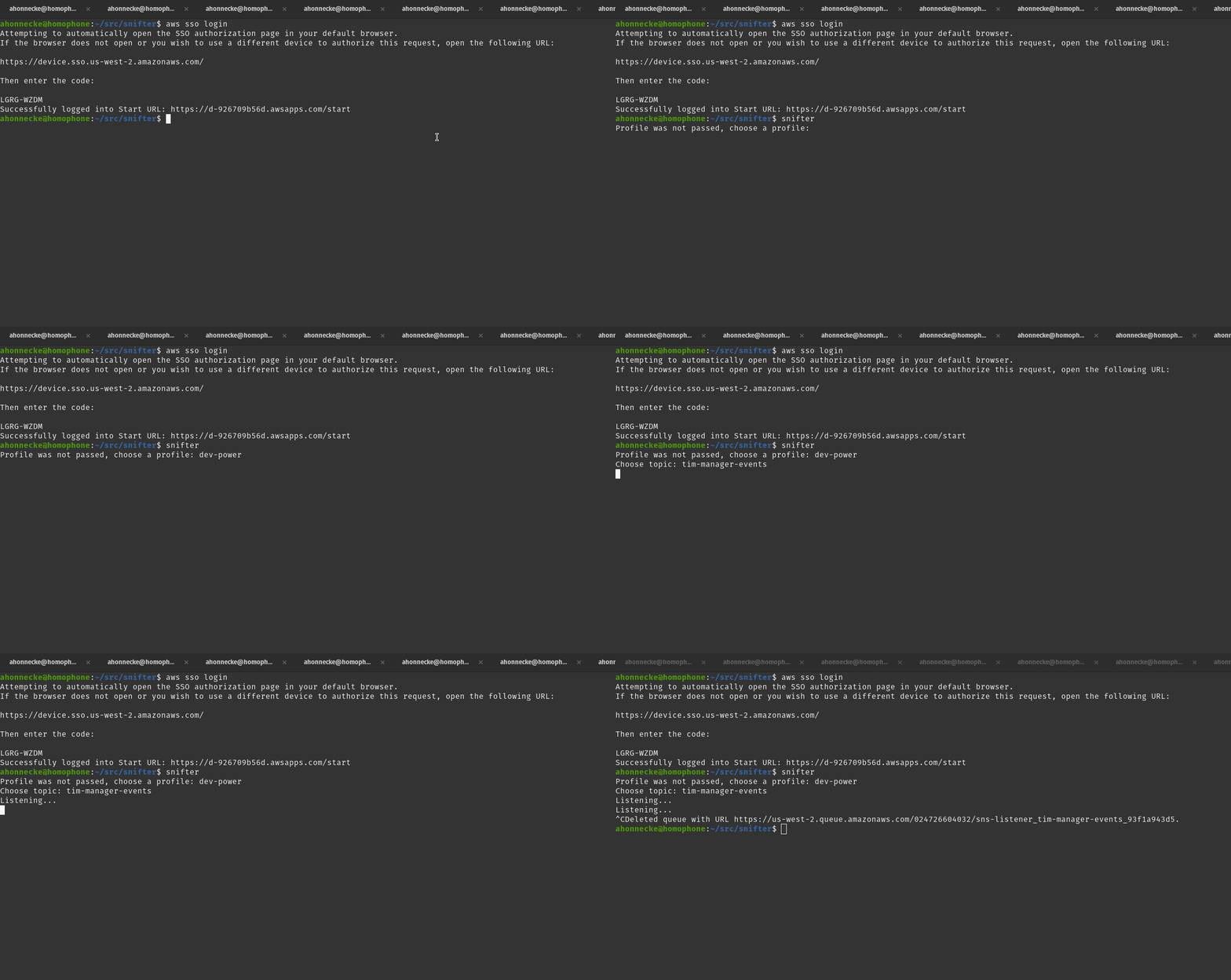
Provide a profile and a topic, the queue will be torn down when it catches Ctrl+c
Basic Usage
$ snifter --profile=dev-power --topic=tim-manager-events
Listening...
Listening...
^CListening...
Deleted queue with URL https://us-west-2.queue.amazonaws.com/024726604032/sns-listener_tim-manager-events_88fc71e98a.
Debug Usage
Providing the –debug flag will cause you to drop into a debugger when something is popped from the queue, PDB behavior applies. The payload of the SNS message (‘Message’) is assigned a namespace (‘m’). This means that you get tab completion on the dynamic keys in your message payload.
Help
$ snifter --help
usage: snifter [-h] [-p PROFILE] [-d] [-t TOPIC]

Listen to an SNS topic

optional arguments:
  -h, --help            show this help message and exit
  -p PROFILE, --profile PROFILE
                        AWS profile name
  -d, --debug           Drop into debugger to inspect message
  -t TOPIC, --topic TOPIC
                        SNS topic name
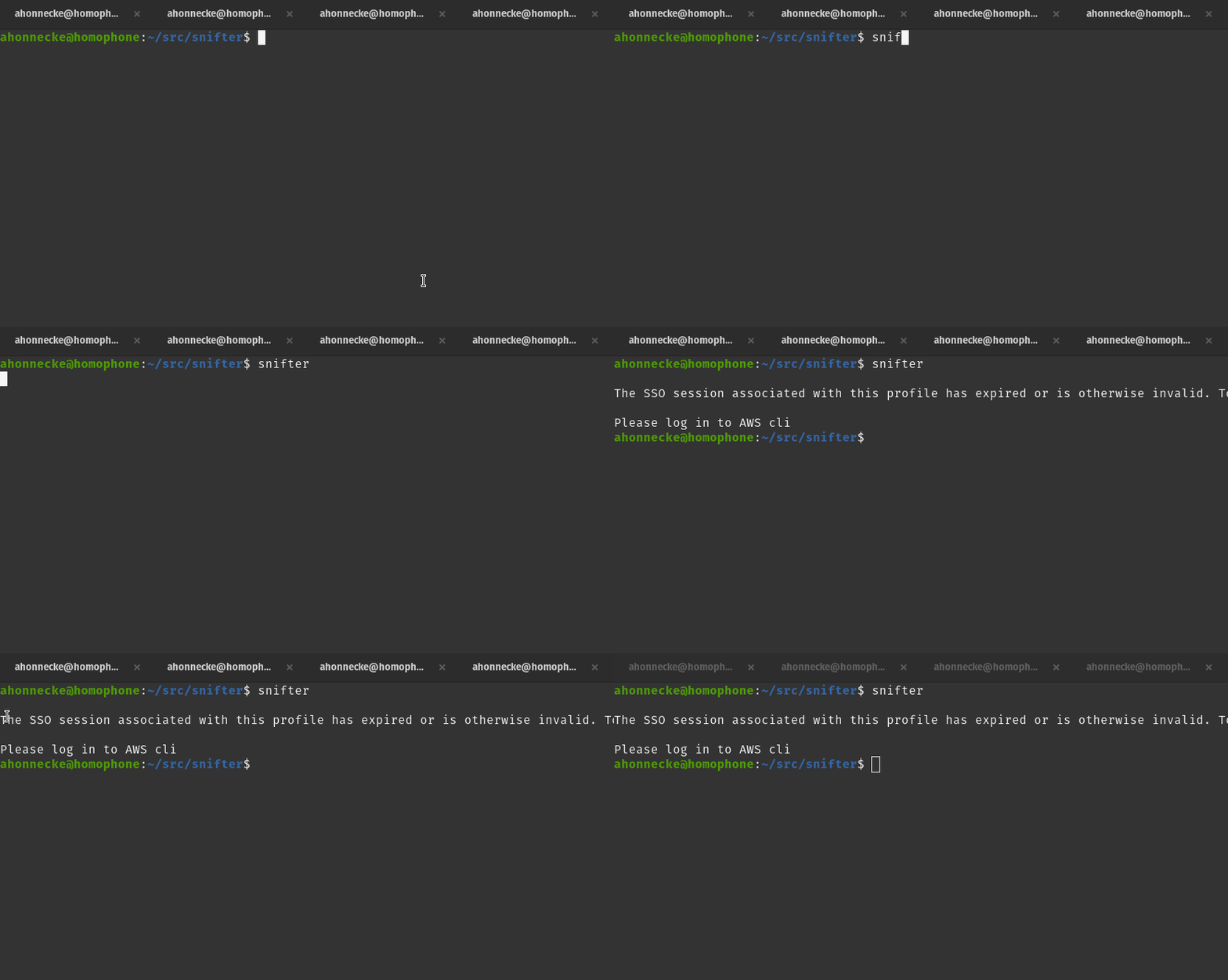
Login
Listening
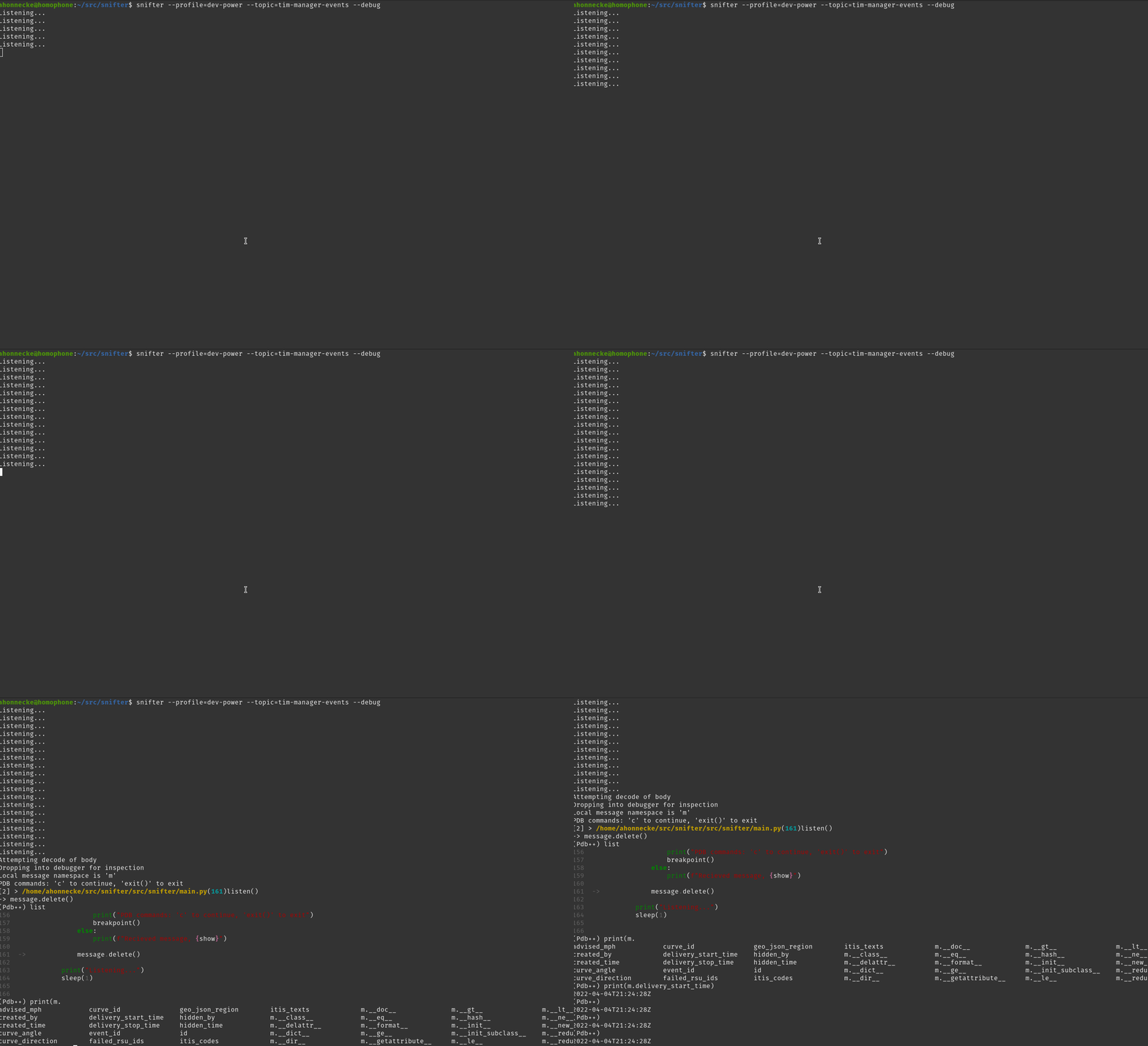
Inspecting (with debug on)
$ snifter --profile=dev-power --topic=tim-manager-events --debug
Listening...
Listening...
Attempting decode of body
Dropping into debugger for inspection
Local message namespace is 'm'
PDB commands: 'c' to continue, 'exit()' to exit
[2] > /home/ahonnecke/src/snifter/src/snifter/main.py(161)listen()
-> message.delete()
(Pdb++) list
156                         print("PDB commands: 'c' to continue, 'exit()' to exit")
157                         breakpoint()
158                     else:
159                         print(f"Recieved message, {show}")
160
161  ->                 message.delete()
162
163                 print("Listening...")
164                 sleep(1)
165
166
(Pdb++) print(m.curve_angle)
None
(Pdb++) print(m.failed_rsu_ids)
['590d0953-444d-4f0a-842d-3ad425394baf', '8bfacac8-9c8f-41e6-b9a3-09641913da8a', 'd4d7cc04-b98a-4ad8-b9b6-801966c84f68', 'e7e259da-926c-4c0e-93cd-a8507bda76b3']1 maintainer

Metadata
1 maintainer
Release files for snifter 0.0.19
For a detailed explanation of source distributions (sdists) and built distributions (wheels), please see the package formats documentation.
Source distribution (sdist)
| File | Size | Uploaded | Provenance | |
|---|---|---|---|---|
| snifter-0.0.19.tar.gz | 22.6 kB | Without provenance | Details |
Built distribution (wheel)
| File | Interpreter | ABI | Platform | Reset |
|---|---|---|---|---|
| snifter-0.0.19-py3-none-any.whl | Python 3 | none | any | Details |
Total release size: 29.5 kB
Release files / snifter-0.0.19.tar.gz
| Download URL | snifter-0.0.19.tar.gz |
|---|---|
| Size | 22.6 kB |
| Tags | Source |
|
SHA-256 checksum How to use checksums |
9a663fb98bacbdcc5f0b532f39c5e2ff3dcbda3000b648cfb08abcb7522c225c
|
|
BLAKE2b-256 checksum How to use checksums |
3883255bc8ed8a02e88b9d9ff12b9b82f1200a75d36d0a27a64394c8f6a47b2a
|
| Upload date | |
|
Uploaded using Trusted Publishing? What is trusted publishing? |
No |
| Uploaded via |
twine/4.0.0 CPython/3.9.7
|
Release files / snifter-0.0.19-py3-none-any.whl
| Download URL | snifter-0.0.19-py3-none-any.whl |
|---|---|
| Size | 6.9 kB |
| Tags | Python 3 |
|
SHA-256 checksum How to use checksums |
b21e5814850a3205b7bb8f02ebe4ba12b1bc9fc427c9202d4fffe51ad282f556
|
|
BLAKE2b-256 checksum How to use checksums |
f9e8fe8eef202adb595d2d9c2d5683f05fff7132719f0dc9b0dae0e6c0b12f78
|
| Upload date | |
|
Uploaded using Trusted Publishing? What is trusted publishing? |
No |
| Uploaded via |
twine/4.0.0 CPython/3.9.7
|
Security for snifter 0.0.19
Provenance
Provenance describes where a file came from. On PyPI, provenance is shared via attestations, which provide a verifiable record of the build or publishing details. View details, limitations and caveats.
No provenance found
None of the files in this release were uploaded with provenance metadata.
A note on package security
PyPI is a repository for distributing packages, not a service for auditing them. While third-party security researchers and our staff do their best to detect and remove malicious packages, PyPI cannot guarantee the quality, security or suitability of any given package.
To learn more about protecting yourself from malicious actors, visit our package security documentation.














