
Simple Sentence Mining



Simple Sentence Mining (ssmtool) is a program for sentence mining, in which sentences with target vocabulary words are collected and added into a spaced repetition system (SRS) for language learning.
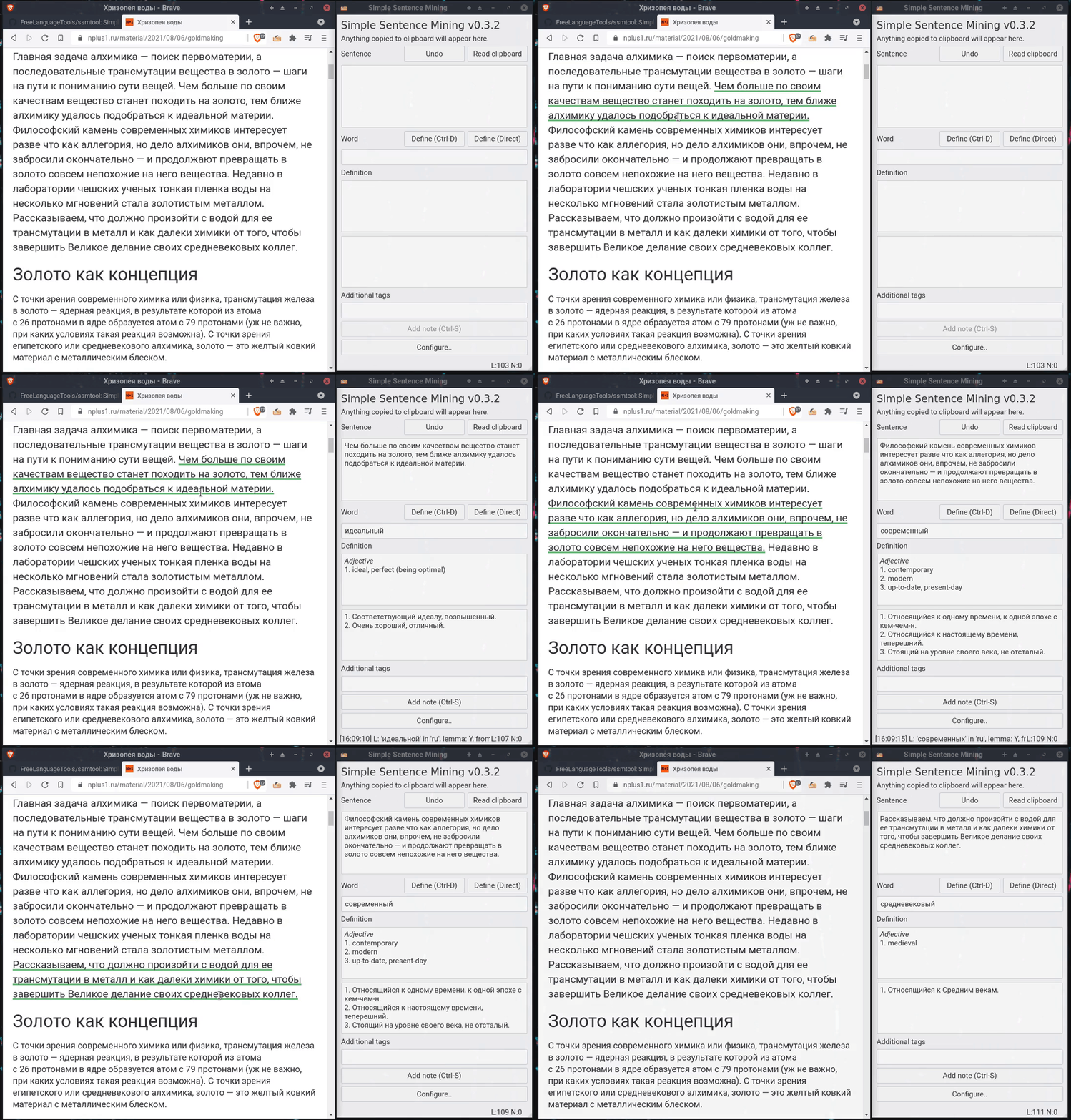
Features
- Double-click lookups from sentences and even faster lookups from integrated applications
- Lemmatization of words on lookup
- Online and local dictionaries in multiple formats
- Frequency lists and pronunciations
- Web reader (epub, fb2, plaintext) allowing one-click lookup
- Kindle highlights to Anki sentence cards (KOReader support is planned too)
For a detailed list of features and language support data, please consult the blog post on my blog
Tutorials
Text tutorial (The text originally on this document has since been moved there.)
Video tutorial (Basic, a bit outdated)
USERS: If you want to install it, go to Releases and from the latest release, download the appropriate file for your operating system.
Linux distro packages

Development
To run from source, simply use pip3 -r requirements.txt and then python3 ssmtool.py.
Alternatively, you can also install a live version to your python package library with pip3 install .
API documentation
If you want to leverage ssmtool to build your own plugins, you can refer to the API Documentation
Feedback
You are welcome to report bugs, suggest features/enhancements, or ask for clarifications by opening a GitHub issue.
Credits
The definitions provided by the program by default come from English Wiktionary, without which this program would never have been created.
Support for Google Translate without the use of an API key comes from the py-googletrans project
App icon is made from icons by Freepik available on Flaticon.
1 maintainer

Metadata
1 maintainer
Release files for ssmtool 0.6.4
For a detailed explanation of source distributions (sdists) and built distributions (wheels), please see the package formats documentation.
Source distribution (sdist)
| File | Size | Uploaded | Provenance | Actions |
|---|---|---|---|---|
| ssmtool-0.6.4.tar.gz | 153.1 kB | Without provenance | Details for ssmtool-0.6.4.tar.gz |
Built distribution (wheel)
| File | Interpreter | ABI | Platform | Actions Reset |
|---|---|---|---|---|
| ssmtool-0.6.4-py3-none-any.whl | Python 3 | none | any | Details for ssmtool-0.6.4-py3-none-any.whl |
Total release size: 309.6 kB
Release files / ssmtool-0.6.4.tar.gz
| Download URL | ssmtool-0.6.4.tar.gz |
|---|---|
| Size | 153.1 kB |
| Tags | Source |
|
SHA-256 checksum How to use checksums |
998db4063e9e8147ac617290db3f8beb4aa7060b7f07bcf9d91c7e0ea6188af8
|
|
BLAKE2b-256 checksum How to use checksums |
596e2e24dd7e5fbef6c32940fa9892175814fe9306f3829f5b830875828fe254
|
| Upload date | |
|
Uploaded using Trusted Publishing? What is trusted publishing? |
No |
| Uploaded via |
twine/3.8.0 pkginfo/1.8.2 readme-renderer/34.0 requests/2.27.1 requests-toolbelt/0.9.1 urllib3/1.26.9 tqdm/4.63.1 importlib-metadata/4.11.3 keyring/23.5.0 rfc3986/2.0.0 colorama/0.4.4 CPython/3.9.12
|
Release files / ssmtool-0.6.4-py3-none-any.whl
| Download URL | ssmtool-0.6.4-py3-none-any.whl |
|---|---|
| Size | 156.4 kB |
| Tags | Python 3 |
|
SHA-256 checksum How to use checksums |
9e8ffad0db7b0f5a31ff650519eb8415010d8b023611fe69b9db49e1df2b2f16
|
|
BLAKE2b-256 checksum How to use checksums |
1fab3efb91e531f04bd5dbf31599ca79b8202d3e7d13403309cfdbdf770110d3
|
| Upload date | |
|
Uploaded using Trusted Publishing? What is trusted publishing? |
No |
| Uploaded via |
twine/3.8.0 pkginfo/1.8.2 readme-renderer/34.0 requests/2.27.1 requests-toolbelt/0.9.1 urllib3/1.26.9 tqdm/4.63.1 importlib-metadata/4.11.3 keyring/23.5.0 rfc3986/2.0.0 colorama/0.4.4 CPython/3.9.12
|
Security for ssmtool 0.6.4
Provenance
Provenance describes where a file came from. On PyPI, provenance is shared via attestations, which provide a verifiable record of the build or publishing details. View details, limitations and caveats.
No provenance found
None of the files in this release were uploaded with provenance metadata.
A note on package security
PyPI is a repository for distributing packages, not a service for auditing them. While third-party security researchers and our staff do their best to detect and remove malicious packages, PyPI cannot guarantee the quality, security or suitability of any given package.
To learn more about protecting yourself from malicious actors, visit our package security documentation.














