
StepMix








For StepMixR, please refer to this repository.
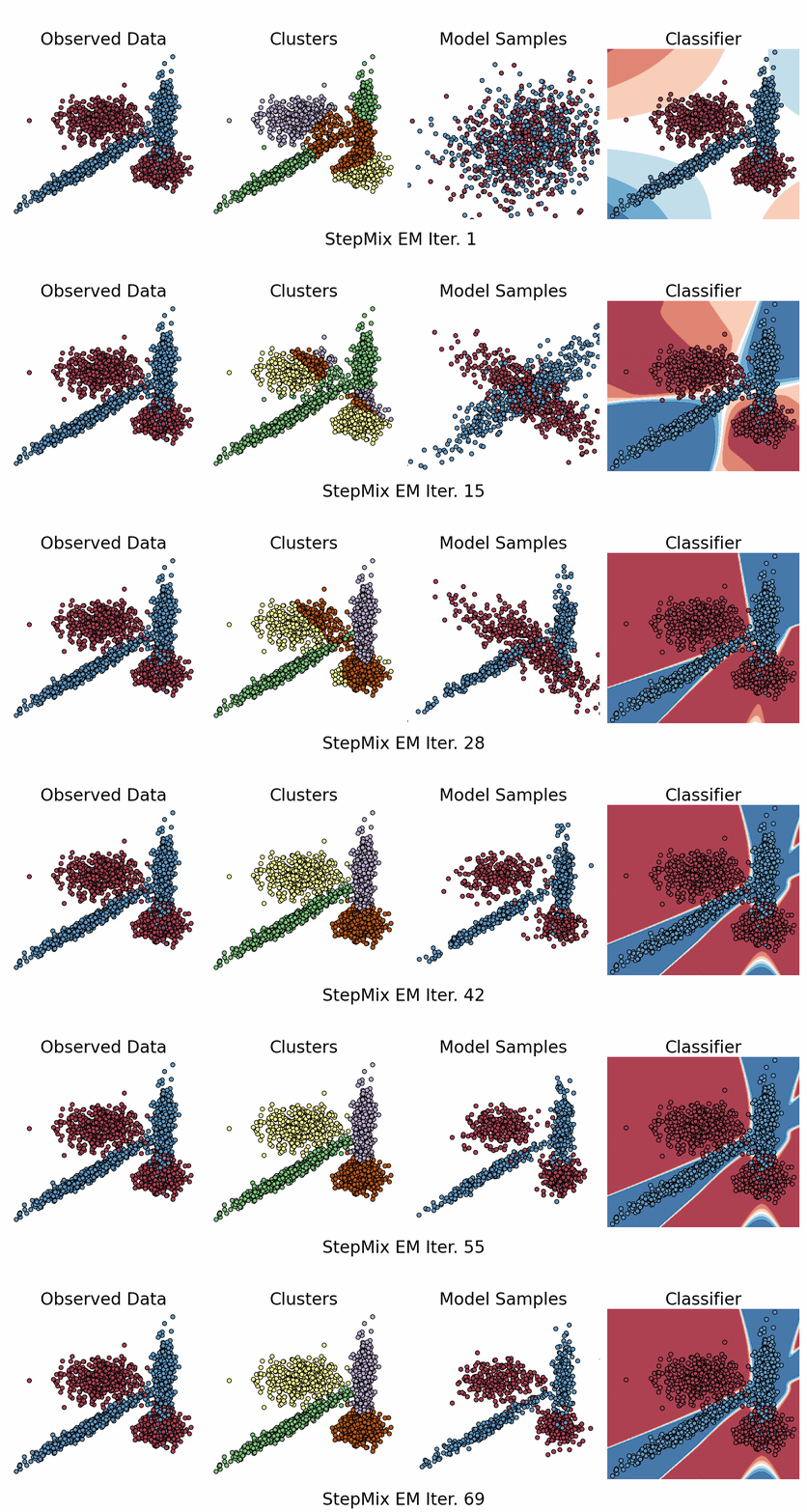
A Python package following the scikit-learn API for generalized mixture modeling. The package supports categorical data (Latent Class Analysis) and continuous data (Gaussian Mixtures/Latent Profile Analysis). StepMix can be used for both clustering and supervised learning.
Additional features include:
- Support for missing values through Full Information Maximum Likelihood (FIML);
- Multiple stepwise Expectation-Maximization (EM) estimation methods based on pseudolikelihood theory;
- Covariates and distal outcomes;
- Parametric and non-parametric bootstrapping.
Reference
If you find StepMix useful, please leave a ⭐ and consider citing our Journal of Statistical Software paper:
@Article{,
  title = {{StepMix}: A {Python} Package for Pseudo-Likelihood
    Estimation of Generalized Mixture Models with External
    Variables},
  author = {Sacha Morin and Robin Legault and F{\'e}lix Lalibert{\'e}
    and Zsuzsa Bakk and Charles-{\'E}douard Gigu{\`e}re and Roxane
    {de la Sablonni{\`e}re} and {\'E}ric Lacourse},
  journal = {Journal of Statistical Software},
  year = {2025},
  volume = {113},
  number = {8},
  pages = {1--39},
  doi = {10.18637/jss.v113.i08},
}
Install
You can install StepMix with pip, preferably in a virtual environment:
pip install stepmix
Quickstart
A StepMix mixture using categorical variables on a preloaded data matrix. StepMix accepts either numpy.arrayor
pandas.DataFrame. Categories should be integer-encoded and 0-indexed.
from stepmix.stepmix import StepMix

# Categorical StepMix Model with 3 latent classes
model = StepMix(n_components=3, measurement="categorical")
model.fit(data)

# Allow missing values
model_nan = StepMix(n_components=3, measurement="categorical_nan")
model_nan.fit(data_nan)
For binary data you can also use measurement="binary" or measurement="binary_nan". For continuous data, you can fit a Gaussian Mixture with diagonal covariances using measurement="continuous" or measurement="continuous_nan".
Set verbose=1 for a detailed output.
Please refer to the StepMix tutorials to learn how to combine continuous and categorical data in the same model.
Tutorials
Detailed tutorials are available in notebooks:
- Generalized Mixture Models with StepMix:
an in-depth look at how mixture models can be defined with StepMix. The tutorial uses the Iris Dataset as an example
and covers:
- Gaussian Mixtures (Latent Profile Analysis);
- Binary Mixtures (LCA);
- Categorical Mixtures (LCA);
- Mixed Categorical and Continuous Mixtures;
- Missing Values through Full-Information Maximum Likelihood.
- Stepwise Estimation with StepMix:
a tutorial demonstrating how to define measurement and structural models. The tutorial discusses:
- LCA models with distal outcomes;
- LCA models with covariates;
- 1-step, 2-step and 3-step estimation;
- Corrections (BCH or ML) and other options for 3-step estimation;
- Putting it All Together: A Complete Model with Missing Values
- Model Selection:
- Selecting the number of components in a mixture model (
n_components) with cross-validation; - Selecting the number of components with the Parametric Bootstrapped Likelihood Ratio Test (BLRT);
- Fit indices: AIC, BIC and other metrics.
- Selecting the number of components in a mixture model (
- Parameters, Bootstrapping and CI:
a tutorial discussing how to:
- Access StepMix parameters;
- Bootstrap StepMix estimators;
- Quickly plot confidence intervals.
- Supervised and Semi-Supervised Learning with StepMix:
- Binary Classification;
- Multiclass Classification;
- Semi-Supervised Learning;
- Cross-Validation.
- Deriving p-values in StepMix: a tutorial demonstrating how to transform SM parameters into conventional regression coefficients and how to derive p-values.
The tutorial covers models with:
- Continuous covariate;
- Binary covariate;
- Categorical covariate;
- Multiple covariates (different distributions);
- Binary distal outcome;
2 maintainers


Metadata
2 maintainers
Release files for stepmix 3.0.0
For a detailed explanation of source distributions (sdists) and built distributions (wheels), please see the package formats documentation.
Source distribution (sdist)
| File | Size | Uploaded | |
|---|---|---|---|
| stepmix-3.0.0.tar.gz | 61.7 kB | Details |
Built distribution (wheel)
| File | Interpreter | ABI | Platform | Reset |
|---|---|---|---|---|
| stepmix-3.0.0-py3-none-any.whl | Python 3 | none | any | Details |
Total release size: 106.2 kB
Release files / stepmix-3.0.0.tar.gz
| Download URL | stepmix-3.0.0.tar.gz |
|---|---|
| Size | 61.7 kB |
| Tags | Source |
|
SHA-256 checksum How to use checksums |
11f878e97d7b00403b75da6539963f5cb67aff5a8eb903c2ae61319367da3398
|
|
BLAKE2b-256 checksum How to use checksums |
69035b5dc796be94d0ec2cb8d420a2ff0f4f0fcd748d1bc408265b20ddd66fd9
|
| Upload date | |
|
Uploaded using Trusted Publishing? What is trusted publishing? |
No |
| Uploaded via |
python-requests/2.33.1
|
Release files / stepmix-3.0.0-py3-none-any.whl
| Download URL | stepmix-3.0.0-py3-none-any.whl |
|---|---|
| Size | 44.5 kB |
| Tags | Python 3 |
|
SHA-256 checksum How to use checksums |
5b44579d3238d70ef516c354a2cd71a4d4d0362f3931d833f87c82b1e9eb969c
|
|
BLAKE2b-256 checksum How to use checksums |
325e1cadb823d7a96cd393a52011f3d749d1ba88ffa64224ad07cc804b6582c9
|
| Upload date | |
|
Uploaded using Trusted Publishing? What is trusted publishing? |
No |
| Uploaded via |
python-requests/2.33.1
|














