












SWIFTGalaxy is an open-source astrophysics module that extends SWIFTSimIO tailored to analyses of particles belonging to individual galaxies simulated with SWIFT. It inherits from and extends the functionality of the SWIFTDataset. It understands the content of halo catalogues (supported: Velociraptor, Caesar, SOAP) and therefore which particles belong to a galaxy or other group of particles, and its integrated properties. The particles occupy a coordinate frame that is enforced to be consistent, such that particles loaded on-the-fly will match e.g. rotations and translations of particles already in memory. Intuitive masking of particle datasets is also enabled. Utilities to make working in cylindrical and spherical coordinate systems more convenient are also provided. Finally, tools to iterate efficiently over multiple galaxies are also provided.
Installation is as simple as pip install swiftgalaxy.
To install optional dependencies to support Velociraptor catalogues use pip install swiftgalaxy[velociraptor]. For Caesar support use:
pip install git+https://github.com/dnarayanan/caesar.gitNo additional dependencies are needed for reading SOAP catalogues. If you want to generate example input files for SOAP, you should install:
pip install git+https://github.com/SWIFTSIM/soap.gitOnce installed, creating a SWIFTGalaxy object to get started with analysis is simple! For instance, for a SWIFT simulation with a SOAP-format halo catalogue (an example - 300 MB - will be automatically downloaded):
from swiftgalaxy import SWIFTGalaxy, SOAP
from swiftgalaxy.demo_data import web_examples

sg = SWIFTGalaxy(
    web_examples.virtual_snapshot,
    SOAP(web_examples.soap, soap_index=0)
)

# access data for particles belonging to the galaxy:
sg.gas.temperatures

# access integrated properties from the halo catalogue
sg.halo_catalogue.spherical_overdensity_200_crit.soradius

# automatically generated spherical/cylindrical coordinates:
sg.gas.spherical_coordinates.r

# consistent coordinate transformations of all particles, even those not loaded yet:
from scipy.spatial.transform import Rotation
sg.rotate(Rotation.from_euler("x", 90, degrees=True))

# compatible with swiftsimio visualisation:
import numpy as np
import unyt as u
from swiftsimio import cosmo_array
from swiftsimio.visualisation import project_gas
import matplotlib.pyplot as plt
img = project_gas(
    sg,
    periodic=False,
    resolution=256,
    region=cosmo_array(
        [-30, 30, -30, 30],
        u.kpc,
        comoving=True,
        scale_factor=sg.metadata.a,
        scale_exponent=1
    ),
)
plt.imsave("eagle6_galaxy.png", np.log10(img.T), origin="lower", cmap="inferno")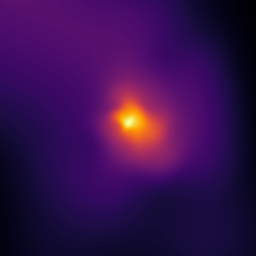
Examples
More usage examples can be found in the examples folder on github.
Citing SWIFTGalaxy
If your use of SWIFTGalaxy leads to a publication, please cite the JOSS paper (ADS listing). You may also cite the swiftgalaxy entry in the ASCL (indexed on ADS). Ideally specify the version used (Zenodo DOI, git commit ID and/or version number) and link to the github repository.
@ARTICLE{2025JOSS...10.9278O,
    author = {{Oman}, Kyle A.},
    title = "{SWIFTGalaxy: a Python package to work with particle groups from SWIFT simulations}",
    journal = {The Journal of Open Source Software},
    keywords = {astronomy, simulations},
    year = 2025,
    month = oct,
    volume = {10},
    number = {114},
    eid = {9278},
    pages = {9278},
    doi = {10.21105/joss.09278},
    adsurl = {https://ui.adsabs.harvard.edu/abs/2025JOSS...10.9278O},
    adsnote = {Provided by the SAO/NASA Astrophysics Data System}
}

@MISC{
    2025ascl.soft05002O,
    author = {{Oman}, Kyle A.},
    title = "{swiftgalaxy}",
    keywords = {Software},
    howpublished = {Astrophysics Source Code Library, record ascl:2505.002},
    year = 2025,
    month = may,
    eid = {ascl:2505.002},
    pages = {ascl:2505.002},
    archivePrefix = {ascl},
    eprint = {2505.002},
    adsurl = {https://ui.adsabs.harvard.edu/abs/2025ascl.soft05002O},
    adsnote = {Provided by the SAO/NASA Astrophysics Data System}
}
Please also consider the citations requested for SWIFTSimIO.
Community
Code contributions are very welcome! A good place to start is the contributing guide and how to set up a development environment.
SWIFTGalaxy is licensed under GPL-3.0 and community members are expected to abide by the code of conduct.
1 maintainer

Metadata
1 maintainer
Release files for swiftgalaxy 3.0.2
For a detailed explanation of source distributions (sdists) and built distributions (wheels), please see the package formats documentation.
Source distribution (sdist)
| File | Size | Uploaded | |
|---|---|---|---|
| swiftgalaxy-3.0.2.tar.gz | 2.0 MB | Details |
Built distribution (wheel)
| File | Interpreter | ABI | Platform | Reset |
|---|---|---|---|---|
| swiftgalaxy-3.0.2-py3-none-any.whl | Python 3 | none | any | Details |
Total release size: 2.1 MB
Release files / swiftgalaxy-3.0.2.tar.gz
| Download URL | swiftgalaxy-3.0.2.tar.gz |
|---|---|
| Size | 2.0 MB |
| Tags | Source |
|
SHA-256 checksum How to use checksums |
9f45914b41b6a1b08d10036f703365356a5c3d458b86fa506d6e7928e372acba
|
|
BLAKE2b-256 checksum How to use checksums |
e80db117ceac1c2bca7860ca9201a1aacd60f55c148aa20aea7a7aa1bcf3d37f
|
| Upload date | |
|
Uploaded using Trusted Publishing? What is trusted publishing? |
Yes |
| Uploaded via |
twine/6.1.0 CPython/3.13.12
|
Provenance
Provenance describes where a file came from. On PyPI, provenance is shared via attestations, which provide a verifiable record of the build or publishing details. View details, limitations and caveats.


PyPI Publish Attestation
PyPI verified that this artifact, at this checksum, originated from the publisher listed below.
Signed by GitHub Actions, verified by PyPI on Jun 5, 2026.
Transparency logRelease files / swiftgalaxy-3.0.2-py3-none-any.whl
| Download URL | swiftgalaxy-3.0.2-py3-none-any.whl |
|---|---|
| Size | 83.4 kB |
| Tags | Python 3 |
|
SHA-256 checksum How to use checksums |
57e8ab4fac45112fec7f26810ef3f56158881fe70ad0e26a8abc73d003356ef4
|
|
BLAKE2b-256 checksum How to use checksums |
9457853536c80aa439aeb7e444e36f40ddb69a2771995eb316d0f4d18a372825
|
| Upload date | |
|
Uploaded using Trusted Publishing? What is trusted publishing? |
Yes |
| Uploaded via |
twine/6.1.0 CPython/3.13.12
|
Provenance
Provenance describes where a file came from. On PyPI, provenance is shared via attestations, which provide a verifiable record of the build or publishing details. View details, limitations and caveats.
PyPI Publish Attestation
PyPI verified that this artifact, at this checksum, originated from the publisher listed below.
Signed by GitHub Actions, verified by PyPI on Jun 5, 2026.
Transparency log













