
Turn private notes into local knowledge packs and synthesized wikis
Verified details
These details have been verified by PyPIProject links
GitHub Statistics
Maintainers

Project description
Synto







Install · Quick start · How it works · Features · Use cases · Provider support · What's in a pack
Turn your raw notes into a self-improving, interlinked wiki — powered by a local LLM.
You drop Markdown notes in a folder. Synto reads them with a local LLM, extracts the concepts they contain, and writes one cross-linked article per concept. Every note you add makes the wiki richer. Every article stays on your machine unless you decide otherwise.
After setup (~5 minutes) you have: a structured wiki built from your notes, a queryable knowledge base that works without embeddings or a vector database, and an agent-ready pack that Claude, Cursor, or any file-aware AI can install and reason over — including reading your sources' exact words on demand over MCP.
[!NOTE] Synto succeeds obsidian-llm-wiki-local (608 ★, 9k+ downloads) — same proven local pipeline, redesigned for distributable knowledge packs.
The idea
Andrej Karpathy described it as the LLM Wiki: a personal knowledge base where the model doesn't just store what you tell it — it synthesizes, cross-references, and keeps everything current. You add raw material; it does the bookkeeping.
The key insight: treat your notes as source material, not as the final artifact. A raw note is a claim about the world. A wiki article is the compiled, cross-linked explanation of a concept derived from many notes. The LLM does the compilation step.
You write raw notes  →  LLM extracts concepts  →  Wiki articles grow  →  Agent-ready pack
      raw/                    (automatic)              wiki/             .synto/exports/
  quantum.md           "Qubit", "Superposition"     Qubit.md
  ml-basics.md         "Neural Net", "SGD"          Superposition.md ←── [[wikilinks]]
  physics.md           "Qubit"  ← same concept      Neural_Network.md
                              │
                     Duplicates merge, not multiply.
                     One article per concept, fed by all relevant notes.
Unlike a chatbot that forgets, the wiki persists and compounds. Every note you add and every draft you review makes it smarter.
How it works
Four stages. Two LLM tiers.
┌────────────────────────────────────────────────────────────────────────┐
│  Stage 1: Import  Stage 2: Ingest  Stage 3: Compile  Stage 4: Export  │
│                                                                        │
│  synto add ─────┐                                                      │
│  (PDF/md/txt)   ├─ raw/*.md ──────► wiki/.drafts/ ──────► exports/    │
│  .synto/sources/┘  fast model       heavy model      agent-ready      │
│                    (4B params)      (14B+ params)     directory        │
│                                                                        │
│  archives:         extracts:        writes:           produces:       │
│  · original file   · concepts       · one article     · INDEX.json    │
│  · segments        · summaries        per concept     · AGENTS.md     │
│  · source type     · relationships  · cross-linked    · CLAUDE.md     │
│                    · language         [[wikilinks]]   · articles/     │
│                                     · source-type                     │
│                                       prompt                          │
└────────────────────────────────────────────────────────────────────────┘
Why two LLM tiers? Analysis is pattern-matching — a 4B model running locally can extract "this note is about Qubit, Superposition, and Entanglement" reliably and fast. Writing a coherent, cross-linked article requires more reasoning — a 14B+ model does this well. Splitting the work keeps the pipeline cheap and fast on consumer hardware.
Your vault layout after synto init:
~/my-wiki/
  raw/              ← drop your notes here (Synto never modifies these)
  wiki/             ← published articles (Obsidian-compatible Markdown)
    .drafts/        ← LLM-generated articles waiting for your review
    sources/        ← per-note source summary pages
    queries/        ← saved Q&A sessions
    synthesis/      ← synthesized answers published as wiki pages
  .synto/
    state.db        ← SQLite: note lifecycle, concept registry, metrics
    sources/        ← originals archived via synto add (PDF, md, txt)
    exports/agents/ ← agent-ready export (synto pack export; --out to relocate)
  synto.toml        ← vault config (provider, models, pipeline settings)
Key mechanisms
Incremental compilation. Change one note — only the articles derived from that note recompile. A vault with 200 notes doesn't restart from scratch on every run.
Rejection feedback loop. Reject a draft and explain why. The reason is stored and injected into the LLM prompt the next time that concept compiles, so the model can address it. Five rejections auto-block the concept until you re-enable it.
synto reject wiki/.drafts/Qubit.md --feedback "Too abstract, needs a hardware analogy"
# next compile: prompt includes your feedback → better draft
Confidence scores. Each compiled draft gets a confidence score (0–1). Approve selectively or set a threshold — drafts below it stay in .drafts/ for manual review.
synto verify --min-confidence 0.8               # mark trusted drafts as verified
synto approve --min-confidence 0.8              # publish reviewed or fresh drafts to wiki/
Three-state lifecycle. Drafts move through draft → verified → published. synto verify marks a reviewed draft as verified in place (frontmatter status: verified, file stays in .drafts/). synto approve publishes drafts to wiki/, preserving the existing publish workflow while allowing an explicit staged review step.
Hand-edit protection. Edit a published article in Obsidian or any editor. Synto tracks a SHA-256 content hash and detects your change on the next run — your edits are never overwritten by a recompile.
No embeddings, no vector database. synto query routes questions to relevant articles using INDEX.json. It works on any machine without a GPU, FAISS, or Chroma.
Source-type analysis. Imported documents carry a type — notes, textbook, paper,
spec, api_docs, web_article, corp_docs, transcript, or unknown_text. During ingest
analysis the fast model receives a matching system prompt: a paper prompt extracts
abstract/methods/results structure; an api_docs prompt preserves parameter names; a
textbook prompt follows chapter/definition flow. If --type is omitted, PDFs default to
paper and everything else to notes — pass --type for anything more specific.
Use cases
Architectural reference from a textbook
@dobryakov turned Tanenbaum's Distributed Systems into a cross-linked wiki and used it as context for Claude/Cursor. Instead of falling back to generic integration advice, the AI started reasoning from distributed-systems concepts like persistent messaging, idempotency, eventual consistency, and two-phase commit when designing a production-grade event-driven architecture. Read the write-up: Book-as-context. Any technical book, spec, or documentation set can become a live context layer for your AI tools.
Course material as a wiki
Andrej Karpathy's LLM Wiki idea works well for learning. Start with lectures, transcripts, and notes from a course like Karpathy's neural-network series. Instead of searching through raw files every time you ask a question, Synto turns them into a linked wiki that grows as you add more material. Then an agent can answer questions about backpropagation, attention, or training using your own course material. Good answers can also be saved back into the wiki, so it becomes more useful over time.
Your own research notes
Works today with Markdown. Drop notes in raw/, run synto run, and get a cross-linked wiki exported as an agent-ready pack. Expose it via synto serve as a local MCP server, or ship the pack directory for any file-aware agent to use.
Features
Incremental compiles. Each concept gets its own article. When you change a source note, only the articles tied to that note recompile — not the whole vault.
Rejection feedback. Reject a draft and attach a reason. The next compile of that concept includes your feedback in the prompt. Five rejections auto-block the concept until you run synto unblock.
Hand-edit protection. Edit any published article directly. Synto tracks a content hash — if the file changed since last compile, it won't overwrite your work.
Interactive review. synto review opens a terminal UI per draft: read the article, approve, reject with feedback, launch your editor, or diff against the previous version. Full control over what enters your wiki.
File watcher. synto watch runs in the background and processes anything you drop into raw/ automatically. Ingest and compile happen while you keep writing.
Query and synthesize. synto query "what is X?" answers from your published wiki without embeddings or a vector database. Add --synthesize to save the answer as a permanent wiki page with source citations and hand-edit protection.
Pack export. synto pack export --target agents produces a portable directory any file-aware agent can read: articles, INDEX.json for fast concept lookup, source provenance, and agent-readable entry points.
MCP server. synto serve exposes your wiki as a local MCP server with 12 tools. Eight cover the published wiki: list_articles, read_article, find_concept, search_articles, get_concept, list_sources, trace_lineage, and answer_question. Four more (below) expose the raw source text. Wire it into Claude Code, Cursor, or any MCP-compatible client in one command. Drafts are hidden by default; answer_question runs the same routed query as synto query end-to-end (uses both fast and heavy models), so it may cost money on paid providers.
Verbatim source tools
Four additional MCP tools expose raw source paragraphs to frontier-model callers.
Use them when you want the source's own words, not a synto-generated synthesis.
(For a ready-made answer from your own local models instead, use answer_question.)
read_source_segment(segment_id)— fetch one paragraph by id.search_source_segments(query, limit=10)— BM25 search across raw segments.get_source_passages(concept_name, max_passages=5)— verbatim passages backing a known concept.list_segments(source_id, limit=200, offset=0)— enumerate a source's segments in reading order.
Privacy and source access
Raw-paragraph access is governed by [mcp.source_access] in synto.toml:
[mcp.source_access]
mode = "permissive_only"  # "all" returns every segment; "deny" disables raw-passage tools
permissive_licenses = ["CC-BY", "CC-BY-SA", "MIT", "Apache-2.0", "BSD-3-Clause", "public-domain"]
permissive_only(default) — only sources whoselicenseis inpermissive_licensesreturn raw text; everything else is hidden.all— every segment is returned. Use for a private personal vault where you trust the connected MCP client.deny— the four verbatim tools refuse all raw passages.
Legacy-vault behavior (important). A vault with no declared license on any source
cannot return anything under permissive_only, so to keep the feature working synto
treats such vaults as "all" until you declare a license or set mode explicitly. That
means all raw source text is readable by any connected MCP client. This is surfaced as
a WARNING at synto serve startup and in synto doctor. If your vault holds private or
copyrighted material, declare licenses on your sources or set mode explicitly, then
restart serve.
Audit detail. [mcp] audit_detailed (default false) keeps query text and resolved
labels as 8-char hashes in the local state DB. Set it to true only if you want the
synto doctor --backlog report to show literal query text — it writes raw queries to the
DB. The backlog report works either way.
SQLite without FTS5. If your SQLite build lacks the FTS5 module, the search index is
skipped on upgrade (with a warning) and only search_source_segments is unavailable; the
other three verbatim tools and every other command keep working.
Self-maintenance. synto maintain repairs broken wikilinks, creates stubs for missing targets, and reports orphans, stale articles, and missing frontmatter. --dry-run shows the structural-health report without changing anything.
A/B model comparison. synto compare runs your query set against two different models in isolated copies of your vault so you can evaluate a model switch without touching anything live.
Quality evaluation. synto eval scores your wiki offline: concept coverage, citation support, link resolution, INDEX.json validity. Run it before a pack export or in CI.
Diagnostics. synto doctor checks your configuration, provider connectivity, and vault integrity — start here when something isn't working.
Multi-language. Each note's language is auto-detected at ingest. Articles are written in that language. No hard-coded word lists or language config required.
Git-aware. Every automatic operation commits with a [synto] prefix. synto undo reverts the last N auto-commits. Raw notes are never modified.
Source import. synto add imports PDFs, Markdown, and text files as tracked source
documents. PDFs are segmented into heading-aware chunks, archived under .synto/sources/,
and written back as canonical raw/*.md notes for the normal ingest flow. Pick the right
type for your document to get the matching ingest-analysis prompt:
| Type | Use for |
|---|---|
notes |
Your own notes, meeting minutes, personal writing |
textbook |
Educational material with chapters and exercises |
paper |
Academic papers (abstract / methods / results) |
spec |
Technical specifications, RFCs, standards |
api_docs |
API references, SDK docs, OpenAPI specs |
web_article |
Blog posts, news articles, web clips |
corp_docs |
Internal wikis, runbooks, design documents |
transcript |
Video/audio transcripts, interview notes |
unknown_text |
Fallback when text doesn't fit a richer source type |
Compile lineage. Every compiled article records which source notes and compile run it
came from. synto trace article <name> prints the full history: timestamp, model,
contributing sources.
LLM response cache. Identical prompts reuse cached responses from a local SQLite
table instead of hitting the model. synto maintain --clear-cache flushes it;
--older-than N prunes entries older than N days.
Pack extension flag. synto add --extend-pack NAME is reserved for future pack-scoped
imports and is currently a safe no-op that does not mutate synto.toml.
Install
Requires Python 3.11+ and an LLM provider (Ollama recommended for local use).
pip install synto
# or
uv tool install synto
The MCP server (synto serve) ships in the base install — no extras flag needed.
Quick start
1. Pull models
# Install Ollama: https://ollama.com/download
ollama pull gemma4:e4b      # fast model — analysis and concept extraction
ollama pull qwen2.5:14b     # heavy model — article writing
Minimal setup: pull only
gemma4:e4band assign it to both fast and heavy in the wizard below. Enough to get started.
2. Run the setup wizard
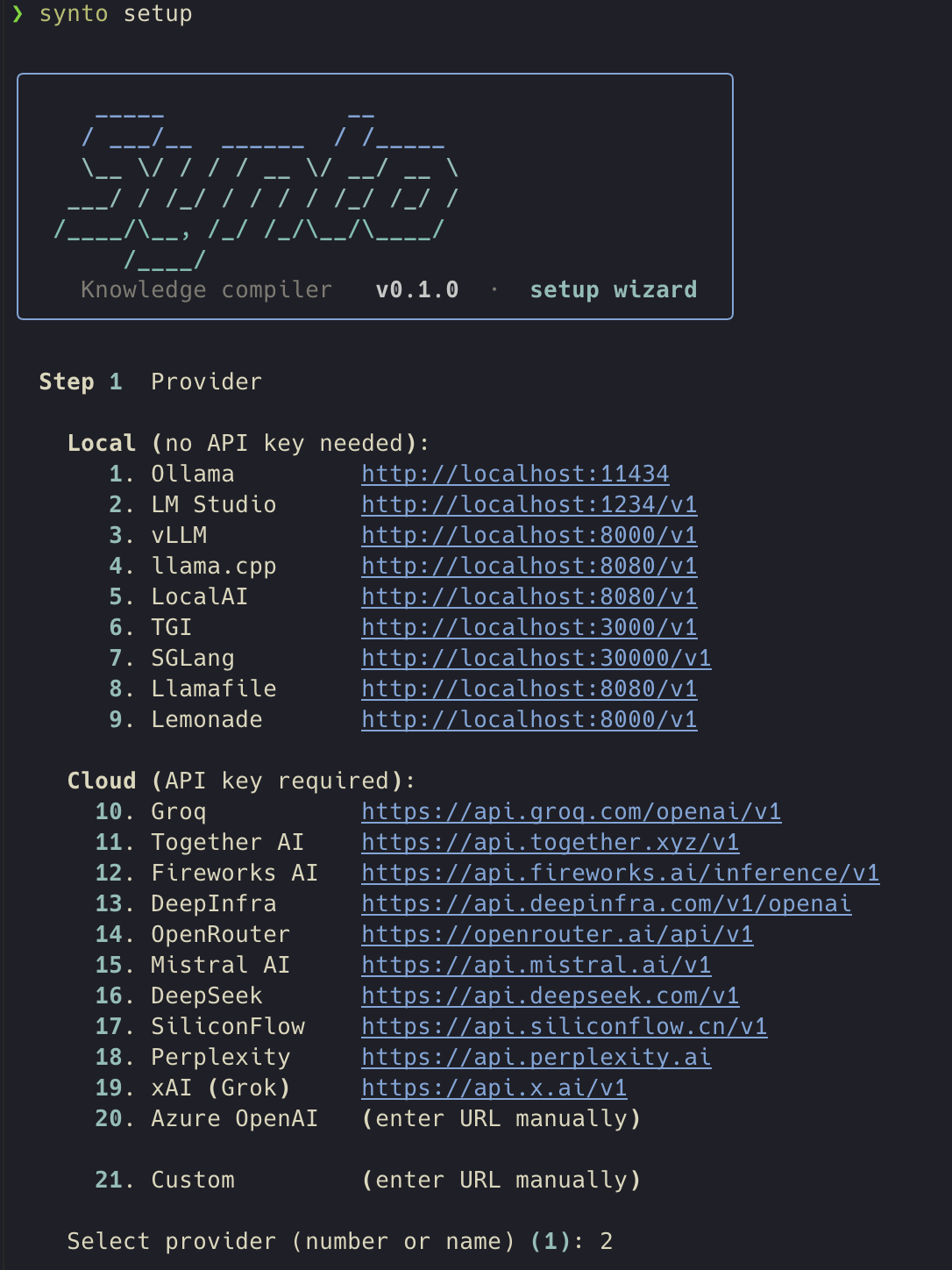
synto setup
An interactive wizard selects your provider, configures the endpoint, picks models, and optionally sets a default vault. Takes about 30 seconds.
╭──────────────────────────────────────────────╮
│         synto  ·  setup                      │
╰──────────────────────────────────────────────╯

  Step 1  Provider

    Local (no API key needed):
      1. Ollama         http://localhost:11434  [default]
      2. LM Studio      http://localhost:1234/v1
      3. vLLM           http://localhost:8000/v1
      ...
    Cloud (API key required):
      9. Groq           https://api.groq.com/openai/v1
     10. Together AI    https://api.together.xyz/v1
      ...

    Select provider [1]: _

  Step 2  Fast model  (analysis · 3–8B recommended)
    1  gemma4:e4b    2  phi4-mini    3  other
    Select [1]: _

  Step 3  Heavy model  (writing · 14B+ recommended)
    1  qwen2.5:14b   2  same as fast   3  other
    Select [1]: _
Settings are saved to ~/.config/synto/config.toml. API keys are stored only in this user-private file, never inside your vault.
3. Create a vault
synto init ~/my-wiki
Creates the folder structure and a synto.toml pre-filled with your wizard settings.
4. Add notes and sources
Drop any .md files into ~/my-wiki/raw/. Web clips, book notes, meeting notes, transcripts — anything.
~/my-wiki/raw/
  quantum-computing.md
  ml-fundamentals.md
  distributed-systems-chapter3.md
To import a PDF or other structured document:
synto add paper.pdf --type paper --vault ~/my-wiki
synto add textbook_chapter.pdf --type textbook --vault ~/my-wiki
synto add api-reference.md --type api_docs --vault ~/my-wiki
Use --type to select the matching ingest-analysis prompt (see the table in Features).
If omitted, PDFs are treated as paper and everything else as notes — pass --type for
anything more specific (spec, transcript, api_docs, …).
synto add --force re-imports an existing source in place. --extend-pack is reserved for
future pack integration and is currently a safe no-op.
5. Run the pipeline
synto run --vault ~/my-wiki
Ingest + compile. Drafts appear in wiki/.drafts/. Then review and publish:
synto review --vault ~/my-wiki                    # inspect each draft: approve / verify / reject / edit
# or
synto verify --all --vault ~/my-wiki              # mark all drafts verified in place
synto approve --all --vault ~/my-wiki             # publish drafts to wiki/
One-command flow (skip review):
synto run --auto-approve --vault ~/my-wiki
Set-it-and-forget-it (auto-process every time you save a note):
synto watch --vault ~/my-wiki
Query your wiki once articles are published:
synto query "what is consistent hashing?" --vault ~/my-wiki
synto query "explain backpropagation" --vault ~/my-wiki --synthesize
Expose as MCP server (Claude Code, Cursor, any MCP client). synto serve is a
stdio server launched by the client, not run by hand — point your client's config at
it:
{ "mcpServers": { "synto": { "command": "synto", "args": ["serve", "--vault", "~/my-wiki"] } } }
Run by hand it will print a "waiting for a client" line on stderr and otherwise sit idle — that is expected, not a hang.
Provider support
| Local (offline, no API key) | Cloud (API key required) |
|---|---|
| Ollama | Groq |
| LM Studio | Together AI |
| vLLM | Fireworks AI |
| llama.cpp | DeepInfra |
| LocalAI | OpenRouter |
| TGI | Mistral AI |
| SGLang | DeepSeek |
| Llamafile | SiliconFlow |
| Lemonade | Perplexity |
| xAI (Grok) | |
| NVIDIA NIM | |
| Azure OpenAI | |
| Kimi (Anthropic-compatible) | |
| Custom OpenAI-compatible |
Any OpenAI-compatible endpoint works. Use synto setup to configure interactively, or edit ~/.config/synto/config.toml directly.
Per-role providers
Each model role can use a different provider and account. Define connections as named
[providers.<alias>] blocks and point roles at them — for example, the fast model on local
Ollama and the heavy model on a cloud account:
[providers.default]
name = "ollama"
url  = "http://localhost:11434"

[providers.ngc]
name = "nvidia"
url  = "https://integrate.api.nvidia.com/v1"
api_key_env = "NVIDIA_API_KEY"   # env var name only — never the key itself

[models.fast]
provider = "default"
model    = "gemma4:e4b"

[models.heavy]
provider = "ngc"
model    = "qwen2.5:14b"
ctx      = 32768
The API key belongs to the provider block, so each model can have its own key (point two
blocks at the same provider with different api_key_env) or none at all (local providers).
Keys are read from the named env var, the provider's conventional env var, SYNTO_API_KEY,
or the user-private ~/.config/synto/config.toml — never from the vault's synto.toml.
synto setup can configure this interactively: after you pick the primary provider and fast
model, answer "yes" to "Use a different provider for the heavy (writing) model?" and the primary
is reused as the fast role while you set up the heavy one. It saves the split to the global config
so synto init reproduces it for new vaults.
Re-running synto init only re-syncs a simple single-provider vault whose provider matches your
global default; in that case any per-model options/think you hand-edited there are replaced.
It leaves a vault untouched when there is no global config, when the vault is set to a different
provider than the global default, or when the vault already splits roles across providers (a
per-role setup). Change those via synto setup or by editing synto.toml directly.
NVIDIA / NGC
NVIDIA inference is OpenAI-compatible; pick the block that matches how your model is served:
-
Self-hosted NIM (a model you host with NGC — the NIM container is pulled from NGC and run on your own infra). It exposes
http://<host>:8000/v1and usually needs no key on inference requests. Usename = "custom"+ yoururlso no environment key is auto-sent:[providers.ngc] name = "custom" url = "http://your-host:8000/v1" timeout = 600 # raise for a large self-hosted model — the cloud default is 120s [models.heavy] provider = "ngc" model = "meta/llama-3.1-70b-instruct"
-
NVIDIA Cloud Functions (NVCF) — set the OpenAI-compatible LLM Gateway base URL for your function (from NVIDIA's console, ending in
/v1) andapi_key_env = "NGC_API_KEY". -
API Catalog (
build.nvidia.com) —name = "nvidia"(default URL) withapi_key_env = "NVIDIA_API_KEY"(annvapi-key).
The legacy /v2/nvcf/pexec invocation form is not OpenAI-compatible and is not supported — use
the LLM Gateway URL. synto doctor may list an NVCF model as "not found" if the per-function
gateway has no /v1/models; that doesn't mean inference is broken.
Advanced model parameters
These are hand-edit-only (not prompted by synto setup):
[models.heavy]
model       = "qwen3.5:9b"
think       = true     # Ollama thinking models: on for heavy by default, off for fast
temperature = 0.3      # override the per-stage default

[models.heavy.options]   # raw passthrough — any provider-native parameter
top_p = 0.9
think controls Ollama's reasoning flag (a no-op on OpenAI/Anthropic-compatible providers;
use options for those). Keys under [models.<role>.options] are merged into the provider
request as-is and override the matching first-class field, so set computed values like
num_predict only if you mean to.
What ships now
- Full ingest → compile → approve pipeline; supports Markdown notes and Obsidian vaults
synto pack export --target agents— portable knowledge pack withINDEX.jsonand agent metadatasynto serve— MCP server with 12 tools. Eight wiki tools:list_articles,read_article,find_concept,search_articles,get_concept,list_sources,trace_lineage,answer_question. Four verbatim-source tools:search_source_segments,get_source_passages,read_source_segment,list_segments. Quality signals (status,confidence,source_count,single_source) are surfaced on every article ref so agents can self-filter;min_statusdefaults to"published"to keep drafts out of agent context.synto doctor --backlog— reads the MCP audit log to show what to ingest next: zero-result queries, single-source concepts in active demand, and the verbatim-vs-answer_questiontool mix.synto query— index-routed Q&A with optional synthesis towiki/synthesis/synto review— interactive draft review: approve, reject, edit, or diff before publishingsynto concept rename OLD NEW— rename a concept everywhere: moves the article, repoints every inbound wikilink, and migrates the name across the state DB;--dry-runpreviewssynto watch— file watcher: auto-ingest and compile on every savesynto maintain— wiki health check, stub creation, orphan cleanupsynto eval— offline structural evaluation (coverage, citation support, link resolution)synto compare— A/B model comparison without touching your vaultsynto doctor— configuration and connectivity diagnostics- Multi-language: notes are ingested and compiled in their source language
- 20+ LLM providers supported via OpenAI-compatible API
synto add SOURCE— import PDF, Markdown, or text files as tracked source documents; PDFs are segmented automatically into heading-aware chunks and written back as canonical raw notes- Source-type prompts: built-in templates for
notes,textbook,paper,spec,api_docs,web_article,corp_docs,transcript, plusunknown_textfallback, select the optimal ingest strategy per document type - Compile lineage: every article records its source notes and compile run;
synto trace article <name>shows the full history - LLM response cache: identical prompts reuse cached responses;
synto maintain --clear-cachemanages it
What's in a pack
.synto/exports/agents/   ← default output dir (synto pack export; --out DIR to relocate)
  articles/           one Markdown file per concept
  synthesis/          published synthesis articles (when present)
  index/
    INDEX.json        machine-readable index with stable article IDs
  agent/
    manifest.json     capabilities and pack metadata
    concepts.json     concept registry with aliases
    sources.json      source provenance
    routes.json       concept/source routing hints
  AGENTS.md           agent-readable entrypoint and usage guide
  CLAUDE.md           Claude Code context file
Any file-aware agent can read the articles directly. INDEX.json enables fast concept lookup without a database. synto serve exposes 12 MCP tools — browse (list_articles), read (read_article, get_concept, trace_lineage, list_sources), search (search_articles, find_concept), answer (answer_question, which runs the full query pipeline), and read raw source text (search_source_segments, get_source_passages, read_source_segment, list_segments).
Data & Privacy
- Local by default. Ollama and LM Studio process all content on your machine — notes never leave it.
- Cloud providers. If you configure a cloud provider, note content and wiki text are sent to that service. Review their privacy policy before use.
- No remote analytics. Synto does not send usage data anywhere. Local runtime and cost metrics stay in your vault database.
- Pack exports. Exported packs include raw notes, sources, wiki articles, queries, and synthesis by default. Review your vault before sharing a pack.
- API keys. Stored in
~/.config/synto/config.toml(user-owned, not inside the vault). Never commit that file. - Verbatim MCP tools gate raw text by source license. The four verbatim-source tools return raw paragraphs only from sources whose license is permissive (
[mcp.source_access]insynto.toml). A vault with no declared licenses is treated as"all"— every segment is readable by a connected MCP client — andsynto serve/synto doctorwarn you about it. See Privacy and source access.
Requirements
- Python 3.11+
- An LLM provider: Ollama (local), LM Studio, or any OpenAI-compatible endpoint
Minimum recommended: a 4B model for ingest (e.g. Gemma 4 gemma4:e4b) and a 14B+ model for compilation (e.g. Qwen 2.5 14B qwen2.5:14b). This is the ground-floor setup for quality output — works offline on 16 GB RAM. A single 4B model for both stages works if you're just getting started.
Migrate from obsidian-llm-wiki-local
Existing obsidian-llm-wiki-local vaults must be migrated first. Run migrate-olw to convert the vault layout:
synto migrate-olw --vault ~/my-old-vault
Copies wiki.toml → synto.toml and .olw/ → .synto/. Notes and articles are untouched. Old files are preserved — delete them once you've verified everything works.
Project details
Verified details
These details have been verified by PyPIProject links
GitHub Statistics
Maintainers
Release history Release notifications | RSS feed


Download files
Download the file for your platform. If you're not sure which to choose, learn more about installing packages.
Source Distribution
Built Distribution
Filter files by name, interpreter, ABI, and platform.
If you're not sure about the file name format, learn more about wheel file names.
Copy a direct link to the current filters
File details
Details for the file synto-0.5.0.tar.gz.
File metadata
- Download URL: synto-0.5.0.tar.gz
- Upload date:
- Size: 855.8 kB
- Tags: Source
- Uploaded using Trusted Publishing? Yes
- Uploaded via: twine/6.1.0 CPython/3.13.12
File hashes
| Algorithm | Hash digest | |
|---|---|---|
| SHA256 |
e929b31771129363bfdebbd4cc12155de8781469a30bc77c6d198f13442124be
|
|
| MD5 |
7d3796eee9fd157d16a6145c000837d1
|
|
| BLAKE2b-256 |
f65a2af6eee16c297f69816b74918d0d28c332283b45ba60ce491ff07f2df422
|
Provenance
The following attestation bundles were made for synto-0.5.0.tar.gz:
Publisher:
release.yml on kytmanov/synto
-
Statement:
-
Statement type:
https://in-toto.io/Statement/v1 -
Predicate type:
https://docs.pypi.org/attestations/publish/v1 -
Subject name:
synto-0.5.0.tar.gz -
Subject digest:
e929b31771129363bfdebbd4cc12155de8781469a30bc77c6d198f13442124be - Sigstore transparency entry: 1711125623
- Sigstore integration time:
-
Permalink:
kytmanov/synto@a769df0fa304f73a6d16e97e3528da5bdf1aa287 -
Branch / Tag:
refs/tags/v0.5.0 - Owner: https://github.com/kytmanov
-
Access:
public
-
Token Issuer:
https://token.actions.githubusercontent.com -
Runner Environment:
github-hosted -
Publication workflow:
release.yml@a769df0fa304f73a6d16e97e3528da5bdf1aa287 -
Trigger Event:
push
-
Statement type:
File details
Details for the file synto-0.5.0-py3-none-any.whl.
File metadata
- Download URL: synto-0.5.0-py3-none-any.whl
- Upload date:
- Size: 253.8 kB
- Tags: Python 3
- Uploaded using Trusted Publishing? Yes
- Uploaded via: twine/6.1.0 CPython/3.13.12
File hashes
| Algorithm | Hash digest | |
|---|---|---|
| SHA256 |
785b4b6062d6ec32d0a8e3a78b179f21bf5e69d68d2229bce78a6852fa451d68
|
|
| MD5 |
688791dfe58f7fbcfdddd84cd5edf553
|
|
| BLAKE2b-256 |
18e3ac00a89751bfe4a1dfb5f92688d8cf84883d8d4662c7dbacb81d93a9a398
|
Provenance
The following attestation bundles were made for synto-0.5.0-py3-none-any.whl:
Publisher:
release.yml on kytmanov/synto
-
Statement:
-
Statement type:
https://in-toto.io/Statement/v1 -
Predicate type:
https://docs.pypi.org/attestations/publish/v1 -
Subject name:
synto-0.5.0-py3-none-any.whl -
Subject digest:
785b4b6062d6ec32d0a8e3a78b179f21bf5e69d68d2229bce78a6852fa451d68 - Sigstore transparency entry: 1711125678
- Sigstore integration time:
-
Permalink:
kytmanov/synto@a769df0fa304f73a6d16e97e3528da5bdf1aa287 -
Branch / Tag:
refs/tags/v0.5.0 - Owner: https://github.com/kytmanov
-
Access:
public
-
Token Issuer:
https://token.actions.githubusercontent.com -
Runner Environment:
github-hosted -
Publication workflow:
release.yml@a769df0fa304f73a6d16e97e3528da5bdf1aa287 -
Trigger Event:
push
-
Statement type:






