
Automate with flows, not loose prompts. Chain LLM, shell, and code in one YAML pipeline.
Verified details
These details have been verified by PyPIProject links
GitHub Statistics
Maintainers

Project description
Telize
Build reproducible, structured AI workflows with YAML and run them from your terminal, combining LLMs, shell, Python, and more—fully under your control.
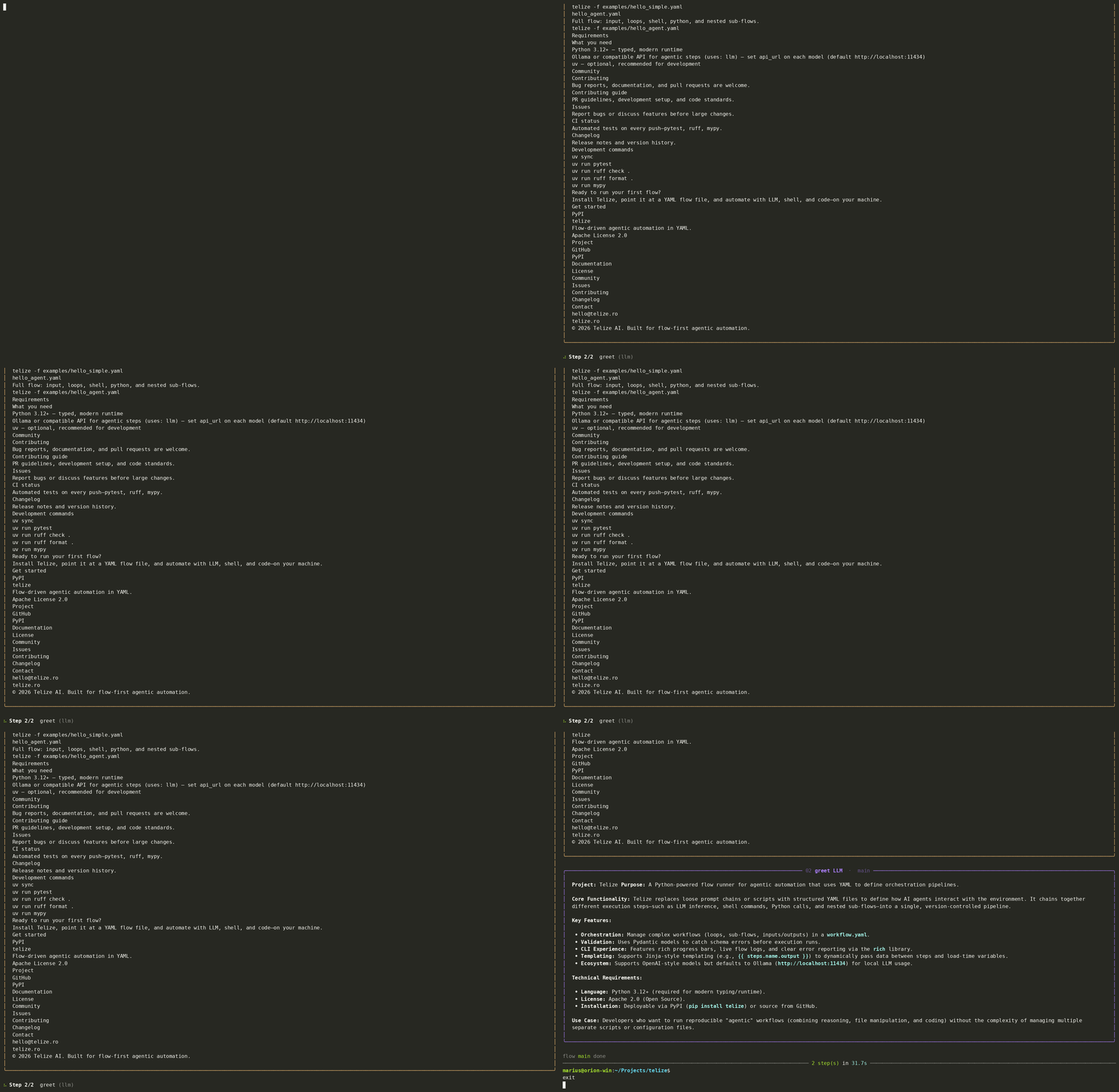
Telize is a low-code framework for building agent-style pipelines: chain shell commands, file I/O, LLM calls, Python functions, and nested flows in a single workflow file. Configuration is validated before execution, and the CLI shows live progress as each step completes.
CI · Python 3.12+ · License
Table of contents
- Features
- Requirements
- Installation
- Quick start
- Motivation
- How it works
- Workflow reference
- Examples
- CLI
- Development
- Contributing
- License
Features
- YAML workflows — one file defines
config, namedmodels, flows, and steps - Composable steps —
input,llm,shell,python,flow, andyamlactions - Jinja templating — wire step outputs together with
{{ steps.name.output }} - Loops and sub-flows — iterate LLM steps over split lists; call nested flows with
uses: flow - Validated upfront — Pydantic models catch schema errors before any step runs
- Rich CLI output — progress, step panels, and errors in the terminal
- OpenAI-compatible LLMs — official OpenAI API or local Ollama via the same client
Requirements
- Python 3.12+
- LLM endpoint for
uses: llmsteps — OpenAI or Ollama; setapi_urlon each model profile (defaulthttp://localhost:11434) - Optional: uv for fast local development
Installation
pip install telize
From source:
git clone https://github.com/telize-ai/telize.git
cd telize
uv sync
uv pip install -e .
Check the install:
telize --version
Quick start
1. For local models, start Ollama and pull a model:
ollama pull qwen3.5:4b # or any model id you set under models.*.model
For OpenAI Cloud, set OPENAI_API_KEY and point a model profile at the API, for example api_url: https://api.openai.com/v1.
2. Create hello.yaml:
config:
  entrypoint: main

models:
  default:
    provider: openai
    model: qwen3.5:4b
    api_url: http://localhost:11434

flows:
  main:
    steps:
      - name: greet
        uses: llm
        model: default
        prompt: Say hello in one friendly sentence.
3. Run it:
telize -f hello.yaml
Validate the file without executing steps:
telize -f hello.yaml --validate-only
Run the bundled examples:
telize -f examples/minimal_llm.yaml
telize -f examples/spec_reference.yaml --validate-only
🚀 Motivation
Telize addresses a massive pain point in the current AI engineering landscape:
✨ unpredictability and unnecessary complexity.
Many popular frameworks force developers to write complex, nested Python code (LangChain, CrewAI, AutoGen) just to string together a few API calls, a bash script, and an LLM prompt.
This results in heavy, hard-to-maintain codebases that frequently break when APIs change.
Telize essentially acts as the “GitHub Actions or Ansible for AI.”
By treating LLMs as just another step in a standard automation pipeline, it brings sanity back to the engineering process.
✨ Why it works:
- Deterministic Structure + Non-Deterministic AI:
It keeps the overall architecture rigid and predictable (YAML), while allowing the AI to handle the fuzzy, creative tasks (text generation, summarization) within strict boundaries. - Upfront Validation:
Running LLM pipelines can be expensive and time-consuming; catching a syntax or configuration error before wasting API credits is a huge win. - Low Friction:
Local-first by default (Ollama-ready) and zero-code setup means a developer can prototype an agentic workflow in 5 minutes without dealing with dependency hell.
👥 Who may choose Telize over Classic Agents?
- DevOps and System Administrators:
People who already love Ansible, Docker Compose, or CI/CD pipelines may want to gravitate toward Telize or similar sollutions.
They don't want an AI Agent guessing how to deploy code; they want a script that runs a test, summarizes the failure using an LLM, and posts it to Slack. - Enterprise & Production Environments:
Companies hate unpredictability. Classic agents are too risky for production because they can behave wildly.
Telize provides guardrails. You know exactly what the workflow is going to do because you mapped out the steps. - Data Pipelines:
For ETL (Extract, Transform, Load) tasks where text needs to be scraped, cleaned by an LLM, and saved to a database, a YAML flow is infinitely better than a multi-agent swarm.
⚡ Where Telize Might Struggle (The Limitations)
While it is great for structured automation, it isn’t a silver bullet:
- Dynamic Decision Making:
If a task requires an AI to dynamically look at a problem, decide it needs to create 3 new files, write code, test it, and self-correct on the fly, Telize’s static YAML structure will feel too restrictive. - Complex State Management:
For highly conversational applications (like a customer support chatbot that needs to maintain a complex state over days), a linear flow runner isn't the right tool.
How it works
- Telize loads your YAML and validates it against typed Pydantic models.
- The flow named in
config.entrypointruns first. - Each step executes through a registered action (
input,llm,shell, …);llmsteps resolve theirmodel:profile from the top-levelmodelsmap. - Later steps can reference earlier outputs via Jinja templates.
- The CLI prints progress and results as the workflow runs.
Workflow reference
Top-level structure
| Key | Description |
|---|---|
config |
Global settings: entrypoint (which flow runs first) |
models |
Named LLM profiles; referenced by model: on each uses: llm step |
flows |
Named flows; config.entrypoint must match one of these keys |
config
| Field | Description |
|---|---|
entrypoint |
Name of the flow to run when the file is executed |
models
Each key under models is a profile name (for example default, creative). LLM steps pick a profile with model: <name>.
| Field | Required | Description |
|---|---|---|
provider |
no (default openai) |
Registered provider id |
model |
yes | Model id passed to the provider (e.g. qwen3.5:4b, gpt-4o-mini) |
temperature |
no | Sampling temperature (0–2) |
api_url |
no (default http://localhost:11434) |
OpenAI-compatible API base URL (/v1 is appended automatically) |
api_key |
no | API key; use {{ env.OPENAI_API_KEY }} or rely on the OPENAI_API_KEY env var |
system_prompt |
no | System message for steps using this profile (Jinja at runtime) |
Example — multiple profiles:
models:
  factual:
    model: qwen3.5:4b
    temperature: 0.2
    api_url: http://localhost:11434
    system_prompt: Be concise and factual.

  creative:
    model: qwen3.5:4b
    temperature: 1.0
    api_url: http://localhost:11434
    system_prompt: Be witty but brief.
Load-time env in api_url (see examples/env_config.yaml):
models:
  default:
    model: qwen3.5:4b
    api_url: http://{{ env.OLLAMA_HOST }}:11434
Flow
| Field | Description |
|---|---|
steps |
List of steps (unique name per flow), executed in order |
Steps (uses)
uses |
Description |
|---|---|
input |
Read a file or a directory (with glob include) |
llm |
Send a prompt using a named model from models; optional output_to, loop |
shell |
Run run commands; optional envs (supports templates) |
python |
Call call (module.function) with args |
flow |
Run another flow via run |
yaml |
Run an external workflow from file (own config, models, and flows); optional input map passed to the child as {{ input.key }} |
Templating
Telize uses Jinja2 in step fields.
| When | What you can use |
|---|---|
| Load time | {{ env.VAR }} — expanded when the file is parsed |
| Runtime | {{ steps.<name>.output }}, {{ models.<name>.model }}, {{ input.<key> }}, {{ item }} (inside loops) |
Workflow input is provided when invoking Telize from the shell (--input, --input-file, --input-stdin) or by a parent yaml step's input map when running a nested workflow.
With --input-stdin or --input-file, input may be a YAML/JSON mapping ({"name": "Ada"} → {{ input.name }}) or plain text (echo Hello or a .txt file → {{ input.text }}).
Example — chain a shell step into an LLM step:
- name: fetch_data
  uses: shell
  run: cat ./data.txt

- name: summarize
  uses: llm
  model: default
  prompt: |
    Summarize this:
    {{ steps.fetch_data.output }}
Examples
| File | What it demonstrates |
|---|---|
examples/spec_reference.yaml |
Full specification reference (all step types and fields) |
examples/minimal_llm.yaml |
Smallest runnable LLM workflow |
examples/shell_to_llm.yaml |
Shell → LLM with {{ steps.*.output }} |
examples/read_file.yaml |
uses: input — single file |
examples/read_directory.yaml |
uses: input — directory glob |
examples/llm_save_output.yaml |
output_to — persist LLM text to disk |
examples/llm_loop.yaml |
loop — split output and iterate |
examples/call_subflow.yaml |
uses: flow — sub-flow in the same file |
examples/nested_workflow.yaml |
uses: yaml — external workflow + input |
examples/python_step.yaml |
uses: python — call a Python function |
examples/multi_model.yaml |
Multiple named models profiles |
examples/shell_with_env.yaml |
Shell envs and load-time {{ env.* }} |
examples/env_config.yaml |
{{ env.VAR }} in the models section at load time |
CLI
usage: telize [-h] [--version] [-f FILE] [--validate-only]

options:
  -h, --help         show help
  --version          show version
  -f, --file FILE    path to workflow YAML
  --validate-only    parse and validate without running steps
Development
uv sync
uv run pytest
uv run ruff check .
uv run ruff format .
uv run mypy
See CONTRIBUTING.md for pull request guidelines and CHANGELOG.md for release notes.
Contributing
Contributions are welcome — bug reports, docs, and pull requests. Please read CONTRIBUTING.md and open an issue before large changes.
License
Apache License 2.0 — see LICENSE.
Project details
Verified details
These details have been verified by PyPIProject links
GitHub Statistics
Maintainers


Download files
Download the file for your platform. If you're not sure which to choose, learn more about installing packages.
Source Distribution
Built Distribution
Filter files by name, interpreter, ABI, and platform.
If you're not sure about the file name format, learn more about wheel file names.
Copy a direct link to the current filters
File details
Details for the file telize-0.2.3.tar.gz.
File metadata
- Download URL: telize-0.2.3.tar.gz
- Upload date:
- Size: 439.8 kB
- Tags: Source
- Uploaded using Trusted Publishing? Yes
- Uploaded via: twine/6.1.0 CPython/3.13.12
File hashes
| Algorithm | Hash digest | |
|---|---|---|
| SHA256 |
c18ec11a3c3ceb5ee51e3e6b1a0be45be58982339db238e7520a63f2536983a5
|
|
| MD5 |
a417a96cd36828af6230c27786e38b8e
|
|
| BLAKE2b-256 |
f34360dec20f7f82849804aae5f0979359c3b538b9668cbe48c54adc59496efc
|
Provenance
The following attestation bundles were made for telize-0.2.3.tar.gz:
Publisher:
publish.yml on telize-ai/telize
-
Statement:
-
Statement type:
https://in-toto.io/Statement/v1 -
Predicate type:
https://docs.pypi.org/attestations/publish/v1 -
Subject name:
telize-0.2.3.tar.gz -
Subject digest:
c18ec11a3c3ceb5ee51e3e6b1a0be45be58982339db238e7520a63f2536983a5 - Sigstore transparency entry: 1571854268
- Sigstore integration time:
-
Permalink:
telize-ai/telize@9d103590fc701eb293c57fe60cb103a0f337fd4e -
Branch / Tag:
refs/tags/v0.2.3 - Owner: https://github.com/telize-ai
-
Access:
public
-
Token Issuer:
https://token.actions.githubusercontent.com -
Runner Environment:
github-hosted -
Publication workflow:
publish.yml@9d103590fc701eb293c57fe60cb103a0f337fd4e -
Trigger Event:
release
-
Statement type:
File details
Details for the file telize-0.2.3-py3-none-any.whl.
File metadata
- Download URL: telize-0.2.3-py3-none-any.whl
- Upload date:
- Size: 38.2 kB
- Tags: Python 3
- Uploaded using Trusted Publishing? Yes
- Uploaded via: twine/6.1.0 CPython/3.13.12
File hashes
| Algorithm | Hash digest | |
|---|---|---|
| SHA256 |
e45a39e80a0d6aaf0a637b16eceacef96ee786bd4315d536a03c1ca68b1393b2
|
|
| MD5 |
a87416d53f6e54b9101a34aff9cb7b6d
|
|
| BLAKE2b-256 |
a2009817eccece6622038671db3b0e8ff48757af3e04965f99be79048f9b804b
|
Provenance
The following attestation bundles were made for telize-0.2.3-py3-none-any.whl:
Publisher:
publish.yml on telize-ai/telize
-
Statement:
-
Statement type:
https://in-toto.io/Statement/v1 -
Predicate type:
https://docs.pypi.org/attestations/publish/v1 -
Subject name:
telize-0.2.3-py3-none-any.whl -
Subject digest:
e45a39e80a0d6aaf0a637b16eceacef96ee786bd4315d536a03c1ca68b1393b2 - Sigstore transparency entry: 1571854319
- Sigstore integration time:
-
Permalink:
telize-ai/telize@9d103590fc701eb293c57fe60cb103a0f337fd4e -
Branch / Tag:
refs/tags/v0.2.3 - Owner: https://github.com/telize-ai
-
Access:
public
-
Token Issuer:
https://token.actions.githubusercontent.com -
Runner Environment:
github-hosted -
Publication workflow:
publish.yml@9d103590fc701eb293c57fe60cb103a0f337fd4e -
Trigger Event:
release
-
Statement type:






