
This release is a pre-release and may not be stable for production use.

Simple and Fast Geospatial Features API for PostGIS.


Documentation: https://developmentseed.org/tifeatures/
Source Code: https://github.com/developmentseed/tifeatures
⚠️ This project is on pause while we focus on
developmentseed/tipg⚠️ref: https://github.com/developmentseed/timvt/discussions/96
TiFeatures, pronounced T[ee]Features, is a python package which helps creating lightweight Features server for PostGIS Database. The API has been designed with respect to OGC Features API specification.
Install
$ python -m pip install pip -U
$ python -m pip install tifeatures

# or from source
$ git clone https://github.com/developmentseed/tifeatures.git
$ cd tifeatures
$ python -m pip install -e .
OGC Specification
| Specification | Status | link |
|---|---|---|
| Part 1: Core | ✅ | https://docs.ogc.org/is/17-069r4/17-069r4.html |
| Part 2: CRS by Reference | ❌ | https://docs.ogc.org/is/18-058r1/18-058r1.html |
| Part 3: Filtering / CQL2 | ✅ | https://docs.ogc.org/DRAFTS/19-079r1.html |
Notes:
The project authors choose not to implement the Part 2 of the specification to avoid the introduction of CRS based GeoJSON. This might change in the future.
While the authors tried to follow the specification (part 1 and 3) to the letter, some API endpoints might have more capabilities (e.g geometry column selection).
PostGIS/PostgreSQL
TiFeatures rely a lot of ST_* PostGIS functions. You need to make sure your PostgreSQL database has PostGIS installed.
SELECT name, default_version,installed_version
FROM pg_available_extensions WHERE name LIKE 'postgis%' or name LIKE 'address%';
CREATE EXTENSION postgis;
Configuration
To be able to work, the application will need access to the database. tifeatures uses starlette's configuration pattern which make use of environment variable and/or .env file to pass variable to the application.
Example of .env file can be found in .env.example
# you need define the DATABASE_URL directly
DATABASE_URL=postgresql://username:password@0.0.0.0:5432/postgis
Launch
$ pip install uvicorn

# Set your postgis database instance URL in the environment
$ export DATABASE_URL=postgresql://username:password@0.0.0.0:5432/postgis
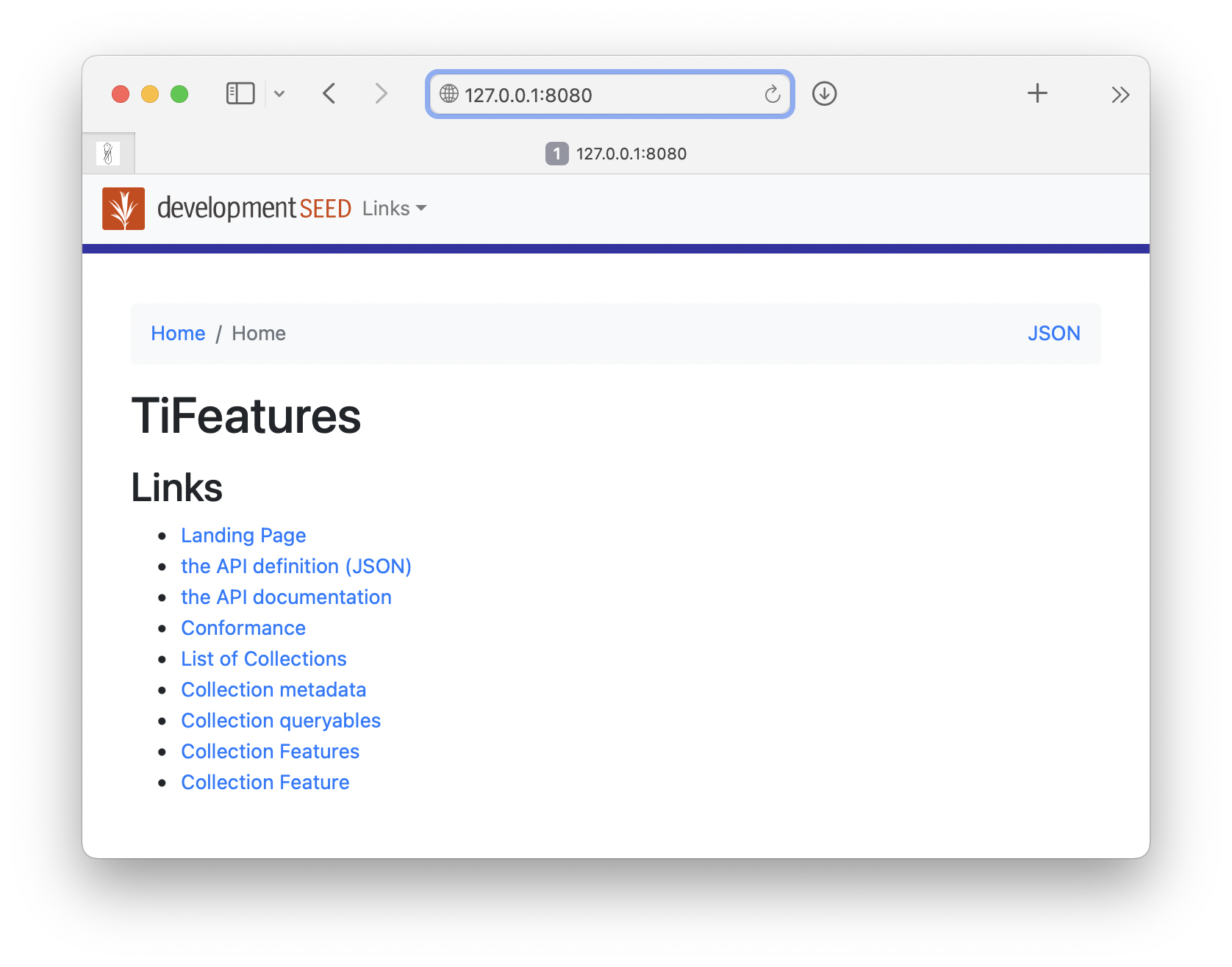
$ uvicorn tifeatures.main:app

# or using Docker

$ docker-compose up
Contribution & Development
See CONTRIBUTING.md
License
See LICENSE
Authors
Created by Development Seed
Changes
See CHANGES.md.
Metadata
Release files for tifeatures 0.1.0a4
For a detailed explanation of source distributions (sdists) and built distributions (wheels), please see the package formats documentation.
Source distribution (sdist)
| File | Size | Uploaded | Provenance | Actions |
|---|---|---|---|---|
| tifeatures-0.1.0a4.tar.gz | 35.3 kB | Without provenance | Details for tifeatures-0.1.0a4.tar.gz |
Built distribution (wheel)
| File | Interpreter | ABI | Platform | Actions Reset |
|---|---|---|---|---|
| tifeatures-0.1.0a4-py3-none-any.whl | Python 3 | none | any | Details for tifeatures-0.1.0a4-py3-none-any.whl |
Total release size: 79.1 kB
Release files / tifeatures-0.1.0a4.tar.gz
| Download URL | tifeatures-0.1.0a4.tar.gz |
|---|---|
| Size | 35.3 kB |
| Tags | Source |
|
SHA-256 checksum How to use checksums |
b3c267f2b71626c01e6ffdcb45f055f7e3731da8e973253522f3c66b6ae83653
|
|
BLAKE2b-256 checksum How to use checksums |
c5a705b5077a289c5c46c69780602734ef7fef0670019bdf86c623406540034c
|
| Upload date | |
|
Uploaded using Trusted Publishing? What is trusted publishing? |
No |
| Uploaded via |
python-httpx/0.23.3
|
Release files / tifeatures-0.1.0a4-py3-none-any.whl
| Download URL | tifeatures-0.1.0a4-py3-none-any.whl |
|---|---|
| Size | 43.9 kB |
| Tags | Python 3 |
|
SHA-256 checksum How to use checksums |
af14ad4fda38ab939a14b9f60999e51265ae2b07db2385c51c0da477989696f3
|
|
BLAKE2b-256 checksum How to use checksums |
84966e29215cc387c16d8769b570c6d71bc11d1df9eae4471a3ecc944f73fbb3
|
| Upload date | |
|
Uploaded using Trusted Publishing? What is trusted publishing? |
No |
| Uploaded via |
python-httpx/0.23.3
|
Security for tifeatures 0.1.0a4
Provenance
Provenance describes where a file came from. On PyPI, provenance is shared via attestations, which provide a verifiable record of the build or publishing details. View details, limitations and caveats.
No provenance found
None of the files in this release were uploaded with provenance metadata.
A note on package security
PyPI is a repository for distributing packages, not a service for auditing them. While third-party security researchers and our staff do their best to detect and remove malicious packages, PyPI cannot guarantee the quality, security or suitability of any given package.
To learn more about protecting yourself from malicious actors, visit our package security documentation.














