
This is a plugin for Tutor that makes it easy to integrate Jupyter notebooks in Open edX. It achieves the following:
Install the official jupyter-xblock in the Open edX LMS and Studio.
Run a Docker-based JupyterHub instance with a Docker spawner.
In practice, it means that students will be allocated Docker containers with limited CPU and memory to run their custom notebooks.
⚠️ Compatibility with Kubernetes was not battle-tested. Please report any issue you face. For a more production-ready Kubernetes environment, you are encouraged to check the documentation of the Zero to JupyterHub with Kubernetes project.
Installation
tutor plugins install jupyterUsage
Enable the plugin:
tutor plugins enable jupyterRe-build the “openedx” Docker image to install the Jupyter XBlock:
tutor images build openedxLaunch your platform again:
tutor local launchPrint the default passport ID:
echo "$(tutor config printvalue JUPYTER_DEFAULT_PASSPORT_ID):$(tutor config printvalue JUPYTER_LTI_CLIENT_KEY):$(tutor config printvalue JUPYTER_LTI_CLIENT_SECRET)"Make a note of the printed value. Go to the Studio Tools ➡️ Advanced Settings ➡️ LTI Passports. Insert the passport value:

In “Advanced Module List” add “jupyter” (with quotes):
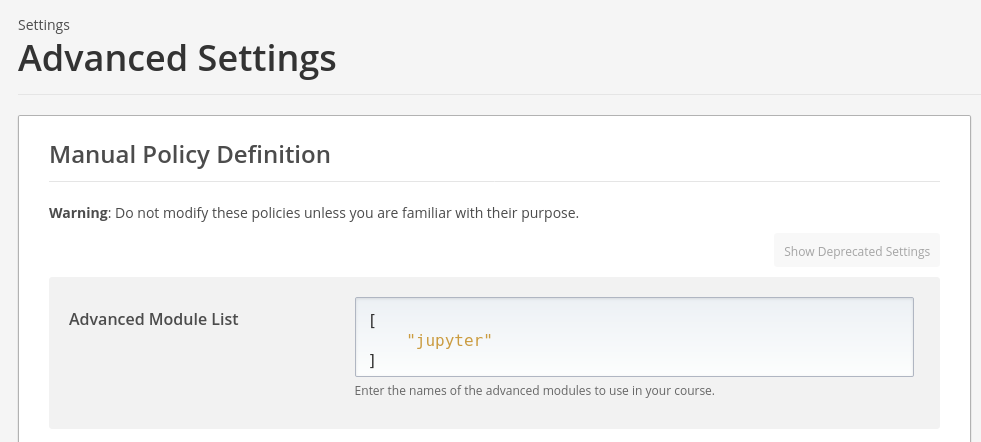
You should then be able to create an advanced Jupyter XBlock in the Studio:
> Add New Component ➡️ Advanced ➡️ Jupyter notebook
The default “hello” notebook will be pulled from the jupyter-block repository and displayed in the studio.
Configuration
Settings
This plugin has the following Tutor settings. Each setting can be printed with tutor config printvalue JUPYTER_SETTING_NAME and modified with tutor config save --set JUPYTER_SETTING_NAME=value.
Default settings:
JUPYTER_DOCKER_IMAGE_HUB (default: "{{ DOCKER_REGISTRY }}overhangio/jupyterhub:{{ JUPYTER_VERSION }}")
JUPYTER_DOCKER_IMAGE_LAB (default: "{{ DOCKER_REGISTRY }}overhangio/jupyterlab:{{ JUPYTER_VERSION }}")
JUPYTER_HOST (default: "jupyter.{{ LMS_HOST }}")
JUPYTER_DEFAULT_PASSPORT_ID (default: "jupyterhub")
JUPYTER_LTI_CLIENT_KEY (default: "openedx")
JUPYTER_HUB_MYSQL_DATABASE (default: "jupyterhub")
JUPYTER_HUB_MYSQL_USERNAME (default: "jupyterhub")
JUPYTER_LAB_CPU_LIMIT (default: None)
JUPYTER_LAB_MEMORY_LIMIT (default: "200M")
Unique, user-specific settings:
JUPYTER_HUB_COOKIE_SECRET (default: "{{ 32|jupyterhub_crypt_key }}")
JUPYTER_HUB_CRYPT_KEY (default: "{{ 32|jupyterhub_crypt_key }}")
JUPYTER_HUB_MYSQL_PASSWORD (default: "{{ 24|random_string }}")
JUPYTER_LTI_CLIENT_SECRET (default: "{{ 24|random_string }}")
JupyterHub
The configuration template for the JupyterHub instance is stored in jupyterhub_config.py. This template file includes a {{ patch("jupyterhub-config") }} statement, which means that its contents can be overridden by creating an ad-hoc Tutor plugin. For instance, to add custom LTI keys to your JupyterHub instance:
To modify the “jupyterhub” Docker image and add extra Python packages (for example), you should create a Tutor plugin that implements the “jupyterhub-dockerfile” patch:
Then build the JupyterHub image again:
tutor config save
tutor images build jupyterhub
Lab environment
By default, Jupyter lab notebooks will be spawned that do not include extra Python packages or dependencies. To modify the “jupyterlab” Docker image and add extra Python packages (for example), you should create a Tutor plugin that implements the “jupyterlab-dockerfile” patch:
Then build the lab image again:
tutor config save
tutor images build jupyterlab
You should now be able to run import matplotlib statements within your Jupyter notebooks.
Troubleshooting
This Tutor plugin is maintained by Abdul-Muqadim from Edly. Community support is available from the official Open edX forum. Do you need help with this plugin? See the troubleshooting section from the Tutor documentation.
License
This work is licensed under the terms of the GNU Affero General Public License (AGPL).
4 maintainers


Metadata
4 maintainers
Release files for tutor-jupyter 22.0.0
For a detailed explanation of source distributions (sdists) and built distributions (wheels), please see the package formats documentation.
Source distribution (sdist)
| File | Size | Uploaded | |
|---|---|---|---|
| tutor_jupyter-22.0.0.tar.gz | 20.5 kB | Details |
Release files / tutor_jupyter-22.0.0.tar.gz
| Download URL | tutor_jupyter-22.0.0.tar.gz |
|---|---|
| Size | 20.5 kB |
| Tags | Source |
|
SHA-256 checksum How to use checksums |
51ea09c0c0f577af7fa467de708b39d25410e91b38ea13e20f7e8d8c00ec4526
|
|
BLAKE2b-256 checksum How to use checksums |
c041fd2be46c6f7807fb237e0e217cf20b49e0a4e6a82519342a447245c26059
|
| Upload date | |
|
Uploaded using Trusted Publishing? What is trusted publishing? |
No |
| Uploaded via |
twine/7.0.0 CPython/3.12.10
|














