
twopiece: Two-Piece Distributions


- Homepage: https://github.com/quantgirluk/twopiece
- Pip Repository: twopiece
- Demo: Python Notebook
Overview
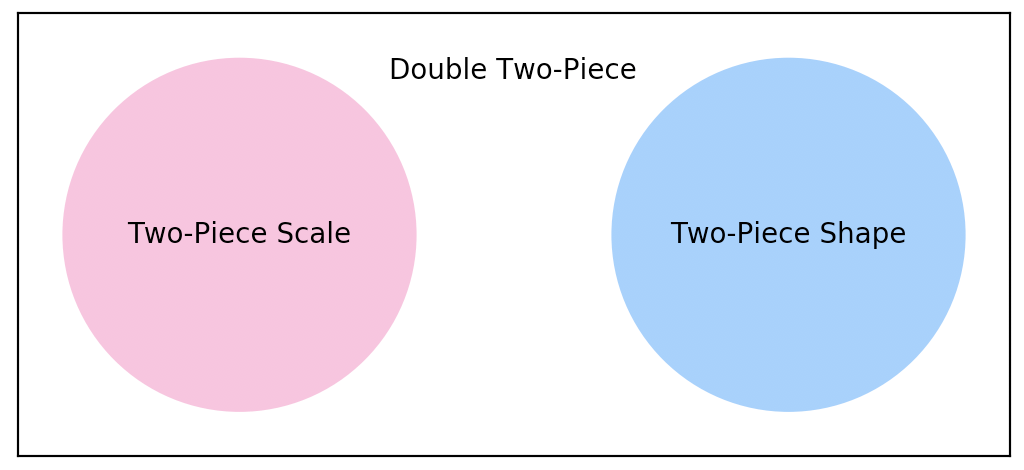
The twopiece library provides a Python implementation of the family of Two Piece distributions. It covers three subfamilies Two-Piece Scale, Two-Piece Shape, and Double Two-Piece. The following diagram shows how these families relate.
Two-Piece Scale
The family of two–piece scale distributions is a family of univariate three parameter location-scale models, where skewness is introduced by differing scale parameters either side of the mode.
Definition. Let $f: \mathbb{R} \mapsto \mathbb{R}_{+}$ be a unimodal symmetric (around zero) probability density function (pdf) from the location-scale family, possibly including a shape parameter $\delta$. Then, the pdf of a member of the two-piece family of distributions is given by
$$ s\left(x; \mu,\sigma_1,\sigma_2, \delta\right) = \begin{cases} \dfrac{2}{\sigma_1+\sigma_2}f\left(\dfrac{x-\mu}{\sigma_1};\delta\right), \mbox{if } x < \mu, \ \dfrac{2}{\sigma_1+\sigma_2}f\left(\dfrac{x-\mu}{\sigma_2};\delta\right), \mbox{if } x \geq \mu. \ \end{cases} $$
Example. If $f$ corresponds to the normal pdf, then $s$ corresponds to the pdf of the Two-Piece Normal distribution as proposed by Gustav Fechner in 1887.
Two-Piece Shape
The family of two–piece shape distributions is a family of univariate three parameter location-scale models, where skewness is introduced by differing shape parameters either side of the mode.
Definition. Let $f: \mathbb{R} \mapsto \mathbb{R}_{+}$ be a unimodal symmetric (around 0) probability density function (pdf) from the location-scale family which includes a shape parameter $\delta$. Then, the pdf of a member of the two-piece family of distributions is given by
$$ s\left(x; \mu,\sigma,\delta_1 \delta_2\right) = \begin{cases} \dfrac{2\epsilon}{\sigma}f\left(\dfrac{x-\mu}{\sigma};\delta_1\right), \mbox{if } x < \mu, \ \dfrac{2(1 -\epsilon)}{\sigma}f\left(\dfrac{x-\mu}{\sigma};\delta_2\right), \mbox{if } x \geq \mu. \ \end{cases} $$
where
$$ \epsilon = \dfrac{f(0;\delta_2)}{f(0;\delta_1)+f(0;\delta_2)}. $$
Example. If $f$ corresponds to the Student-t pdf, then $s$ corresponds to the pdf of the Two-Piece Shape Student-t distribution. Note that $s$ has different shape parameter on each side mode but the same scale.
Double Two-Piece
The family of double two–piece distributions is obtained by using a density–based transformation of unimodal symmetric continuous distributions with a shape parameter. The resulting distributions contain five interpretable parameters that control the mode, as well as both scale and shape in each direction.
Definition. Let $f: \mathbb{R} \mapsto \mathbb{R}_{+}$ be a unimodal symmetric (around 0) probability density function (pdf) from the location-scale family which includes a shape parameter $\delta$. Then, the pdf of a member of the two-piece family of distributions is given by
$$ s\left(x; \mu,\sigma_1,\sigma_2, \delta_1, \delta_2 \right) = \begin{cases} \dfrac{2\epsilon}{\sigma_1}f\left(\dfrac{x-\mu}{\sigma_1};\delta_1\right), \mbox{if } x < \mu, \ \dfrac{2(1 -\epsilon)}{\sigma_2}f\left(\dfrac{x-\mu}{\sigma_2};\delta_2\right), \mbox{if } x \geq \mu. \ \end{cases} $$
where
$$ \epsilon = \dfrac{\sigma_1f(0;\delta_2)}{\sigma_2f(0;\delta_1)+\sigma_1 f(0;\delta_2)}. $$
Example. If $f$ corresponds to the Student-t pdf then $s$ corresponds to the pdf of the Double Two-Piece Student-t distribution. Note that $s$ has different scale and shape on each side of the mode.
Notes
For technical details on this families of distributions we refer to the following two publications which serve as reference for our implementation.
-
Inference in Two-Piece Location-Scale Models with Jeffreys Priors published in Bayesian Anal. Volume 9, Number 1 (2014), 1-22.
-
Bayesian modelling of skewness and kurtosis with Two-Piece Scale and shape distributions published in Electron. J. Statist., Volume 9, Number 2 (2015), 1884-1912.
For the R implementation we refer to the following packages.
twopiece has been developed and tested on Python 3.6, and 3.7.
Supported Distributions
Implementation is provided for the following distributions.
Two-Piece Scale
| Name | Function | Parameters |
|---|---|---|
| Two-Piece Normal | tpnorm | loc, sigma1, sigma2 |
| Two-Piece Laplace | tplaplace | loc, sigma1, sigma2 |
| Two-Piece Cauchy | tpcauchy | loc, sigma1, sigma2 |
| Two-Piece Logistic | tplogistic | loc, sigma1, sigma2 |
| Two-Piece Student-t | tpstudent | loc, sigma1, sigma2, shape |
| Two-Piece Exponential Power | tpgennorm | loc, sigma1, sigma2, shape |
| Two-Piece SinhArcSinh | tpsas | loc, sigma1, sigma2, shape |
Two-Piece Shape
| Name | Function | Parameters |
|---|---|---|
| Two-Piece-Shape Student-t | tpshastudent | loc, sigma, shape1, shape2 |
| Two-Piece-Shape Exponential Power | tpshagennorm | loc, sigma, shape1, shape2 |
| Two-Piece-Shape SinhArcSinh | tpshasas | loc, sigma, shape1, shape2 |
Double Two-Piece
| Name | Function | Parameters |
|---|---|---|
| Double Two-Piece Student-t | dtpstudent | loc, sigma1, sigma2, shape1, shape2 |
| Double Two-Piece Exponential Power | dtpgennorm | loc, sigma1, sigma2, shape1, shape2 |
| Double Two-Piece SinhArcSinh | dtpsinhasinh | loc, sigma1, sigma2, shape1, shape2 |
Main Features
We provide the following functionality for all the supported distributions.
| Function | Method | Parameters |
|---|---|---|
| Probability Density Function | x | |
| Cumulative Distribution Function | cdf | x |
| Quantile Function | ppf | q |
| Random Sample Generation | random_sample | size |
Quick Start
Install
We recommend install twopiece using pip as follows.
pip install twopiece
To illustrate usage two-piece scale distributions we will use the two-piece Normal, and two-piece Student-t. The behaviour is analogous for the rest of the supported distributions.
1. Create a twopiece instance
First, we load the family (scale, shape and double) of two-piece distributions that we want to use.
from twopiece.scale import *
from twopiece.shape import *
from twopiece.double import *
To create an instance we need to specify either 3, 4, or 5 parameters:
For the Two-Piece Normal we require:
- loc: which is the location parameter
- sigma1, sigma2 : which are both scale parameters
loc=0.0
sigma1=1.0
sigma2=1.0
dist = tpnorm(loc=loc, sigma1=sigma1, sigma2=sigma2)
For the Two-Piece Student-t we require:
- loc: which is the location parameter
- sigma1, sigma2 : which are both scale parameters
- shape : which defines the degrees of freedom for the t-Student distribution
loc=0.0
sigma1=1.0
sigma2=2.0
shape=3.0
dist = tpstudent(loc=loc, sigma1=sigma1, sigma2=sigma2, shape=shape)
For the Double Two-Piece Student-t we require:
- loc: which is the location parameter
- sigma1, sigma2 : which are both scale parameters
- shape1, shape2 : which define the degrees of freedom for the t-Student distribution on each side of the mode.
loc=0.0
sigma1=1.0
sigma2=2.0
shape1=3.0
shape2=10.0
dist = dtpstudent(loc=loc, sigma1=sigma1, sigma2=sigma2, shape1=shape1, shape2=shape2)
Hereafter we assume that there is a twopiece instance called dist.
2. Evaluate and visualise the probability density function (pdf)
We can evaluate the pdf on a single point or an array type object
dist.pdf(0)
dist.pdf([0.0,0.25,0.5])
To visualise the pdf use
x = arange(-12, 12, 0.1)
y = dist.pdf(x)
plt.plot(x, y)
plt.show()
3. Evaluate the cumulative distribution function (cdf)
We can evaluate the cdf on a single point or an array type object
dist.cdf(0)
dist.cdf([0.0,0.25,0.5])
To visualise the cdf use
x = arange(-12, 12, 0.1)
y = dist.cdf(x)
plt.plot(x, y)
plt.show()
4. Evaluate the quantile function (ppf)
We can evaluate the ppf on a single point or an array type object. Note that the ppf has support on [0,1].
dist.ppf(0.95)
dist.ppf([0.5, 0.9, 0.95])
To visualise the ppf use
x = arange(0.001, 0.999, 0.01)
y = dist.ppf(x)
plt.plot(x, y)
plt.show()
5. Generate a random sample
To generate a random sample we require:
- size: which is simply the size of the sample
sample = dist.random_sample(size = 100)
1 maintainer

Metadata
1 maintainer
Release files for twopiece 1.3.1
For a detailed explanation of source distributions (sdists) and built distributions (wheels), please see the package formats documentation.
Source distribution (sdist)
| File | Size | Uploaded | |
|---|---|---|---|
| twopiece-1.3.1.tar.gz | 13.5 kB | Details |
Built distribution (wheel)
| File | Interpreter | ABI | Platform | Reset |
|---|---|---|---|---|
| twopiece-1.3.1-py3-none-any.whl | Python 3 | none | any | Details |
Total release size: 26.7 kB
Release files / twopiece-1.3.1.tar.gz
| Download URL | twopiece-1.3.1.tar.gz |
|---|---|
| Size | 13.5 kB |
| Tags | Source |
|
SHA-256 checksum How to use checksums |
d8602f186b53066e29eb4fabdc722a04e5f38e3e58ddde76f5417bd4873b2c5e
|
|
BLAKE2b-256 checksum How to use checksums |
5d614b6c325252a2aeba6cc4be7fdcde6a12f99857ec1f70cc93981b3dd63d87
|
| Upload date | |
|
Uploaded using Trusted Publishing? What is trusted publishing? |
No |
| Uploaded via |
twine/4.0.1 CPython/3.8.0
|
Release files / twopiece-1.3.1-py3-none-any.whl
| Download URL | twopiece-1.3.1-py3-none-any.whl |
|---|---|
| Size | 13.2 kB |
| Tags | Python 3 |
|
SHA-256 checksum How to use checksums |
3c35dbe24b78ef190209bd723849afebf46d9f6c072dcf58f7d7862739dbbb06
|
|
BLAKE2b-256 checksum How to use checksums |
ebec98d504e4cbe0fb996d27639b56930723e8103f24b33d8c815674e48ed153
|
| Upload date | |
|
Uploaded using Trusted Publishing? What is trusted publishing? |
No |
| Uploaded via |
twine/4.0.1 CPython/3.8.0
|














