
Type III Radio Burst Automatic Recognition Algorithm
The automatic recognition of the Type III radio burst using Hough Transform.
Installation
Python
install from pypi
pip install type3detect
install from git
git clone https://github.com/peijin94/type3detect.git
cd src/python
python pip install .
Matlab:
git clone https://github.com/peijin94/type3detect.git
cd src/matlab
Example
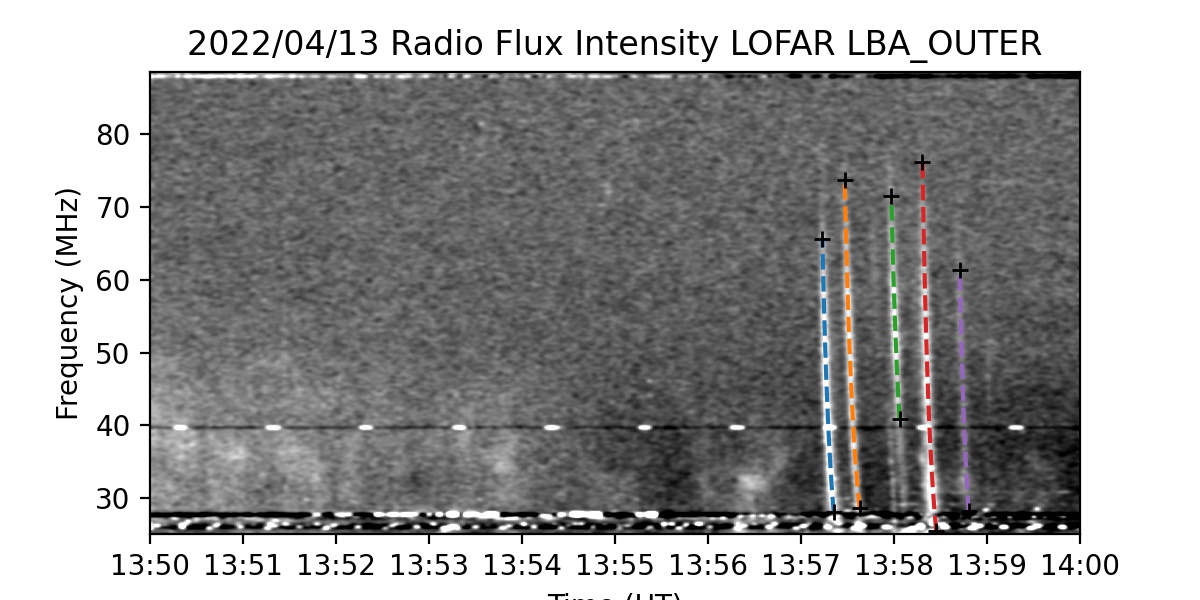
Read fits file and detect type III radio bursts in dynamic spectrum.
import matplotlib.dates as mdates
import matplotlib.pyplot as plt
import numpy as np

from type3detect import detectRadioburst as drb
from type3detect import radioTools as rt

fname  = './LOFAR_20220701_070000_LBA_OUTER_S0.fits'

# preprocess
(dyspec,t_fits,f_fits,hdu) = drb.read_fits(fname) # read LOFAR dynspec fits
(dyspec,f_fits) = drb.cut_low(dyspec,f_fits,f_low_cut_val=30) # remove below freq (RFI)
(data_fits_new,data_fits_new_smooth) = drb.preproc(dyspec,gauss_sigma=1.5)

# binarization
bmap = drb.binarization(data_fits_new,N_order=6,peak_r=1.002)

# detect verticle features
lines = drb.hough_detect(bmap,dyspec,threshold=40,line_gap=10,line_length=30,
            theta=np.linspace(np.pi/2-np.pi/8,np.pi/2-1/180*np.pi,300))
line_sets = drb.line_grouping(lines)

# get electron beam information from radio bursts
(v_beam, f_range_burst, t_range_burst, model_curve_set,
     t_set_arr_set,f_set_arr_set,t_model_arr,f_model_arr
    )= drb.get_info_from_linegroup(line_sets,t_fits,f_fits)

# detailed demo in ./type3detect_demo.ipynb
Example: Implementation with for LOFAR dynamic spectrum.
Demo Notebook: type3detect_demo.ipynb
Binarization
Use several ways to transform the flux intensity data into binary. (LocalMax(matlab)) (binarization(Python))
Active-Contour method for Backbone
The Active Contour Method for the backbone of the radio burst (ACBone)
Take the result of the Hough transform as a initail position and iteratively move the line to find the backbone position. The demo code : (ACBone-Matlab, ACBone-Python)
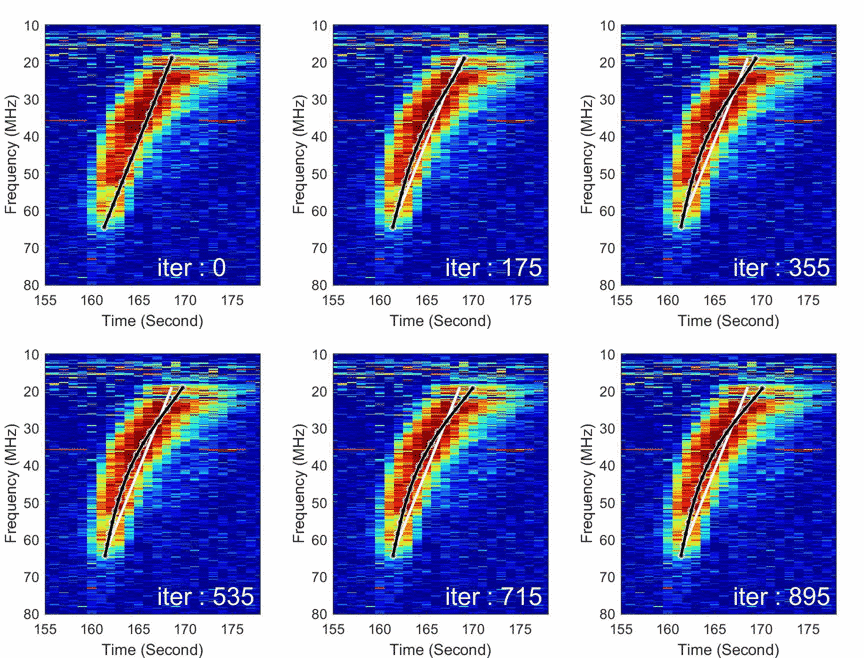
Eventually, we can obtain the centerline of a Type III radio burst.
Citation
Make sure to cite the paper if you use the idea or code in this repo: A type III radio burst automatic analysis system and statistic results for a half solar cycle with Nançay Decameter Array data Peijin Zhang. A&A 2018.10
bibtex:
@article{zhang2018type,
  title={A type III radio burst automatic analysis system and statistic results for a half solar cycle with Nan{\c{c}}ay Decameter Array data},
  author={Zhang, PJ and Wang, Chuan Bing and Ye, Lin},
  journal={Astronomy \& Astrophysics},
  volume={618},
  pages={A165},
  year={2018},
  publisher={EDP Sciences}
}
1 maintainer

Metadata
1 maintainer
Release files for type3detect 0.0.3
For a detailed explanation of source distributions (sdists) and built distributions (wheels), please see the package formats documentation.
Source distribution (sdist)
| File | Size | Uploaded | Provenance | Actions |
|---|---|---|---|---|
| type3detect-0.0.3.tar.gz | 7.2 kB | Without provenance | Details for type3detect-0.0.3.tar.gz |
Release files / type3detect-0.0.3.tar.gz
| Download URL | type3detect-0.0.3.tar.gz |
|---|---|
| Size | 7.2 kB |
| Tags | Source |
|
SHA-256 checksum How to use checksums |
62c2eed2fa2855837ab80ddf225864b57b29299ff0f28bdf58ce00bd4322dbe4
|
|
BLAKE2b-256 checksum How to use checksums |
9b551e7ef84441ec8b7693933e5a5e05abb7ad13ac87096d453008f3d36f259b
|
| Upload date | |
|
Uploaded using Trusted Publishing? What is trusted publishing? |
No |
| Uploaded via |
twine/4.0.2 CPython/3.9.13
|
Security for type3detect 0.0.3
Provenance
Provenance describes where a file came from. On PyPI, provenance is shared via attestations, which provide a verifiable record of the build or publishing details. View details, limitations and caveats.
No provenance found
None of the files in this release were uploaded with provenance metadata.
A note on package security
PyPI is a repository for distributing packages, not a service for auditing them. While third-party security researchers and our staff do their best to detect and remove malicious packages, PyPI cannot guarantee the quality, security or suitability of any given package.
To learn more about protecting yourself from malicious actors, visit our package security documentation.














