
Judgement as a Service.
Typejudge will automatically check for semver compliance based on type hints. If the type signature for a function changes, it will judge this to be an API change and recommend a major version bump.
This is largely inspired by Elm’s package manager, which also enforces semver.
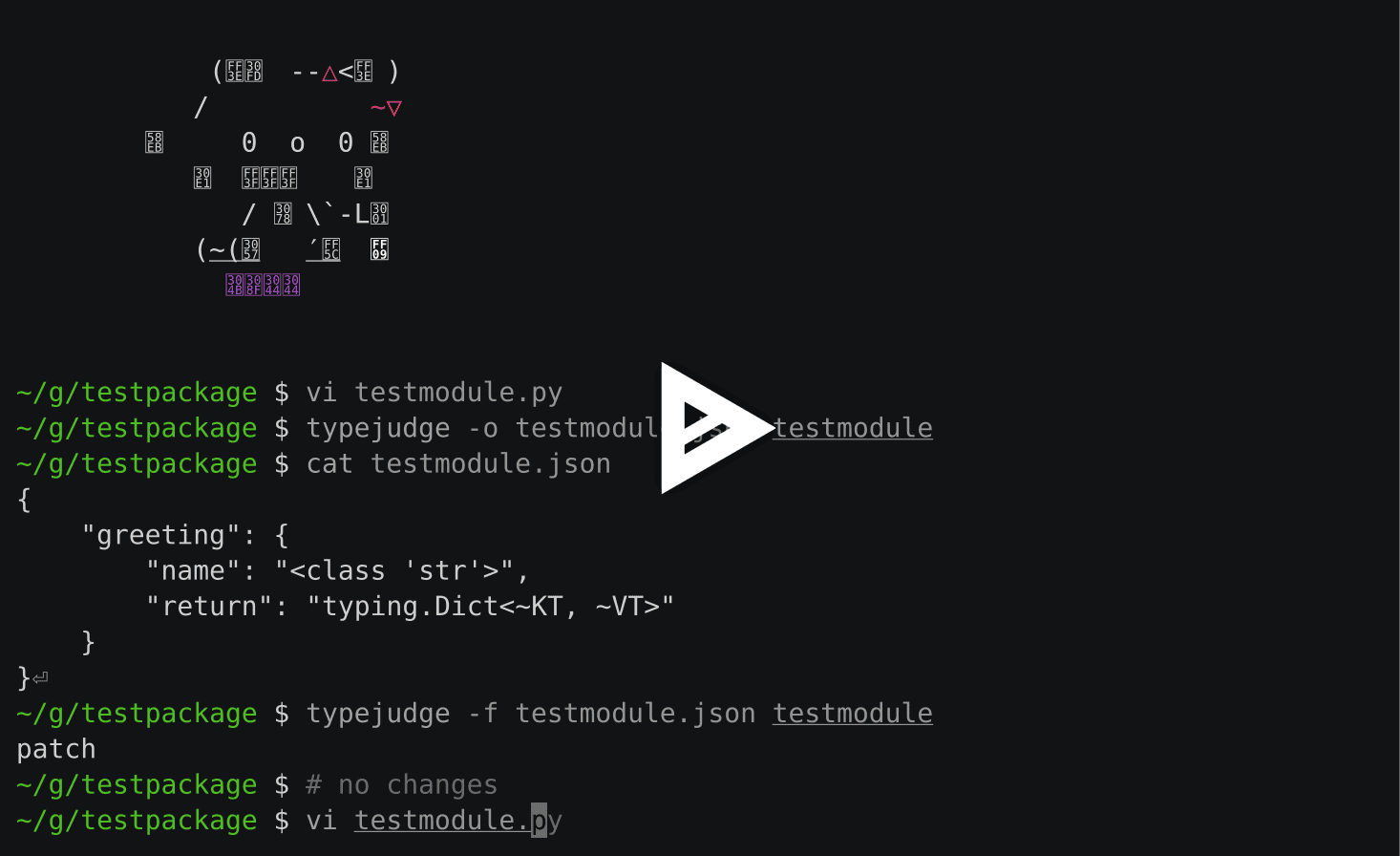
Installation
Note: typejudge only works on python 3.5 and higher.
Install with pip:
$ pip install typejudge
Usage
$ typejudge --help
usage: typejudge [-h] [-o OUT] [-f FILE] MODULE [VERSION]

judge your types

positional arguments:
  MODULE                module to import and check
  VERSION               current version of the package

optional arguments:
  -h, --help            show this help message and exit
  -o OUT, --out OUT     save current type definitions to this file
  -f FILE, --file FILE  load type definitions from this file
Example usage
Suppose we’ve got a module that contains some type annotations on the publicly exported API, testmodule.py:
def greeting(name: str) -> str:
    return 'Hello ' + name
Save the types somewhere:
$ typejudge -o testmodule.json testmoduleMake some small change to testmodule.py, add a new function:
def greeting2(name: str, name2: str) -> str:
    return 'Hello ' + name + ' and ' name2
Typejudge will recommend this is a minor release:
$ typejudge -f testmodule.json testmodule
minor
The same, but with a known current version number:
$ typejudge -f testmodule.json testmodule 0.3.2
0.4.0
Make a change to existing type signatures:
from typing import List

def greeting(names: List[str]) -> str:
    return 'Hello ' + ' '.join(names)
Typejudge will now recommend this is a major release:
$ typejudge -f testmodule.json testmodule
major
With no changes to the API’s types, typejudge will recommend a patch release.
Example usage with bumpversion
Typejudge works quite well with bumpversion. Doing this is probably inadvisable, but you can entirely automate releases.
Assuming similar files as in the previous section, set up a config file for bumpversion, something like:
$ cat .bumpversion.cfg
[bumpversion]
current_version = 2.0.3
commit = True
tag = True

[bumpversion:file:setup.py]
And a setup.py:
$ cat setup.py
import setuptools

setuptools.setup(
    name="testpackage",
    version="2.0.3",
    description="Test stuff",
)
Then run something along these lines to cut a new release:
$ bumpversion $(typejudge -f testmodule.json testmodule)You’ll also want to save the state of the API at this point, so you can compare it at the next release:
$ typejudge -o testmodule.json testmoduleObviously use some discretion when releasing in this way. Just because the types of your API remain the same, it doesn’t necessarily mean that your code is backwards compatible. Typejudge suggests the smallest version increment you should make.
1 maintainer

Metadata
1 maintainer
Release files for typejudge 0.3.0
For a detailed explanation of source distributions (sdists) and built distributions (wheels), please see the package formats documentation.
Source distribution (sdist)
| File | Size | Uploaded | Provenance | |
|---|---|---|---|---|
| typejudge-0.3.0.tar.gz | 3.8 kB | Without provenance | Details |
Release files / typejudge-0.3.0.tar.gz
| Download URL | typejudge-0.3.0.tar.gz |
|---|---|
| Size | 3.8 kB |
| Tags | Source |
|
SHA-256 checksum How to use checksums |
1341004b94af1d445085f31aa2813e14d79aeabdaf4e677cfeec3cdcdcceabd7
|
|
BLAKE2b-256 checksum How to use checksums |
54387562013bb3bdfa69d1c03c0d770defcedab1d4cbc599e74b4c78c6e14f61
|
| Upload date | |
|
Uploaded using Trusted Publishing? What is trusted publishing? |
No |
Security for typejudge 0.3.0
Provenance
Provenance describes where a file came from. On PyPI, provenance is shared via attestations, which provide a verifiable record of the build or publishing details. View details, limitations and caveats.
No provenance found
None of the files in this release were uploaded with provenance metadata.
A note on package security
PyPI is a repository for distributing packages, not a service for auditing them. While third-party security researchers and our staff do their best to detect and remove malicious packages, PyPI cannot guarantee the quality, security or suitability of any given package.














