



Important note
-
Since
2026.02.16:- Partial support of
tytype checker - Supports type checking under
PyPy3.11
- Partial support of
-
Since
2026.01.01:- Support for
pyreflytype checker - New
mypyplugin that mimicsXMLParser.set_element_class_lookup()behavior
- Support for
-
Since
2025.11.25:- PEP 800 support, thus only compatible with newest type checkers as of Oct 2025
- Declare and make use of Python 3.14 support; drops Python 3.8 support
-
Since
2025.08.25:- Supports
lxml6.0 and 5.4, whilelxml4.9 will not be tested anymore
- Supports
-
Since
2025.03.04:BeautifulSoup4package is added as dependency to utilise its inline annotation, thus droppingtypes-beautifulsoup4dependency.- Fixes compatibility with older versions of type checkers, as well as
mypy1.14+.
Introduction
This repository contains external type annotations for lxml. It can be used by type-checking tools to check code that uses lxml, or used within IDEs like Visual Studio Code to facilitate development.
Goal ① : Completion
Implementation is complete since 1Q 2003, thus no more considered as partial. Following submodules intentionally not implemented due to irrelevance to type checking or other reasons:
lxml.etree.Schematron(obsolete and superseded bylxml.isoschematron)lxml.usedoctest(for testing only)lxml.html.usedoctest(for testing only)lxml.html.formfill(shouldn't have existed, this would belong to HTTP libraries likerequestsorhttpx)
Goal ② : Support multiple type checkers
Currently the annotations are validated for following type checkers:
| Name | Version |
|---|---|
basedpyright |
≥ 1.31.6 |
mypy |
≥ 1.18.1 |
pyrefly |
≥ 0.46.3 |
pyright |
≥ 1.1.406 |
ty |
≥ 0.0.7 |
pyright and basedpyright are recommended for their greater flexibility, maturity and early adoption of newer type checking features. In the future, there is plan to bring even more type checker support (such as ty or zuban).
Goal ③: Review and test suite
- All prior
lxml-stubscontributions are reviewed thoroughly, bringing coherency of annotation across the whole package - Perform runtime check, and compare against static type checker result; this guarantees annotations are indeed working in real world, not just within some cooked up test suite
- Existing static test suite already vastly expanded, and is under progress of migrating to runtime test
- Modernize package building infrastructure
Goal ④ : Geared towards users
Docstring
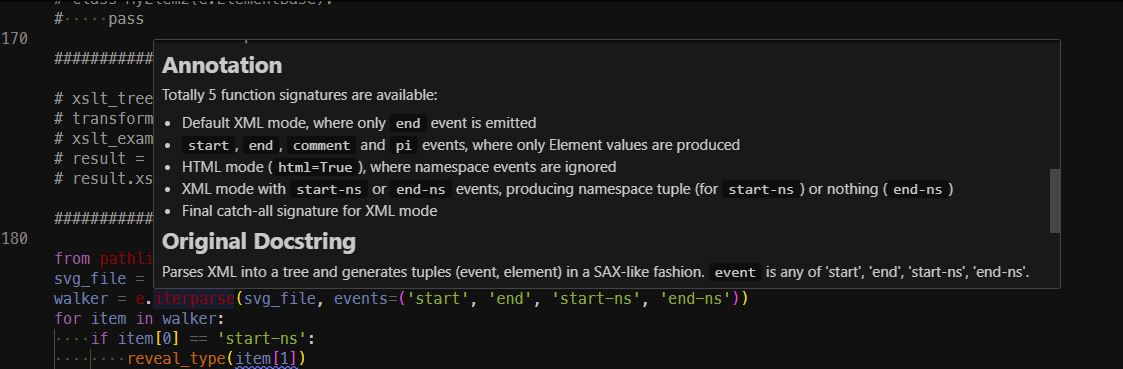
This package tries to bring type annotation specific docstrings for some classes and functions, explaining how they can be used. Following screenshot demonstrates annotation specific docstring in Visual Studio Code:
Warnings for exception and wrong code
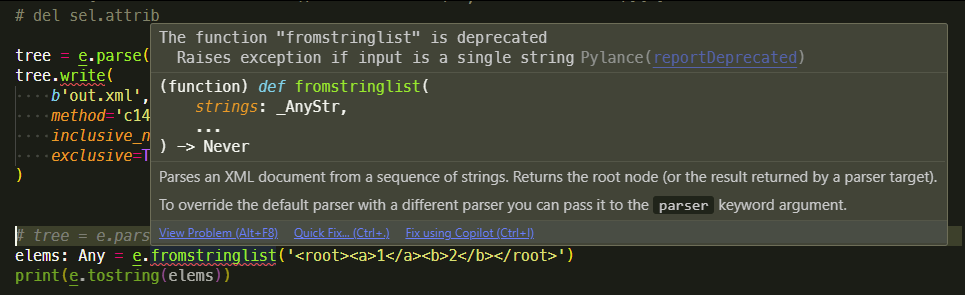
pyright and basedpyright users receive additional benefit of being forewarned when their lxml code will likely cause undesirable runtime behavior or outright exception.
- #64 covers one such example where such warnings are warrented.
- Another example is
html.html5parsersubmodule functions causing exception whenstrinput andguess_charsetparameter are used together.
Similarly their corresponding Visual Studio Code extensions would display visual cue when such problematic usage is encountered, as shown in above screenshot.
[!NOTE] This feature makes use of
@deprecateddecorator from Python 3.13.mypydisables such warnings by default, and need to be turned on explicitly.
Class inheritance change
Current annotations are geared towards convenience for programmers' convenience instead of absolute logical 'correctness'. The deviation of class inheritance for HtmlComment and friends is one prominent example.
Installation
The normal choice for most people is to fetch package from PyPI, like:
uv pip install -U types-lxml  # using uv
pip install -U types-lxml  # using pip
In the unlikely case PyPI is down, one can directly download wheel from latest release in GitHub, and then perform installation as local file.
As convenience, it is possible to pull development related packages. This helps when you want to submit PR on bugs or features:
uv pip install -U types-lxml[dev]
pip install -U types-lxml[dev]
The stub package supports all Python versions since 3.9. But if you want to create PR and test your changes, Python 3.10 is needed.
Mypy plugin usage
Mypy plugin bundled with this stub package needs to be explicitly turned on from config. Add these two lines under [mypy] global section if you're using INI file:
plugins =
    mypy_plugin_lxml.main
Alternatively, add this under [tool.mypy] section for pyproject.toml:
plugins = ["mypy_plugin_lxml.main"]
Choosing the build
Since 2024.08.07 release, there will be two versions of types-lxml. First one is the default one; if there's no problem using it, there's no need to switch.
The second version, types-lxml-multi-subclass, is intended for specific need, namely creation of multiple lxml element subclasses. For example:
  graph TD;
      etree.ElementBase-->MyBaseElement;
      MyBaseElement-->MySubElement1;
      MyBaseElement-->MySubElement2;
If a parsed or constructed element tree consists of single type of element nodes, it is safe to assume the children or parent of a node are of the same type too. But this assumption does not hold for multiple subclasses. Using diagram above as example, calling .iter() method from MyBaseElement node may produce element of any subelement or even MyBaseElement itself.
Therefore output type should be simply MyBaseElement only.
Such scenario is already in effect for lxml.html. <form> element (FormElement) is supposed to contain other form related tags like <input>, <select> etc. But we can't possibly pinpoint single subelement type, so <form> children can only possibly be of type HtmlElement. The multiple subelement scenario is already hardcoded for HtmlElement and ObjectifiedElement within this annotation package, but users may choose to have their own overridden element subclasses (inherit from ElementBase) too.
The 2 paradigms can't coexist within a single type annotation package. See bug #51 that illustrated why multiple build is necessary.
[!IMPORTANT] Users can only choose to install either build, not both.
pipwould arbitrarily overwrite conflicting files with one another. If in doubt, removing existing package first, then install the one you needed.
Release file attestation
[!TIP] For those haven't heard of it, this is sort of like
gnupgorminisignsignatures, but with GitHub backed infrastructure.
Since 2024.11.08 users can download types-lxml release files and verify that they indeed do originate from GitHub. After downloading release wheel file (say pip download types-lxml, or browser access to PyPI directly), one can use GitHub cli to verify it comes from this GitHub repository without being altered:
gh at verify types_lxml-2024.11.8-py3-none-any.whl --repo abelcheung/types-lxml
Should generate following result:
Loaded digest sha256:4b4fa7f9e2f1d5f58b98ac9852a75927e4e0f69363249f9cebc78db095c046e0 for file://types_lxml-2024.11.8-py3-none-any.whl
Loaded 1 attestation from GitHub API
✓ Verification succeeded!

sha256:4b4fa7f9e2f1d5f58b98ac9852a75927e4e0f69363249f9cebc78db095c046e0 was attested by:
REPO                   PREDICATE_TYPE                  WORKFLOW
abelcheung/types-lxml  https://slsa.dev/provenance/v1  .github/workflows/release.yml@refs/tags/2024.11.08
History
Type annotations for lxml were initially included in typeshed, but as it was still incomplete at that time, the stubs are ripped out as a separate project. The code was since then under governance of lxml, until 2022 when this fork intended to revamp lxml-stubs completely and emerge into separate project.
types-lxml is a fork of lxml-stubs that strives for the goals described above, so that most people would find it more useful.
1 maintainer

Metadata
1 maintainer
Release files for types-lxml 2026.2.16
For a detailed explanation of source distributions (sdists) and built distributions (wheels), please see the package formats documentation.
Source distribution (sdist)
| File | Size | Uploaded | |
|---|---|---|---|
| types_lxml-2026.2.16.tar.gz | 161.2 kB | Details |
Built distribution (wheel)
| File | Interpreter | ABI | Platform | Reset |
|---|---|---|---|---|
| types_lxml-2026.2.16-py3-none-any.whl | Python 3 | none | any | Details |
Total release size: 258.2 kB
Release files / types_lxml-2026.2.16.tar.gz
| Download URL | types_lxml-2026.2.16.tar.gz |
|---|---|
| Size | 161.2 kB |
| Tags | Source |
|
SHA-256 checksum How to use checksums |
b3a1340cc06db98d541c785732f6f68bea438daff4e2b7809ef748d545d01406
|
|
BLAKE2b-256 checksum How to use checksums |
ddadc70ac8cbdc28eb58a17301c69b4925af54b614e47f9b2ebc9de5cc10f786
|
| Upload date | |
|
Uploaded using Trusted Publishing? What is trusted publishing? |
No |
| Uploaded via |
twine/6.2.0 CPython/3.14.2
|
Release files / types_lxml-2026.2.16-py3-none-any.whl
| Download URL | types_lxml-2026.2.16-py3-none-any.whl |
|---|---|
| Size | 97.0 kB |
| Tags | Python 3 |
|
SHA-256 checksum How to use checksums |
5dd81ffa54830e5f361988737c5f1d6a0ae48b2742790637ec560df790ea0401
|
|
BLAKE2b-256 checksum How to use checksums |
5f5c03ec9befbf4bb5309bfd576c6a5ac1c75633f78f6b64cf1f594e97cd3d23
|
| Upload date | |
|
Uploaded using Trusted Publishing? What is trusted publishing? |
No |
| Uploaded via |
twine/6.2.0 CPython/3.14.2
|














