
A small unittest-based tool for generating single page html reports in Python.

Project description
:page_facing_up: unitreport 

UnitReport is a small unittest-based tool for generating single page html reports in Python. The reports can include matplotlib figures and html tables. It is designed to be minimal and fit into the unittesting framework, allowing users to make assertions about their data (e.g. data quality) before generating figures.
Getting Started
You can install the library using,
pip3 install unitreport
There are usage examples in test_plots.py and test_tables.py.
You need to create test cases using the unittest Python library, and utilise unitreport's decorators:
import unittest
import unitreport

import seaborn as sns
import pandas as pd

class TestExample(unittest.TestCase):
    """Example test suite producing plots and tables in a report using unitreport."""

    dataset: pd.DataFrame = None

    @classmethod
    def setUpClass(cls):
        """Load dataset on setup."""
        cls.dataset = sns.load_dataset("fmri")

    @unitreport.plotting
    def test_timepoint_vs_signal_by_event(self):
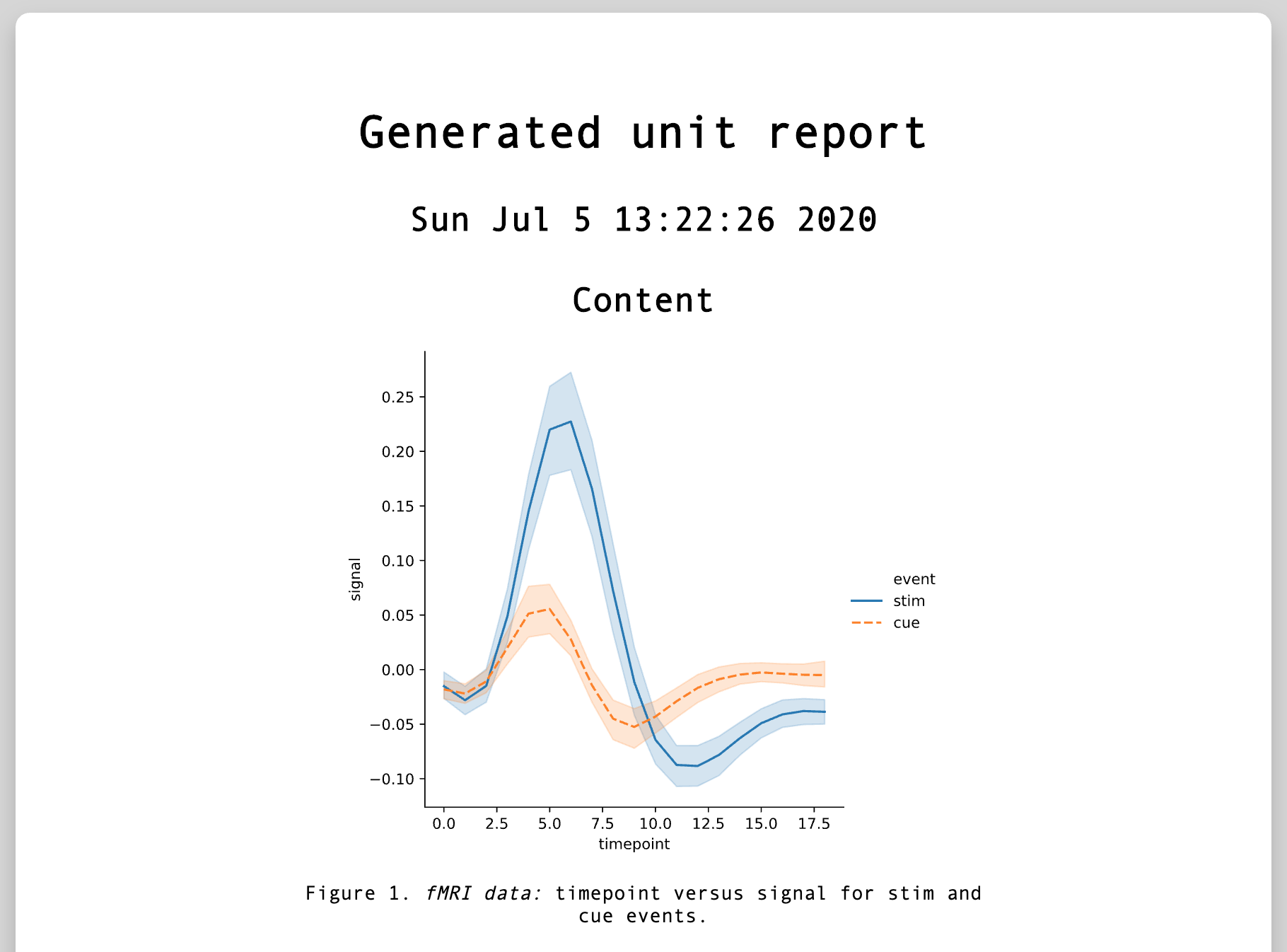
        """*fMRI data:* timepoint versus signal for stim and cue events."""
        # you can still run assertions to check data quality before plotting
        self.assertEqual(self.dataset.shape, (1064, 5))

        # plotting decorator will call plt.savefig() to generate the plot
        sns.relplot(
            x="timepoint",
            y="signal",
            hue="event",
            style="event",
            kind="line",
            data=self.dataset,
        )
        # could also return a figure & .savefig() will be called on returned object

    @unitreport.tabling
    def test_region_counts(self):
        """*fMRI data:* table summary description of timepoints and signals."""
        # you can still run assertions to check data quality before making table
        self.assertEqual(self.dataset.shape, (1064, 5))

        return self.dataset.describe().to_html()
You can run the tests using,
python3 -m unitreport
This will discover and run the tests (which could be across multiple test files), generate the report and save it to the current directory.
For extra parameters you can run the following,
python3 -m unitreport -h

usage: __main__.py [-h] [--tests_dir TESTS_DIR] [--pattern PATTERN]
                   [--templates_dir TEMPLATES_DIR] [--output_file OUTPUT_FILE]

optional arguments:
  -h, --help            show this help message and exit
  --tests_dir TESTS_DIR
                        Path to test files. (default: .)
  --pattern PATTERN     File patterns to discover test cases in. (default:
                        test*.py)
  --templates_dir TEMPLATES_DIR
                        Path to jinja2 templates directory including
                        index.html and main.css. (default: (unitreport) templates)
  --output_file OUTPUT_FILE
                        Output path including name. (default: report.html)
There are template index.html and main.css files which will be used by default to generate the style of the report.
You can also specify a path to your own templates using --templates_dir, where the html Jinja2 template can expect to receive date (today's date), and figures, a dictionary with test function names as keys mapped to values of type (table or plot), content (svg or html table) and description (test function's docstring).
You can also invoke unitreport from a Python script using the library's main() (runs tests and generates report), discover_and_run() (only run tests) and generate_report() (only generate report) functions.
These utilise the default values for the above parameters if not specified by the user, and generate_report() uses the global FIGURES dictionary generated from the tests if not passed. For more details on what they do, you can check the source code.
import unitreport

# result is a unittest.TestResult which you can access things such as result.errors
result, figs = unitreport.discover_and_run()
print(result) # <unittest.runner.TextTestResult run=3 errors=0 failures=0>
print(figs) # Dict with test function names as keys mapped to 'type', 'content', and 'description'
# html_report is a string containing the generated report
html_report = unitreport.generate_report()

# same as above, raises assertion error if there are errors in tests or no tests found
result, figs, html_report = unitreport.main()
Built With
- unittest - underlying testing framework
- Jinja2 - rendering and generating the report
- matplotlib - plotting library
- Markdown - Python markdown library for markdown captions
Release history Release notifications | RSS feed


Download files
Download the file for your platform. If you're not sure which to choose, learn more about installing packages.
Source Distribution
Built Distribution
Filter files by name, interpreter, ABI, and platform.
If you're not sure about the file name format, learn more about wheel file names.
Copy a direct link to the current filters
File details
Details for the file unitreport-0.1.1.tar.gz.
File metadata
- Download URL: unitreport-0.1.1.tar.gz
- Upload date:
- Size: 7.3 kB
- Tags: Source
- Uploaded using Trusted Publishing? No
- Uploaded via: twine/4.0.1 CPython/3.11.4
File hashes
| Algorithm | Hash digest | |
|---|---|---|
| SHA256 |
b19826e09c04527467ecedbb5d3053bf52d7c24debb1f4ded603138f92c5d99a
|
|
| MD5 |
144ae26eadcb00925326288fb2ef1b7a
|
|
| BLAKE2b-256 |
c247aabb7395e82da94754b6152202491fa9a3f61fba49241d8380775ae7580b
|
File details
Details for the file unitreport-0.1.1-py3-none-any.whl.
File metadata
- Download URL: unitreport-0.1.1-py3-none-any.whl
- Upload date:
- Size: 8.9 kB
- Tags: Python 3
- Uploaded using Trusted Publishing? No
- Uploaded via: twine/4.0.1 CPython/3.11.4
File hashes
| Algorithm | Hash digest | |
|---|---|---|
| SHA256 |
4d5ec32393fb26603791962b10a2a301ad852798f1a992e882ed6f10af519455
|
|
| MD5 |
26d572ac84722233807a5dfa8a3be0b5
|
|
| BLAKE2b-256 |
1c28643735e43141bcca9c6030fef867b23e1c333a7a46ac6a45dfe9e6aa4b4e
|






