
ViX

Vision Xformers: Efficient Attention for Image Classification
We use Linear Attention mechanisms to replace quadratic attention in ViT for image classification. We show that models using linear attention and CNN embedding layers need less parameters and low GPU requirements for achieving good accuracy. These improvements can be used to democratize the use of transformers by practitioners who are limited by data and GPU.
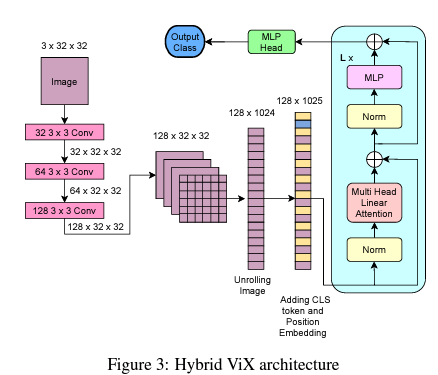
Hybrid ViX uses convolutional layers instead of linear layer for generating embeddings
Rotary Postion Embedding (RoPE) is also used in our models instead of 1D learnable position embeddings
Nomenclature: We replace the X in ViX with the starting alphabet of the attention mechanism used Eg. When we use Performer in ViX, we replace the X with P, calling it ViP (Vision Performer)
'Hybrid' prefix is used in models which uses convolutional layers instead of linear embeddding layer.
We have added RoPE in the title of models which used Rotary Postion Embedding
The code for using all for these models for classification of CIFAR 10/Tiny ImageNet dataset is provided
Models
- Vision Transformer (ViT)
- Vision Linformer (ViL)
- Vision Performer (ViP)
- Vision Nyströmformer (ViN)
- FNet
- Hybrid Vision Transformer (HybridViT)
- Hybrid Vision Linformer (HybridViL)
- Hybrid Vision Performer (HybridViP)
- Hybrid Vision Nyströmformer (HybridViN)
- Hybrid FNet
- LeViN (Replacing Transformer in LeViT with Nyströmformer)
- LeViP (Replacing Transformer in LeViT with Performer)
- CvN (Replacing Transformer in CvT with Nyströmformer)
- CvP (Replacing Transformer in CvT with Performer)
- CCN (Replacing Transformer in CCT with Nyströmformer)
- CCP(Replacing Transformer in CCT with Performer)
We have adapted the codes for ViT and linear transformers from @lucidrains
Install
$ pip install vision-xformer
Usage
Image Classification
Vision Nyströmformer (ViN)
import torch, vision_xformer
from vision_xformer import ViN

model = ViN(
    image_size = 32,
    patch_size = 1,
    num_classes = 10,
    dim = 128,
    depth = 4,
    heads = 4,
    mlp_dim = 256,
    num_landmarks = 256,
    pool = 'cls',
    channels = 3,
    dropout = 0.,
    emb_dropout = 0.
    dim_head = 32
)

img = torch.randn(1, 3, 32, 32)

preds = model(img) # (1, 10)
Vision Performer (ViP)
import torch, vision_xformer
from vision_xformer import ViP

model = ViP(
    image_size = 32,
    patch_size = 1,
    num_classes = 10,
    dim = 128,
    depth = 4,
    heads = 4,
    mlp_dim = 256,
    dropout = 0.25,
    dim_head = 32
)

img = torch.randn(1, 3, 32, 32)

preds = model(img) # (1, 10)
Vision Linformer (ViL)
import torch, vision_xformer
from vision_xformer import ViL

model = ViL(
    image_size = 32,
    patch_size = 1,
    num_classes = 10,
    dim = 128,
    depth = 4,
    heads = 4,
    mlp_dim = 256,
    dropout = 0.25,
    dim_head = 32
)

img = torch.randn(1, 3, 32, 32)

preds = model(img) # (1, 10)
Parameters
image_size: int.
Size of input image. If you have rectangular images, make sure your image size is the maximum of the width and heightpatch_size: int.
Number of patches.image_sizemust be divisible bypatch_size.num_classes: int.
Number of classes to classify.dim: int.
Final dimension of token emeddings after linear layer.depth: int.
Number of layers.heads: int.
Number of heads in multi-head attentionmlp_dim: int.
Embedding dimension in the MLP (FeedForward) layer.num_landmarks: int. Number of landmark points. Use one-fourth the number of patches.pool: str. Pool type must be either'cls'(cls token) or'mean'(mean pooling)dropout: float between[0, 1], default0..
Dropout rate.dim_head: int.
Embedding dimension of token in each head of mulit-head attention.
More information about these models can be obtained from our paper : ArXiv Paper, WACV 2022 Paper
If you wish to cite this, please use:
@misc{jeevan2021vision,
      title={Vision Xformers: Efficient Attention for Image Classification},
      author={Pranav Jeevan and Amit Sethi},
      year={2021},
      eprint={2107.02239},
      archivePrefix={arXiv},
      primaryClass={cs.CV}
}
@InProceedings{Jeevan_2022_WACV,
    author    = {Jeevan, Pranav and Sethi, Amit},
    title     = {Resource-Efficient Hybrid X-Formers for Vision},
    booktitle = {Proceedings of the IEEE/CVF Winter Conference on Applications of Computer Vision (WACV)},
    month     = {January},
    year      = {2022},
    pages     = {2982-2990}
}
1 maintainer

Metadata
1 maintainer
Release files for vision-xformer 0.2.0
For a detailed explanation of source distributions (sdists) and built distributions (wheels), please see the package formats documentation.
Source distribution (sdist)
| File | Size | Uploaded | Provenance | Actions |
|---|---|---|---|---|
| vision_xformer-0.2.0.tar.gz | 13.3 kB | Without provenance | Details for vision_xformer-0.2.0.tar.gz |
Built distribution (wheel)
| File | Interpreter | ABI | Platform | Actions Reset |
|---|---|---|---|---|
| vision_xformer-0.2.0-py3-none-any.whl | Python 3 | none | any | Details for vision_xformer-0.2.0-py3-none-any.whl |
Total release size: 28.3 kB
Release files / vision_xformer-0.2.0.tar.gz
| Download URL | vision_xformer-0.2.0.tar.gz |
|---|---|
| Size | 13.3 kB |
| Tags | Source |
|
SHA-256 checksum How to use checksums |
dd43ee2e6a68d9674a1d360d9677dfa9bf0d510e0b39b6b24d156218a29020ad
|
|
BLAKE2b-256 checksum How to use checksums |
c37183055714b73da06dff2f6b82d389407eba72c24cdded7681c0adc529eccf
|
| Upload date | |
|
Uploaded using Trusted Publishing? What is trusted publishing? |
No |
| Uploaded via |
twine/4.0.2 CPython/3.11.3
|
Release files / vision_xformer-0.2.0-py3-none-any.whl
| Download URL | vision_xformer-0.2.0-py3-none-any.whl |
|---|---|
| Size | 15.1 kB |
| Tags | Python 3 |
|
SHA-256 checksum How to use checksums |
6b4ebfef0a7331ff845a289dbc05556cf88ada592d6b7057031d2eec299bd725
|
|
BLAKE2b-256 checksum How to use checksums |
0c429688c73344eb1b0ddafb21410667e2c480c5c48d35860ef209b167c602ac
|
| Upload date | |
|
Uploaded using Trusted Publishing? What is trusted publishing? |
No |
| Uploaded via |
twine/4.0.2 CPython/3.11.3
|
Security for vision-xformer 0.2.0
Provenance
Provenance describes where a file came from. On PyPI, provenance is shared via attestations, which provide a verifiable record of the build or publishing details. View details, limitations and caveats.
No provenance found
None of the files in this release were uploaded with provenance metadata.
A note on package security
PyPI is a repository for distributing packages, not a service for auditing them. While third-party security researchers and our staff do their best to detect and remove malicious packages, PyPI cannot guarantee the quality, security or suitability of any given package.
To learn more about protecting yourself from malicious actors, visit our package security documentation.














