
vunnel
A tool for fetching, transforming, and storing vulnerability data from a variety of sources.
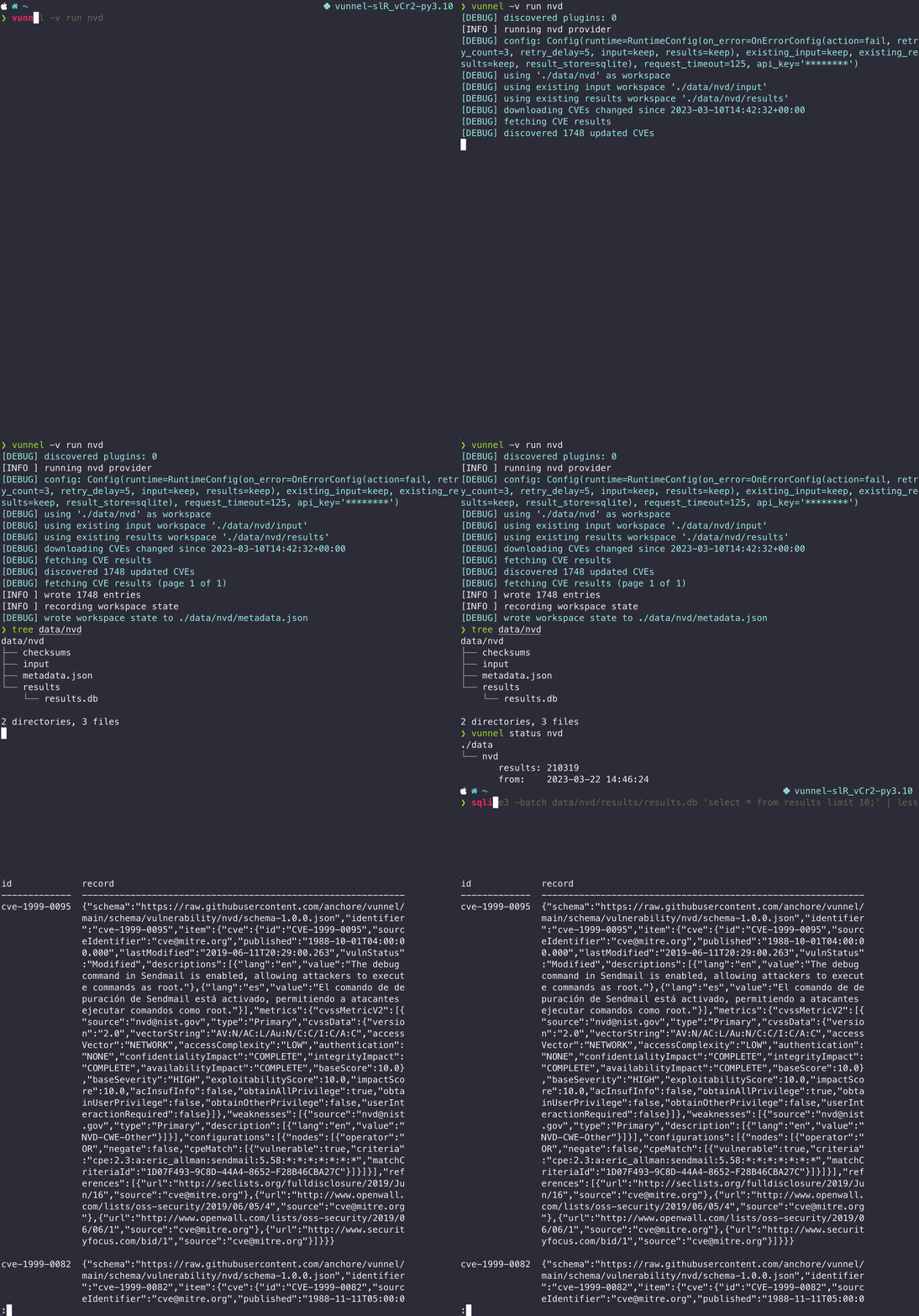
Supported data sources:
- Alpine (https://secdb.alpinelinux.org)
- Amazon (https://alas.aws.amazon.com/AL2/alas.rss & https://alas.aws.amazon.com/AL2022/alas.rss)
- Debian (https://security-tracker.debian.org/tracker/data/json & https://salsa.debian.org/security-tracker-team/security-tracker/raw/master/data/DSA/list)
- GitHub Security Advisories (https://api.github.com/graphql)
- NVD (https://services.nvd.nist.gov/rest/json/cves/2.0)
- Oracle (https://linux.oracle.com/security/oval)
- RedHat (https://www.redhat.com/security/data/oval)
- SLES (https://ftp.suse.com/pub/projects/security/oval)
- Ubuntu (https://launchpad.net/ubuntu-cve-tracker)
- Wolfi (https://packages.wolfi.dev)
Installation
With pip:
pip install vunnel
With docker:
docker run \
  --rm -it \
  -v $(pwd)/data:/data \
  -v $(pwd)/.vunnel.yaml:/.vunnel.yaml \
    ghcr.io/anchore/vunnel:latest  \
      run nvd
Where:
- the
datavolume keeps the processed data on the host - the
.vunnel.yamluses the host application config (if present) - you can swap
latestfor a specific version (same as the git tags)
See the vunnel package for a full listing of available tags.
Getting Started
List the available vulnerability data providers:
$ vunnel list

alpine
amazon
chainguard
debian
github
mariner
nvd
oracle
rhel
sles
ubuntu
wolfi
Download and process a provider:
$ vunnel run wolfi

2023-01-04 13:42:58 root [INFO] running wolfi provider
2023-01-04 13:42:58 wolfi [INFO] downloading Wolfi secdb https://packages.wolfi.dev/os/security.json
2023-01-04 13:42:59 wolfi [INFO] wrote 56 entries
2023-01-04 13:42:59 wolfi [INFO] recording workspace state
You will see the processed vulnerability data in the local ./data directory
$ tree data

data
└── wolfi
    ├── checksums
    ├── metadata.json
    ├── input
    │   └── secdb
    │       └── os
    │           └── security.json
    └── results
        └── wolfi:rolling
            ├── CVE-2016-2781.json
            ├── CVE-2017-8806.json
            ├── CVE-2018-1000156.json
            └── ...
Note: to get more verbose output, use -v, -vv, or -vvv (e.g. vunnel -vv run wolfi)
Delete existing input and result data for one or more providers:
$ vunnel clear wolfi

2023-01-04 13:48:31 root [INFO] clearing wolfi provider state
Example config file for changing application behavior:
# .vunnel.yaml
root: ./processed-data

log:
  level: trace

providers:
  wolfi:
    request_timeout: 125
    runtime:
      existing_input: keep
      existing_results: delete-before-write
      on_error:
        action: fail
        input: keep
        results: keep
        retry_count: 3
        retry_delay: 10
Use vunnel config to get a better idea of all of the possible configuration options.
FAQ
Can I implement a new provider?
Yes you can! See the provider docs for more information.
Why is it called "vunnel"?
This tool "funnels" vulnerability data into a single spot for easy processing... say "vulnerability data funnel" 100x fast enough and eventually it'll slur to "vunnel" :).
1 maintainer

Metadata
1 maintainer
Release files for vunnel 0.18.3
For a detailed explanation of source distributions (sdists) and built distributions (wheels), please see the package formats documentation.
Source distribution (sdist)
| File | Size | Uploaded | Provenance | Actions |
|---|---|---|---|---|
| vunnel-0.18.3.tar.gz | 94.2 kB | Without provenance | Details for vunnel-0.18.3.tar.gz |
Built distribution (wheel)
| File | Interpreter | ABI | Platform | Actions Reset |
|---|---|---|---|---|
| vunnel-0.18.3-py3-none-any.whl | Python 3 | none | any | Details for vunnel-0.18.3-py3-none-any.whl |
Total release size: 209.0 kB
Release files / vunnel-0.18.3.tar.gz
| Download URL | vunnel-0.18.3.tar.gz |
|---|---|
| Size | 94.2 kB |
| Tags | Source |
|
SHA-256 checksum How to use checksums |
4f30bb08db365092bbb373ffccfb0a9697615235f3e67308faa55aa6a70d5d7a
|
|
BLAKE2b-256 checksum How to use checksums |
a26406bc30db4c3a369345170a167574e8f4d116ae44fc3423a0b9901575a5a3
|
| Upload date | |
|
Uploaded using Trusted Publishing? What is trusted publishing? |
No |
| Uploaded via |
poetry/1.7.0 CPython/3.11.7 Linux/6.2.0-1018-azure
|
Release files / vunnel-0.18.3-py3-none-any.whl
| Download URL | vunnel-0.18.3-py3-none-any.whl |
|---|---|
| Size | 114.8 kB |
| Tags | Python 3 |
|
SHA-256 checksum How to use checksums |
0eb45e6a9c65b4397d1381b66089d824bf29e6a1a403d7642702deeb867a9ef5
|
|
BLAKE2b-256 checksum How to use checksums |
87593f6e301de46538fd0f2287e8d5156190880d2247b8767dad9a32d1d2bd21
|
| Upload date | |
|
Uploaded using Trusted Publishing? What is trusted publishing? |
No |
| Uploaded via |
poetry/1.7.0 CPython/3.11.7 Linux/6.2.0-1018-azure
|
Security for vunnel 0.18.3
Provenance
Provenance describes where a file came from. On PyPI, provenance is shared via attestations, which provide a verifiable record of the build or publishing details. View details, limitations and caveats.
No provenance found
None of the files in this release were uploaded with provenance metadata.
A note on package security
PyPI is a repository for distributing packages, not a service for auditing them. While third-party security researchers and our staff do their best to detect and remove malicious packages, PyPI cannot guarantee the quality, security or suitability of any given package.
To learn more about protecting yourself from malicious actors, visit our package security documentation.














