
Web-PDB


Web-PDB is a web-interface for Python’s built-in PDB debugger. It allows to debug Python scripts remotely in a web-browser.
Features
Responsive design based on Bootstrap.
Python syntax highlighting with Prism (“Okaida” theme).
Supports all PDB features.
Standard input and output can be redirected to the web-console to interact with Python scripts remotely.
Current file box tracks current position in a file being executed. Red line numbers indicate breakpoints, if any.
Globals and Locals boxes show local and global variables in the current scope. Special variables that start and end with double underscores __ are excluded (you can always view them using PDB commands).
Human-readable Unicode literals for Python 2.
Command history that stores up to 10 last unique PDB commands (accessed by arrow UP/DOWN keys).
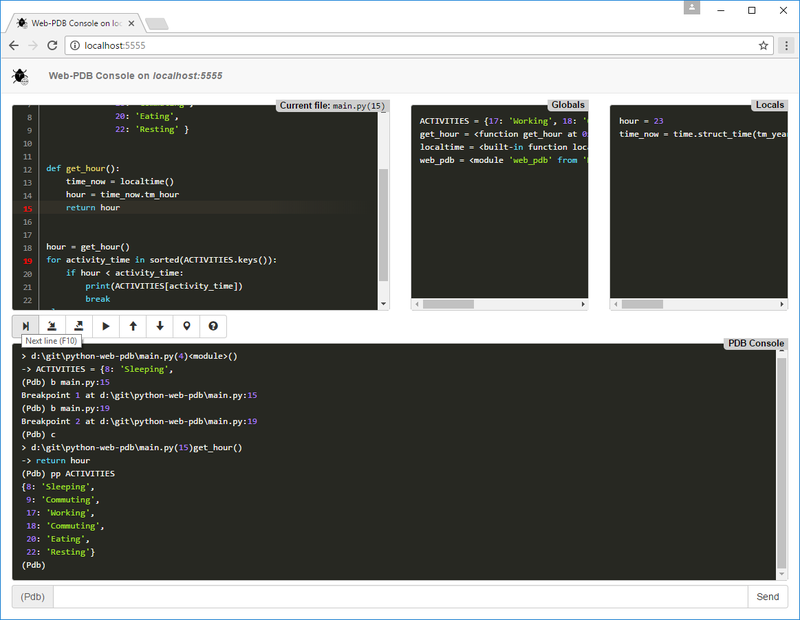
Web-PDB console in Chrome browser
Usage
Install Web-PDB into your working Python environment:
pip install web-pdb
Insert the following line into your Python program at the point where you want to start debugging:
import web_pdb; web_pdb.set_trace()The set_trace() call will suspend your program and open a web-UI at the default port 5555 (port value can be changed). Enter in your browser’s address bar: http://<your Python machine hostname or IP>:5555, for example http://monty-python:5555, and you should see the web-UI like the one on the preceding screenshot. Now you can use all PDB commands and features. Additional Current file, Globals and Locals information boxes help you better track your program runtime state.
Note: it is strongly recommended to work with the Web-PDB web-UI only in one browser session. With more than one browser window accessing the web-UI it can display incorrect data in one or more browser sessions.
Subsequent set_trace() calls can be used as hardcoded breakpoints.
Additionally, Web-PDB provides catch_post_mortem context manager that can catch unhandled exceptions raised within its scope and automatically start PDB post-mortem debugging session. For example:
import web_pdb

with web_pdb.catch_post_mortem():
    # Some error-prone code
    assert foo == bar, 'Oops!'
For more detailed info about the Web-PDB API read docstrings in the ./web_pdb/__init__.py file.
Note: Web-PDB periodically sends AJAX GET requests to /output/update endpoint. This is normal behaviour.
Considerations for Multithreading and Multiprocessing Programs
Multithreading
Web-PDB maintains one debugger instance that traces only one thread. You should not call set_trace() from different threads to avoid race conditions. Each thread needs to be debugged separately one at a time.
Multiprocessing
Each process can have its own debugger instance provided you call set_trace with a different port value for each process. This way you can debug each process in a separate browser tab/window. To simplify this you can use set_trace(port=-1) to select a random port between 32768 and 65536.
Compatibility
Python: 2.7, 3+
Browsers: Firefox, Chrome (all modern browsers should work)
License
MIT, see LICENSE.txt.
The debugger icon made by Freepik from www.flaticon.com is licensed by CC 3.0 BY.
Changelog
v.1.3.3
Fixed setting set_trace() at the last line of a Python script.
Fixed clearing a breakpoint at setups with the current workdir different from the current module directory.
v.1.3.2
Internal changes.
v.1.3.1
Now if web-console data haven’t changed the back-end sends “null” response body instead of a 403 error.
v.1.3.0
Implemented a multi-threaded WSGI server to increase responsiveness of the web-UI.
v.1.2.2
Added deflate compression for data sent to a browser.
Attempt to fix Current file box auto-scrolling.
v.1.2.1
Logger fix.
v.1.2.0
Minor UI redesign.
Added a quick action toolbar and hotkeys for common commands.
Added a quick help dialog.
Breakpoints can be added/deleted with a click on a line number.
The Currrent file box is not auto-scrolled if the current line hasn’t changed.
Multiple set_trace() and post_mortem() calls are processed correctly.
Added random web-UI port selection with port=-1.
v.1.1.0
Initial PyPI release
1 maintainer

Metadata
1 maintainer
Release files for web-pdb 1.3.3
For a detailed explanation of source distributions (sdists) and built distributions (wheels), please see the package formats documentation.
Source distribution (sdist)
| File | Size | Uploaded | Provenance | Actions |
|---|---|---|---|---|
| web-pdb-1.3.3.tar.gz | 198.0 kB | Without provenance | Details for web-pdb-1.3.3.tar.gz |
Built distribution (wheel)
| File | Interpreter | ABI | Platform | Actions Reset |
|---|---|---|---|---|
| web_pdb-1.3.3-py2.py3-none-any.whl | Python 3, Python 2 | none | any | Details for web_pdb-1.3.3-py2.py3-none-any.whl |
Total release size: 400.5 kB
Release files / web-pdb-1.3.3.tar.gz
| Download URL | web-pdb-1.3.3.tar.gz |
|---|---|
| Size | 198.0 kB |
| Tags | Source |
|
SHA-256 checksum How to use checksums |
3020ec9089871e3a262d87f8aaec086b2eacf6c90756c097d42afa488c81d23f
|
|
BLAKE2b-256 checksum How to use checksums |
cc0aedc7aea6f03d01ca4b575622faf2ee177233aec3cab4a1524de11f803f9f
|
| Upload date | |
|
Uploaded using Trusted Publishing? What is trusted publishing? |
No |
Release files / web_pdb-1.3.3-py2.py3-none-any.whl
| Download URL | web_pdb-1.3.3-py2.py3-none-any.whl |
|---|---|
| Size | 202.5 kB |
| Tags | Python 2 Python 3 |
|
SHA-256 checksum How to use checksums |
45e9470301dcf90ff74992f069d69e97ae8c7dd0ded28f3d23a964ed4de6baf5
|
|
BLAKE2b-256 checksum How to use checksums |
c5bb679ea4728f155d6a938652127a40874905047efae1244a088c89042af845
|
| Upload date | |
|
Uploaded using Trusted Publishing? What is trusted publishing? |
No |
Security for web-pdb 1.3.3
Provenance
Provenance describes where a file came from. On PyPI, provenance is shared via attestations, which provide a verifiable record of the build or publishing details. View details, limitations and caveats.
No provenance found
None of the files in this release were uploaded with provenance metadata.
A note on package security
PyPI is a repository for distributing packages, not a service for auditing them. While third-party security researchers and our staff do their best to detect and remove malicious packages, PyPI cannot guarantee the quality, security or suitability of any given package.
To learn more about protecting yourself from malicious actors, visit our package security documentation.














