
Finding certain messages in your WhatsApp message is sometimes hard, but Pandas makes it easier. Doesn't require root access!
Tested against Google Pixel 6 / Windows 10 / Python 3.10
Tutorial (Brazilian Portuguese)
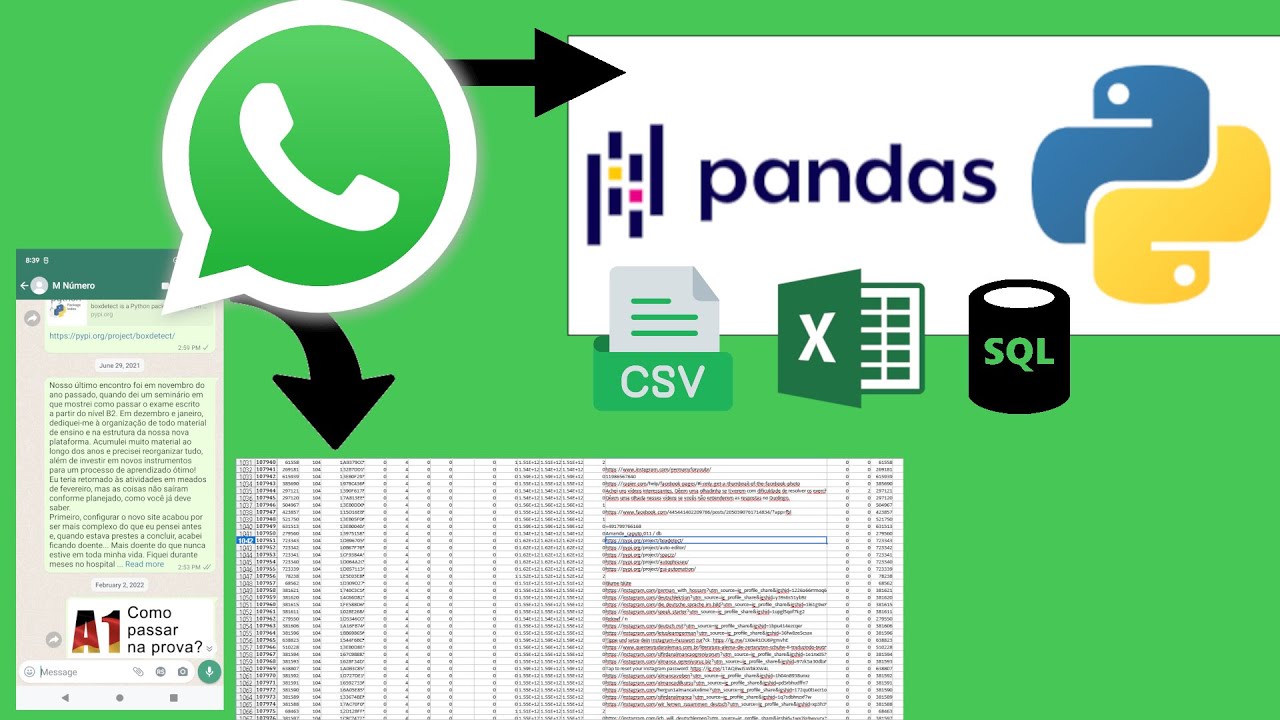
pip install whats2df

# This is the updated version of https://github.com/hansalemaos/a_pandas_ex_whatsapp_to_df
Follow these steps if you want to avoid rooting your cell phone:
- Open WhatsApp on your Android device.
- Tap the three-dot overflow menu button and navigate to "Settings > Chats > Chat backup".
- Tap End-to-end encrypted backup, then tap "Turn on".
- Create a 64-digit key and save it! You will need it! DON'T CREATE a password!
- Tap Create and wait for WhatsApp to create an encrypted backup.
- Copy the backup from your Android device to your computer (File path on my device: storage/emulated/0/Android/media/com.whatsapp/WhatsApp/Databases/msgstore.db.crypt15 - You can localize the file using https://pypi.org/project/a-pandas-ex-adb-to-df )
Function - Python
from whats2df import convert_whatsapp2pandas

convert_whatsapp2pandas(
    decryptkey="e2c412cea3b0a662e47a2062fffa0db7cf7cca093636abf5bca6e701a6fae3bc",
    encrypted_db=r"C:\Users\hansc\Desktop\msgstore.db.crypt15",
    decrypted_db=r"C:\Users\hansc\Desktop\msgstore.db", # doesn't exist yet
    output_df=r"C:\Users\hansc\Desktop\msgstore.plk", # doesn't exist yet
    download_sql_dll = True, # downloads "https://www.sqlite.org/2023/sqlite-dll-win64-x64-3420000.zip" and extracts it to ./DLLs
)
CLI
# adjust the path to "whats2df.py"

python C:\ProgramData\anaconda3\envs\nu\Lib\site-packages\whats2df\whats2df.py --decryptkey e2c412cea3b0a662e47a2062fffa0db7cf7cca093636abf5bca6e701a6fae3bc --encrypted_db C:\Users\hansc\Desktop\msgstore.db.crypt15 --decrypted_db C:\Users\hansc\Desktop\msgstore.db --output_df C:\Users\hansc\Desktop\msgstore.pkl --download_sql_dll 1
1 maintainer

Metadata
1 maintainer
Release files for whats2df 0.11
For a detailed explanation of source distributions (sdists) and built distributions (wheels), please see the package formats documentation.
Source distribution (sdist)
| File | Size | Uploaded | Provenance | Actions |
|---|---|---|---|---|
| whats2df-0.11.tar.gz | 22.6 kB | Without provenance | Details for whats2df-0.11.tar.gz |
Built distribution (wheel)
| File | Interpreter | ABI | Platform | Actions Reset |
|---|---|---|---|---|
| whats2df-0.11-py3-none-any.whl | Python 3 | none | any | Details for whats2df-0.11-py3-none-any.whl |
Total release size: 46.0 kB
Release files / whats2df-0.11.tar.gz
| Download URL | whats2df-0.11.tar.gz |
|---|---|
| Size | 22.6 kB |
| Tags | Source |
|
SHA-256 checksum How to use checksums |
9569022564089a1cde4d838a9a7fc28a001337638647b38f12c2b43af77ada64
|
|
BLAKE2b-256 checksum How to use checksums |
842ed586b5de2890e7d6ac2519cc0962e1aefda7897f5e89d1dea6f6f2526fbb
|
| Upload date | |
|
Uploaded using Trusted Publishing? What is trusted publishing? |
No |
| Uploaded via |
twine/4.0.2 CPython/3.10.10
|
Release files / whats2df-0.11-py3-none-any.whl
| Download URL | whats2df-0.11-py3-none-any.whl |
|---|---|
| Size | 23.4 kB |
| Tags | Python 3 |
|
SHA-256 checksum How to use checksums |
a08a124b6a7599cea3730f33e85b19644fbd4d5b57ef12c31662fd6f3070bc0b
|
|
BLAKE2b-256 checksum How to use checksums |
e0096c0cba77ba45577e305b8b85a1782e4e93141ddea172e5714c6ce64cbffd
|
| Upload date | |
|
Uploaded using Trusted Publishing? What is trusted publishing? |
No |
| Uploaded via |
twine/4.0.2 CPython/3.10.10
|
Security for whats2df 0.11
Provenance
Provenance describes where a file came from. On PyPI, provenance is shared via attestations, which provide a verifiable record of the build or publishing details. View details, limitations and caveats.
No provenance found
None of the files in this release were uploaded with provenance metadata.
A note on package security
PyPI is a repository for distributing packages, not a service for auditing them. While third-party security researchers and our staff do their best to detect and remove malicious packages, PyPI cannot guarantee the quality, security or suitability of any given package.
To learn more about protecting yourself from malicious actors, visit our package security documentation.














