












disba is a computationally efficient Python library for the modeling of surface wave dispersion that implements a subset of codes from Computer Programs in Seismology (CPS) in Python compiled just-in-time with numba. Such implementation alleviates the usual prerequisite for a Fortran compiler needed by other libraries also based on CPS (e.g., pysurf96, srfpython and PyLayeredModel) which often leads to further installation troubleshooting, especially on Windows platform.
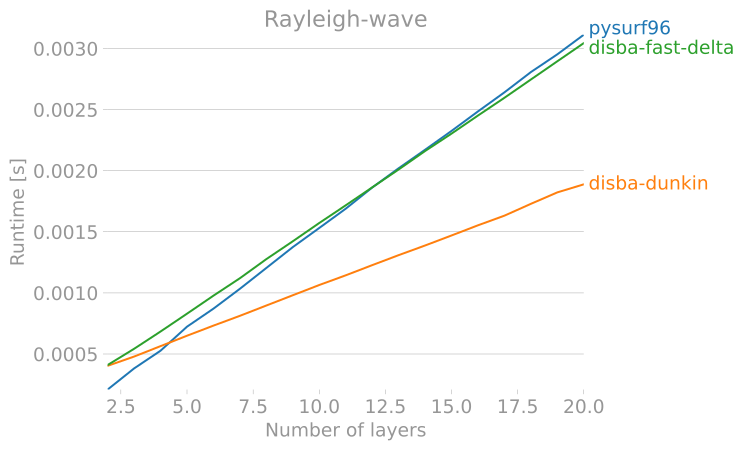
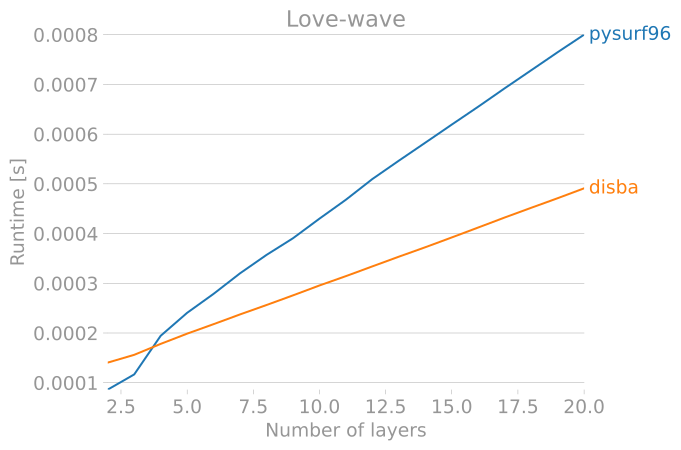
disba aims to be lightweight and portable without compromising on the performance. For both Rayleigh-wave and Love-wave, it is significantly faster than CPS’s surf96 program compiled with f2py, noticeably for large number of layers.
Features
Forward modeling:
Compute Rayleigh-wave phase or group dispersion curves using Dunkin’s matrix or fast delta matrix algorithms,
Compute Love-wave phase or group dispersion curves using Thomson-Haskell method,
Compute Rayleigh-wave ellipticity.
Eigenfunctions and sensitivity kernels:
Compute Rayleigh- and Love- wave eigenfunctions,
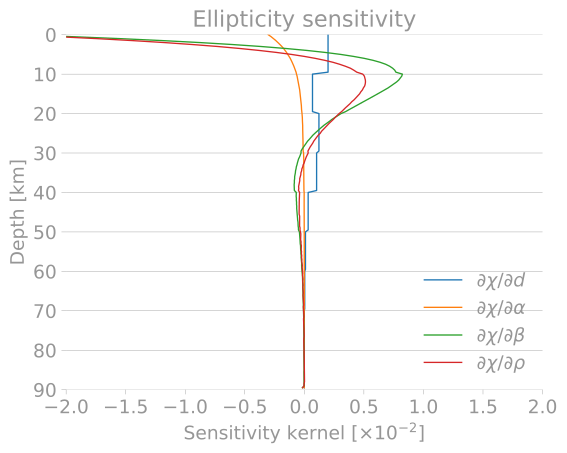
Compute Rayleigh- and Love- wave phase or group velocity, and Rayleigh-wave ellipticity sensitivity kernels with respect to layer thickness, P- and S- wave velocities, and density.
Installation
The recommended way to install disba and all its dependencies is through the Python Package Index:
pip install disba[full] --userOtherwise, clone and extract the package, then run from the package location:
pip install .[full] --userTo test the integrity of the installed package, check out this repository and run:
pytestDocumentation
Refer to the online documentation for detailed description of the API and examples.
Alternatively, the documentation can be built using Sphinx:
pip install -r doc/requirements.txt
sphinx-build -b html doc/source doc/build
Usage
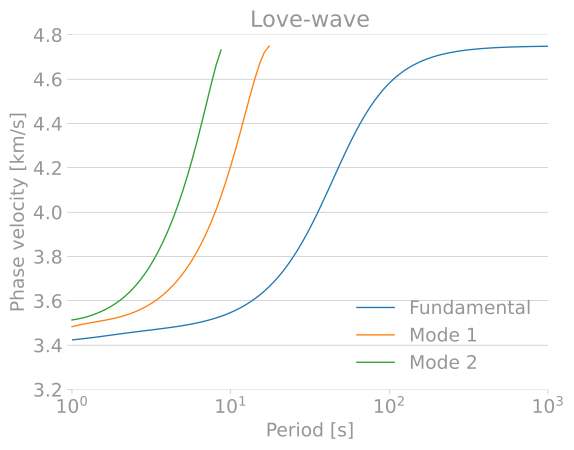
The following example computes the Rayleigh- and Love- wave phase velocity dispersion curves for the 3 first modes.
import numpy as np
from disba import PhaseDispersion

# Velocity model
# thickness, Vp, Vs, density
# km, km/s, km/s, g/cm3
velocity_model = np.array([
   [10.0, 7.00, 3.50, 2.00],
   [10.0, 6.80, 3.40, 2.00],
   [10.0, 7.00, 3.50, 2.00],
   [10.0, 7.60, 3.80, 2.00],
   [10.0, 8.40, 4.20, 2.00],
   [10.0, 9.00, 4.50, 2.00],
   [10.0, 9.40, 4.70, 2.00],
   [10.0, 9.60, 4.80, 2.00],
   [10.0, 9.50, 4.75, 2.00],
])

# Periods must be sorted starting with low periods
t = np.logspace(0.0, 3.0, 100)

# Compute the 3 first Rayleigh- and Love- wave modal dispersion curves
# Fundamental mode corresponds to mode 0
pd = PhaseDispersion(*velocity_model.T)
cpr = [pd(t, mode=i, wave="rayleigh") for i in range(3)]
cpl = [pd(t, mode=i, wave="love") for i in range(3)]

# pd returns a namedtuple (period, velocity, mode, wave, type)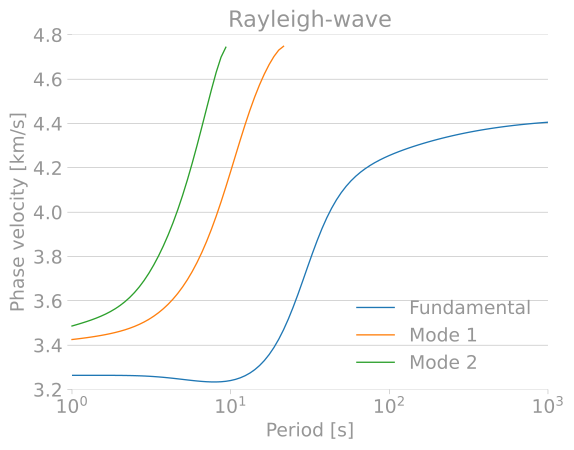
Likewise, GroupDispersion can be used for group velocity.
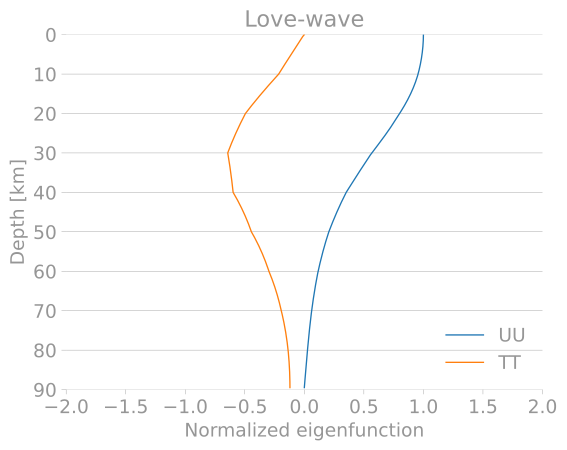
disba’s API is consistent across all its classes which are initialized and called in the same fashion. Thus, eigenfunctions are calculated as follow:
from disba import EigenFunction

eigf = EigenFunction(*velocity_model.T)
eigr = eigf(20.0, mode=0, wave="rayleigh")
eigl = eigf(20.0, mode=0, wave="love")

# eigf returns a namedtuple
#  - (depth, ur, uz, tz, tr, period, mode) for Rayleigh-wave
#  - (depth, uu, tt, period, mode) for Love-wave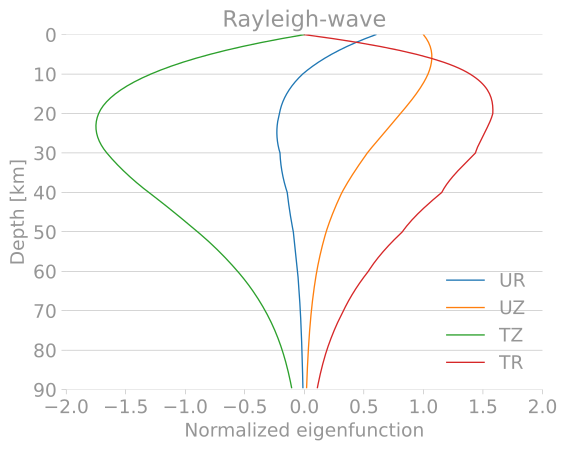
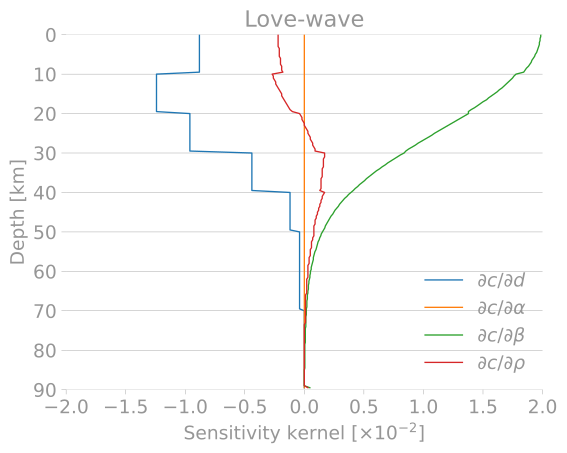
Phase velocity sensitivity kernels (GroupSensitivity for group velocity):
from disba import PhaseSensitivity

ps = PhaseSensitivity(*velocity_model.T)
parameters = ["thickness", "velocity_p", "velocity_s", "density"]
skr = [ps(20.0, mode=0, wave="rayleigh", parameter=parameter) for parameter in parameters]
skl = [ps(20.0, mode=0, wave="love", parameter=parameter) for parameter in parameters]

# ps returns a namedtuple (depth, kernel, period, velocity, mode,wave, type, parameter)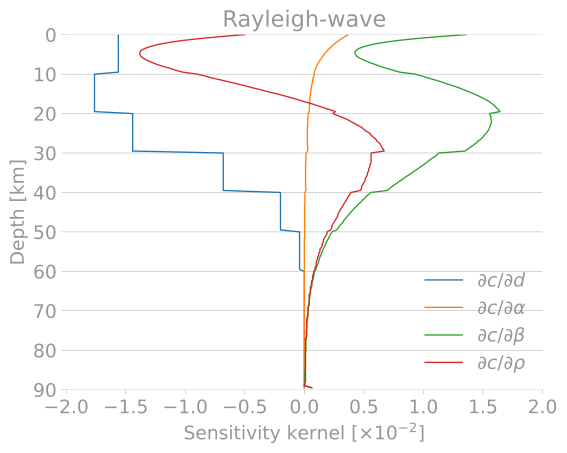
Ellipticity and ellipticity sensitivity kernels:
from disba import Ellipticity, EllipticitySensitivity

ell = Ellipticity(*velocity_model.T)
rel = ell(t, mode=0)

# ell returns a namedtuple (period, ellipticity, mode)

es = EllipticitySensitivity(*velocity_model.T)
ek = [es(20.0, mode=0, parameter=parameter) for parameter in parameters]

# es returns a namedtuple (depth, kernel, period, velocity, mode, wave, type, parameter)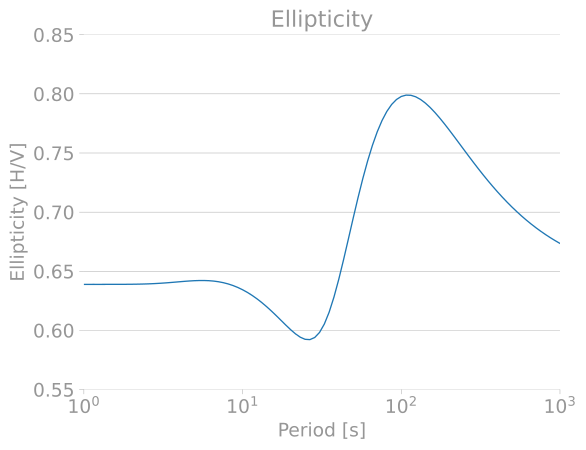
Contributing
Please refer to the Contributing Guidelines to see how you can help. This project is released with a Code of Conduct which you agree to abide by when contributing.
1 maintainer

Release files for disba 0.7.0
For a detailed explanation of source distributions (sdists) and built distributions (wheels), please see the package formats documentation.
Source distribution (sdist)
| File | Size | Uploaded | |
|---|---|---|---|
| disba-0.7.0.tar.gz | 25.4 kB | Details |
Built distribution (wheel)
| File | Interpreter | ABI | Platform | Reset |
|---|---|---|---|---|
| disba-0.7.0-py3-none-any.whl | Python 3 | none | any | Details |
Total release size: 53.4 kB
Release files / disba-0.7.0.tar.gz
| Download URL | disba-0.7.0.tar.gz |
|---|---|
| Size | 25.4 kB |
| Tags | Source |
|
SHA-256 checksum How to use checksums |
06f925d6f08dc917d992257ae089c8a5fba229f12839d91b0ce152fbd5faeb1c
|
|
BLAKE2b-256 checksum How to use checksums |
3dc12e2fd15b910cb7a916a6a560ad9daf7376247aa25516849056ba68bdfd00
|
| Upload date | |
|
Uploaded using Trusted Publishing? What is trusted publishing? |
No |
| Uploaded via |
twine/5.1.1 CPython/3.12.4
|
Release files / disba-0.7.0-py3-none-any.whl
| Download URL | disba-0.7.0-py3-none-any.whl |
|---|---|
| Size | 28.0 kB |
| Tags | Python 3 |
|
SHA-256 checksum How to use checksums |
17d09ab4ad5eabf55a5d55ee6feb15b74cffa238a29bb0ee1346f7605863f91d
|
|
BLAKE2b-256 checksum How to use checksums |
66cd493c94249b86e92389acec94078d782607cc5e0f81d060ea3b7b66305ccd
|
| Upload date | |
|
Uploaded using Trusted Publishing? What is trusted publishing? |
No |
| Uploaded via |
twine/5.1.1 CPython/3.12.4
|














