
Classical Chinese to Modern Japanese Translator

Project description

UD-Kundoku
Classical Chinese to Modern Japanese Translator, working on Universal Dependencies.
Basic usage
>>> import udkundoku
>>> lzh=udkundoku.load()
>>> s=lzh("不入虎穴不得虎子")
>>> t=udkundoku.translate(s)
>>> print(t)
# text = 虎の穴に入らずして虎の子を得ず
1	虎	虎	NOUN	n,名詞,主体,動物	_	3	nmod	_	Gloss=tiger|SpaceAfter=No
2	の	_	ADP	_	_	1	case	_	SpaceAfter=No
3	穴	穴	NOUN	n,名詞,固定物,地形	Case=Loc	5	obj	_	Gloss=cave|SpaceAfter=No
4	に	_	ADP	_	_	3	case	_	SpaceAfter=No
5	入ら	入	VERB	v,動詞,行為,移動	_	0	root	_	Gloss=enter|SpaceAfter=No
6	ずして	不	AUX	v,副詞,否定,無界	Polarity=Neg	5	advmod	_	Gloss=not|SpaceAfter=No
7	虎	虎	NOUN	n,名詞,主体,動物	_	9	nmod	_	Gloss=tiger|SpaceAfter=No
8	の	_	ADP	_	_	7	case	_	SpaceAfter=No
9	子	子	NOUN	n,名詞,人,関係	_	11	obj	_	Gloss=child|SpaceAfter=No
10	を	_	ADP	_	_	9	case	_	SpaceAfter=No
11	得	得	VERB	v,動詞,行為,得失	_	5	parataxis	_	Gloss=get|SpaceAfter=No
12	ず	不	AUX	v,副詞,否定,無界	Polarity=Neg	11	advmod	_	Gloss=not|SpaceAfter=No

>>> print(t.sentence())
虎の穴に入らずして虎の子を得ず

>>> print(s.to_tree())
不 <┐     advmod
入 ─┴─┬─┐ root
虎 <┐ │ │ nmod
穴 ─┘<┘ │ obj
不 <┐   │ advmod
得 ─┴─┐<┘ parataxis
虎 <┐ │   nmod
子 ─┘<┘   obj

>>> print(t.to_tree())
虎 ─┐<┐     nmod(体言による連体修飾語)
の <┘ │     case(格表示)
穴 ─┬─┘<┐   obj(目的語)
に <┘   │   case(格表示)
入 ─┬───┴─┐ root(親)
ら  │     │
ず <┘     │ advmod(連用修飾語)
し        │
て        │
虎 ─┐<┐   │ nmod(体言による連体修飾語)
の <┘ │   │ case(格表示)
子 ─┬─┘<┐ │ obj(目的語)
を <┘   │ │ case(格表示)
得 ─┬───┘<┘ parataxis(隣接表現)
ず <┘       advmod(連用修飾語)
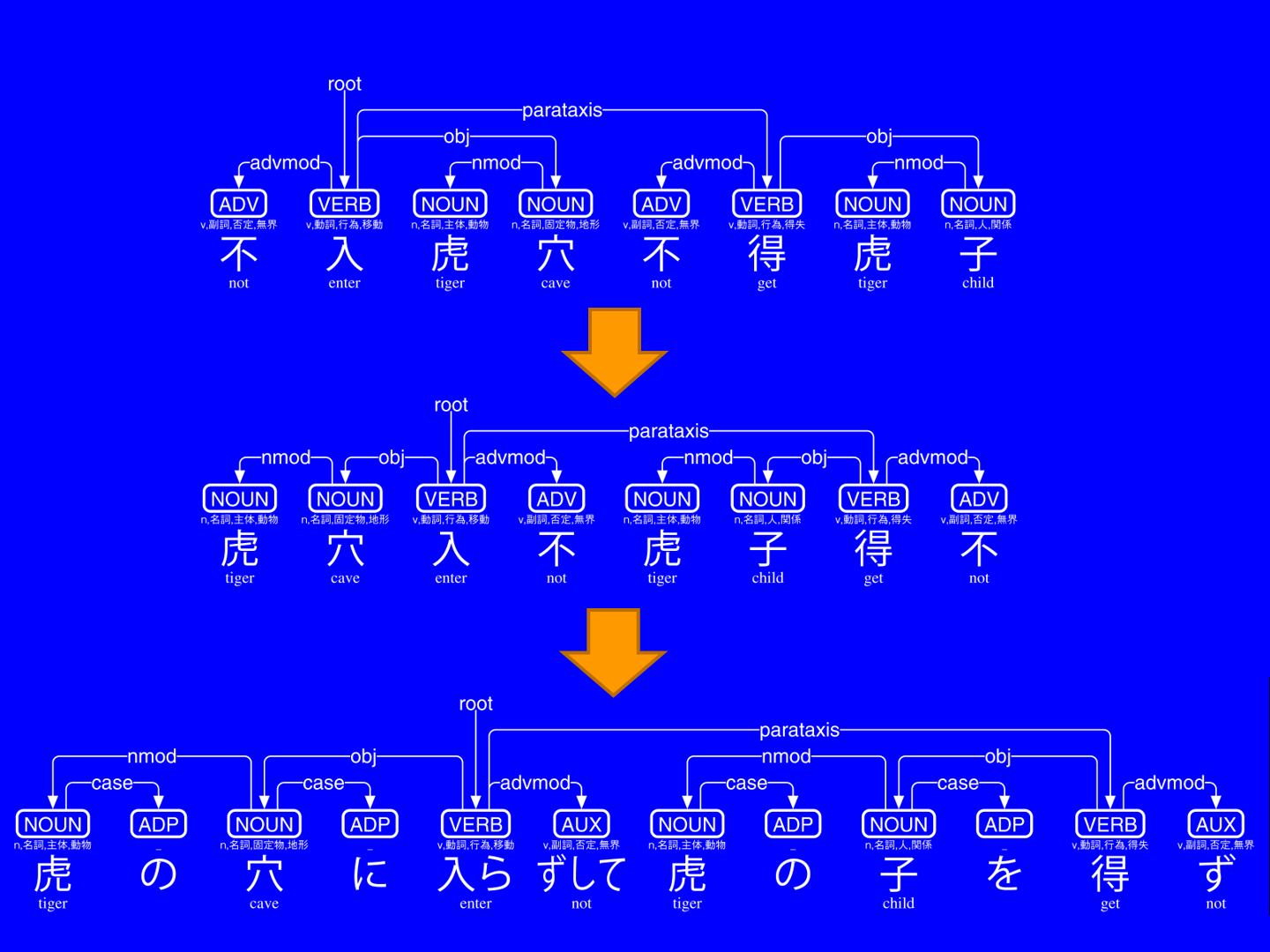
udkundoku.load() is an alias for udkanbun.load() of UD-Kanbun. udkundoku.translate() is a transcriptive converter from Classical Chinese (under Universal Dependencies of UD-Kanbun) into Modern Japanese (under Universal Dependencies of UniDic2UD). udkundoku.rearrange() is called to rearrange Classical Chinese into Japanese word-order inside udkundoku.translate(). to_tree() and to_svg() are borrowed from those of UD-Kanbun.
You can simply use udkundoku on the command line:
echo 不入虎穴不得虎子 | udkundoku -j
HTTP-server usage
python -m udkundoku.server 5000
Try to connect http://127.0.0.1:5000 with your local browser. Input a Classical Chinese sentence there and push 解析-button (at least) three times.
Installation for Linux
Tar-ball is available for Linux, and is installed by default when you use pip:
pip install udkundoku
旧仮名口語UniDic is automatically downloaded for UniDic2UD.
Installation for Cygwin
Make sure to get gcc-g++ python37-pip python37-devel packages, and then:
pip3.7 install udkundoku
Use python3.7 command in Cygwin instead of python.
Installation for Jupyter Notebook (Google Colaboratory)
!pip install udkundoku
Author
Koichi Yasuoka (安岡孝一)
References
- 安岡孝一: 漢文の依存文法解析と返り点の関係について, 日本漢字学会第1回研究大会予稿集 (2018年12月1日), pp.33-48.
- 安岡孝一: 漢日英Universal Dependencies平行コーパスとその差異, 人文科学とコンピュータシンポジウム「じんもんこん2019」論文集 (2019年12月), pp.43-50.
Release history Release notifications | RSS feed


Download files
Download the file for your platform. If you're not sure which to choose, learn more about installing packages.
Source Distribution
File details
Details for the file udkundoku-0.8.6.tar.gz.
File metadata
- Download URL: udkundoku-0.8.6.tar.gz
- Upload date:
- Size: 19.8 kB
- Tags: Source
- Uploaded using Trusted Publishing? No
- Uploaded via: twine/1.13.0 pkginfo/1.5.0.1 requests/2.21.0 setuptools/41.0.0 requests-toolbelt/0.8.0 tqdm/4.31.1 CPython/3.7.6
File hashes
| Algorithm | Hash digest | |
|---|---|---|
| SHA256 |
fba95c0b3840d7de6949abf6322e47eff7d4f8cbd65bd5986516848caa838489
|
|
| MD5 |
0a8a7ded9163c9e3bfb630314d633ef9
|
|
| BLAKE2b-256 |
51923320a0975b180955e0b58cb2aa0fe31de52ab31d7c43750ea875f895fe01
|






