
自适应密度峰值树聚类(Adaptive Density Peak Tree Clustering)
本算法是在快速搜索与发现密度峰值聚类算法(Clustering by fast search and find of density peaks)CFSFDP的基础上进行改进的成果,主要解决的问题有:
- 手动选择聚类中心
- 单簇多密度峰值导致类簇误分
- 面向时空数据聚类时,无法顾及时空耦合
原理:
通过CFSFDP算法的核心概念:局部密度和斥群值,构建密度峰值树,通过直达点、连通点和切割点分离子树,达到类簇划分的目的。

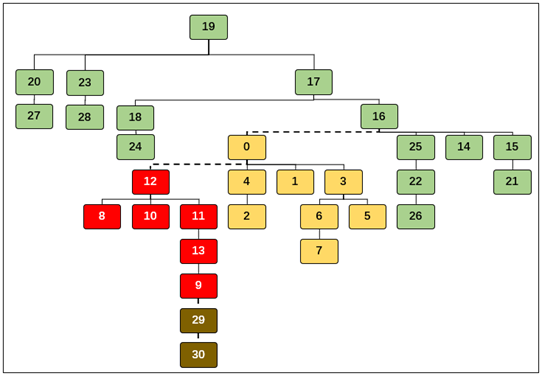
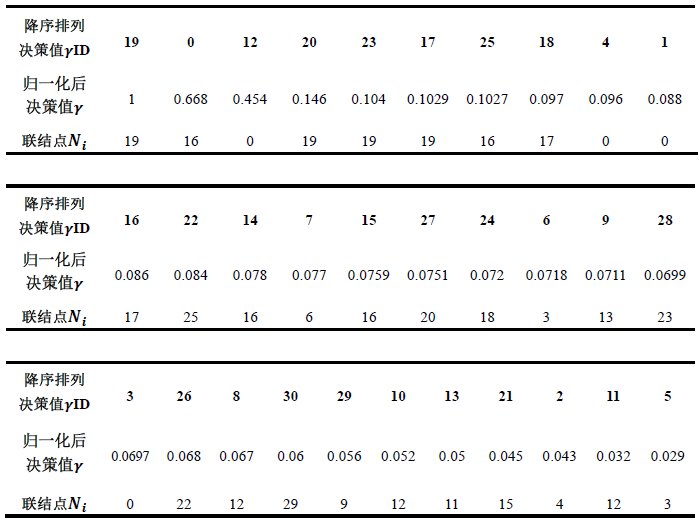
使用方法:
1. 安装:
pip install ADPTC-LIB
2. 空间数据聚类:
import numpy as np
from ADPTC_LIB.cluster import ADPTC
from ADPTC_LIB import visual
X = np.loadtxt(r"../test_data/Aggregation.txt", delimiter="\t")
X = X[:,[0,1]]
atdpc_obj = ADPTC(X)
atdpc_obj.clustering(2)
visual.show_result(atdpc_obj.labels,X,np.array(list(atdpc_obj.core_points)))
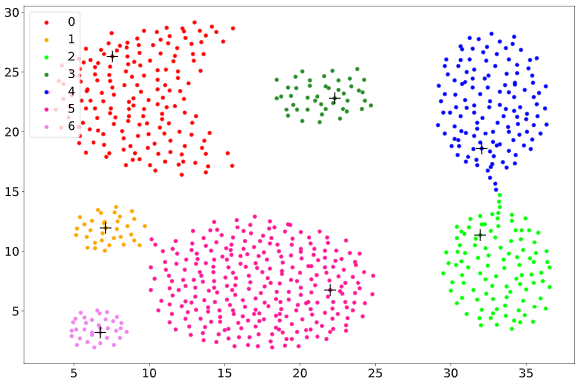
3. 空间属性数据聚类:
from ADPTC_LIB.cluster import ADPTC
from ADPTC_LIB import visual
import xarray as xr
import os
import numpy as np
filePath = os.path.join(r'Z:\regions_daily_010deg\\05\\2013.nc')
dataset = xr.open_dataset(filePath)
pre_ds = dataset['precipitation']
lon = pre_ds.lon
lat = pre_ds.lat
lon_range = lon[(lon>-30)&(lon<70)]
lat_range = lat[(lat>30)&(lat<90)]
var = pre_ds.sel(lon=lon_range,lat = lat_range)
var = var.resample(time='1M',skipna=True).sum()
var_t = var.sel(time=var.time[0])
reduced = var_t.coarsen(lon=5).mean().coarsen(lat=5).mean()
data_nc = np.array(reduced)
spatial_eps=4
attr_eps=8
density_metric='gauss'
spre = ADPTC(data_nc)
spre.spacial_clustering_raster(spatial_eps,attr_eps,density_metric,knn_num=100,leaf_size=3000,connect_eps=0.9)
visual.show_result_2d(reduced,spre.labels)
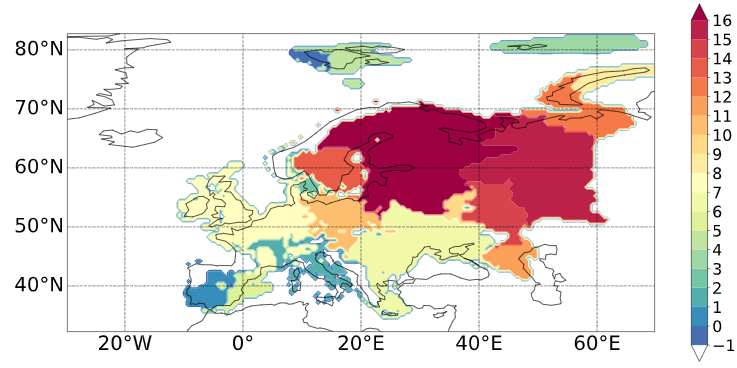
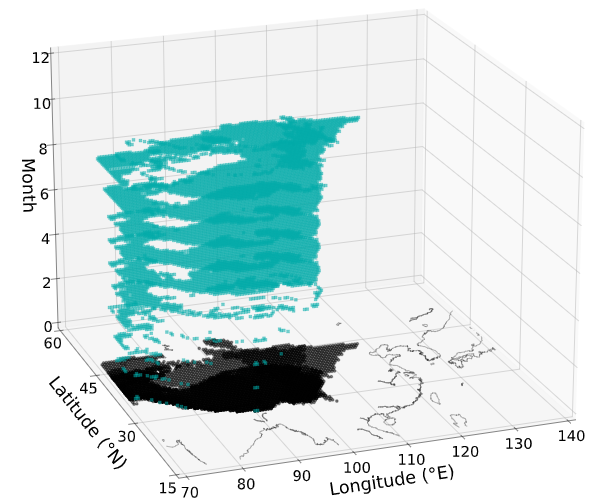
4.时空属性聚类:
from ADPTC_LIB.cluster import ADPTC
from ADPTC_LIB import visual
import xarray as xr
import numpy as np
temp= xr.open_dataset(r'Z:\MSWX\temp\2020.nc')
temp_2020 = temp['air_temperature']
lon = temp_2020.lon
lat = temp_2020.lat
time = temp_2020.time
lon_range = lon[(lon>70)&(lon<140)]
lat_range = lat[(lat>15)&(lat<55)]
var = temp_2020.sel(lon=lon_range,lat = lat_range)
reduced = var.coarsen(lon=5).mean().coarsen(lat=5).mean()
data_nc = np.array(reduced)
s_eps = 5
t_eps = 1
attr_eps = 2.5
density_metric='gauss'
spre = ADPTC(data_nc)
spre.st_clustering_raster(s_eps,t_eps,attr_eps,density_metric,knn_num=100,leaf_size=3000,connect_eps=0.9)
visual.show_result_3d(reduced,spre,[70, 140, 15, 50],[0,12],21)
1 maintainer

Metadata
1 maintainer
Release files for ADPTC-LIB 0.0.7
For a detailed explanation of source distributions (sdists) and built distributions (wheels), please see the package formats documentation.
Source distribution (sdist)
| File | Size | Uploaded | Provenance | Actions |
|---|---|---|---|---|
| ADPTC_LIB-0.0.7.tar.gz | 20.0 kB | Without provenance | Details for ADPTC_LIB-0.0.7.tar.gz |
Release files / ADPTC_LIB-0.0.7.tar.gz
| Download URL | ADPTC_LIB-0.0.7.tar.gz |
|---|---|
| Size | 20.0 kB |
| Tags | Source |
|
SHA-256 checksum How to use checksums |
8316da6d825e0385412bb192bc42858c0147f6c64be771fd850f514fba6c3a9a
|
|
BLAKE2b-256 checksum How to use checksums |
0d2058fd440c18463dc9bb222d4e6af39b8fd11fb91768230058407e2674e9f8
|
| Upload date | |
|
Uploaded using Trusted Publishing? What is trusted publishing? |
No |
| Uploaded via |
twine/3.3.0 pkginfo/1.6.1 requests/2.24.0 setuptools/51.1.1 requests-toolbelt/0.9.1 tqdm/4.55.0 CPython/3.6.9
|
Security for ADPTC-LIB 0.0.7
Provenance
Provenance describes where a file came from. On PyPI, provenance is shared via attestations, which provide a verifiable record of the build or publishing details. View details, limitations and caveats.
No provenance found
None of the files in this release were uploaded with provenance metadata.
A note on package security
PyPI is a repository for distributing packages, not a service for auditing them. While third-party security researchers and our staff do their best to detect and remove malicious packages, PyPI cannot guarantee the quality, security or suitability of any given package.
To learn more about protecting yourself from malicious actors, visit our package security documentation.














