
Time Series Forecasting and Data Augmentation using Deep Generative Models

Project description
AugmentTS :: Time Series Data Augmentation using Deep Generative Models
Note!!! The package is under development so be careful for using in production!
Features
- Time Series Data Augmentation using Deep Generative Models
- Visualizing the Latent Space of Generative Models
- Time Series Forecasting using Deep Neural Networks
Installation
You can install the last stable version using pip
pip install augmentts
How to Use
Augmentation Guide
Create an augmenter
from augmentts.augmenters.vae import LSTMVAE, VAEAugmenter

# create a variational autoencoder
vae = LSTMVAE(series_len=100)
# create an augmenter
augmenter = VAEAugmenter(vae)
The above code uses the default settings for the LSTM-VAE model. You can customize its architecture or use your own model for encoder and decoder. Note currently we only support Keras models.
Train the augmenter
augmenter.fit(data, epochs=50, batch_size=32)
Generate new time series!
Two strategies for sampling have been implemented.
You can simply sample from the latent space. Here n is the number of generated series
augmenter.sample(n=1000)
You also can generate time series by reconstructing a set of series.
augmenter.sample(X=data)
In both cases you can control the variety of generated time series using sigma
augmenter.sample(n=1000, sigma=0.2)
Forecasting Guide
First we create a random dataset then use prepare_ts helper function to prepare the dataset for forecasting.
from augmentts.forecasters.deep import LSTMCNNForecaster
from augmentts.utils import prepare_ts
import numpy as np

# creating a random dataset
ts = np.random.rand(100, 10)
# preparing data for rolling window regression
X, y = prepare_ts(ts, 8, 4)
Now we can create a forecaster and train it. Note the fit function is just an alias for Keras fit function thus you can pass all of the supported arguments of Keras fit function.
model = LSTMCNNForecaster(window_size=8, steps_ahead=4, n_series=10)
model.fit(X, y, epochs=10)
After training you can use predict to evaluate the model.
model.predict(X)
Supported Augmenters
Supported models for augmentation currently are as follows:
| Model | Type | Supported Time Series | Description |
|---|---|---|---|
| LSTMVAE | Variational Autoencoder | Univariate, fixed length | A Variational Autoencoder with stacked LSTM layers for encoder and decoder based on the paper [paper citation] |
Supported Forecasters
Currently an LSTM-CNN forecaster is implemented. You can either customize it or just implement your own architecture.
Examples
Augmenting ETS Time Series
Let's see how to use AugmentTS to generate time series similiar to one of the ETS families.
import matplotlib.pyplot as plt
import seaborn as sb
sb.set(style='white')
import pandas as pd
Using ETSDataset class we can sample time series from any ETS model.
from augmentts.datasets import ETSDataset
For the sake of simplicity we sample 60 series from ANA model (Additive error, No trend, Additive seasonality) and 30 seris from MNN model (Multiplicative error, no trend, no seasonality):
# sampling a few series from ETS model
ets = ETSDataset(ets_families={
    'A,N,A' : 60, # 60 samples from ANA model
    'M,N,N' : 30  # 30 samples from MNN model
}, length=100)

ts_data, family = ets.load(return_family=True)
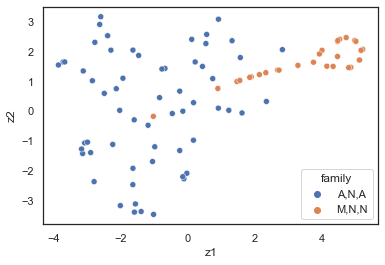
We can use any dimensionality reduction or manifold learning method for visulizing the series in plane. Let's just use t-SNE.
from sklearn.manifold import TSNE

tsne = TSNE(n_components=2)
z = tsne.fit_transform(ts_data)
We simply use Pandas and Seaborn to draw a scatte plot
original_df = pd.DataFrame({'family' : family})
original_df[['z1', 'z2']] = z

sb.scatterplot(data=original_df, x='z1', y='z2', hue='family')
Now we use AugmentTS to augment the MNN family:
from augmentts.augmenters.vae import LSTMVAE, VAEAugmenter

# creating the VAE
vae = LSTMVAE(series_len=100, encoder_hiddens=[512, 256, 128], decoder_hiddens=[128, 256, 512])
augmenter = VAEAugmenter(vae)
# training the VAE on MNN family
vae_data = ts_data[-30:, :].reshape(-1, 1, 100)
augmenter.fit(vae_data, epochs=100, batch_size=16)
Generating 30 new time series.
n_generated = 30
generated = augmenter.sample(n=n_generated, sigma=0.5)
generated = generated.numpy()[:, 0, :]
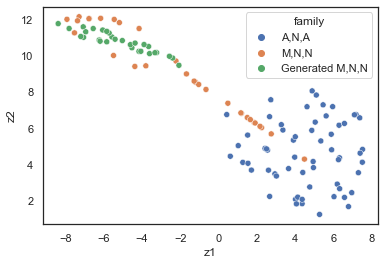
Now we visualize the augmented time series and the original ones
z = tsne.fit_transform(np.vstack([ts_data, generated]))
augmented_df = pd.DataFrame({'family' : family + ['Generated M,N,N']*n_generated})
augmented_df[['z1', 'z2']] = z
sb.scatterplot(data=augmented_df, x='z1', y='z2', hue='family')
Here is the result of augmentation!
Contributors
The list of the current contributors:
- Sasan Barak
- Amirabbas Asadi
- Ehsan Mirafzali
- Mohammad Joshaghani
Release history Release notifications | RSS feed

Download files
Download the file for your platform. If you're not sure which to choose, learn more about installing packages.
Source Distribution
Built Distribution
Filter files by name, interpreter, ABI, and platform.
If you're not sure about the file name format, learn more about wheel file names.
Copy a direct link to the current filters
File details
Details for the file AugmentTS-0.1.0.tar.gz.
File metadata
- Download URL: AugmentTS-0.1.0.tar.gz
- Upload date:
- Size: 12.3 kB
- Tags: Source
- Uploaded using Trusted Publishing? No
- Uploaded via: twine/3.6.0 importlib_metadata/4.8.2 pkginfo/1.8.1 requests/2.23.0 requests-toolbelt/0.9.1 tqdm/4.62.3 CPython/3.7.12
File hashes
| Algorithm | Hash digest | |
|---|---|---|
| SHA256 |
82f558ca8877c6c9e9847ec7d08874995cd7fbc0bb538cdd4436271e1f989e91
|
|
| MD5 |
5d47b0a6369665dea389a73840ac2b6c
|
|
| BLAKE2b-256 |
031db4abe204b61616292ec1743c95109313c75ed025e394be526c8346fb3a07
|
File details
Details for the file AugmentTS-0.1.0-py3-none-any.whl.
File metadata
- Download URL: AugmentTS-0.1.0-py3-none-any.whl
- Upload date:
- Size: 12.8 kB
- Tags: Python 3
- Uploaded using Trusted Publishing? No
- Uploaded via: twine/3.6.0 importlib_metadata/4.8.2 pkginfo/1.8.1 requests/2.23.0 requests-toolbelt/0.9.1 tqdm/4.62.3 CPython/3.7.12
File hashes
| Algorithm | Hash digest | |
|---|---|---|
| SHA256 |
e3c9dffdcebd1e1b4278172142c83fccf728cec265e76b3d7b9618ecfb5b0e82
|
|
| MD5 |
9d9f3f13e3e291422b1debd5b9d97672
|
|
| BLAKE2b-256 |
8e4c997c32cbb3942743c6e3175e0bef1ef4aace7832e32fe1ab52d7fd454cdb
|






