
HROCH
High-Performance c++ symbolic regression library based on parallel local search
- Zero hyperparameter tunning.
- Accurate results in seconds or minutes, in contrast to slow GP-based methods.
- Small models size.
- Support for regression, classification and fuzzy math.
- Support 32 and 64 bit floating point arithmetic.
- Work with unprotected version of math operators (log, sqrt, division)
- Speedup search by using feature importances computed from bbox model
| Supported instructions | |
|---|---|
| math | add, sub, mul, div, pdiv, inv, minv, sq2, pow, exp, log, sqrt, cbrt, aq |
| goniometric | sin, cos, tan, asin, acos, atan, sinh, cosh, tanh |
| other | nop, max, min, abs, floor, ceil, lt, gt, lte, gte |
| fuzzy | f_and, f_or, f_xor, f_impl, f_not, f_nand, f_nor, f_nxor, f_nimpl |
Dependencies
- AVX2 instructions set(all modern CPU support this)
- numpy
- sklearn
- scipy
Installation
pip install HROCH
Usage
Symbolic_Regression_Demo.ipynb

from HROCH import SymbolicRegressor

reg = SymbolicRegressor(num_threads=8, time_limit=60.0, problem='math', precision='f64')
reg.fit(X_train, y_train)
yp = reg.predict(X_test)
Changelog
v1.4
- Sklearn compatibility
- Classificators:
- NonlinearLogisticRegressor for a binary classification
- SymbolicClassifier for multiclass classification
- FuzzyRegressor for a special binary classification
- Xi corelation used for filter unrelated features
v1.3
- Public c++ sources
- Commanline interface changed to cpython
- Support for classification score logloss and accuracy
- Support for final transformations:
- ordinal regression
- logistic function
- clipping
- Acess to equations from all paralel hillclimbers
- User defined constants
v1.2
- Features probability as input parameter
- Custom instructions set
- Parallel hilclimbing parameters
v1.1
- Improved late acceptance hillclimbing
v1.0
- First release
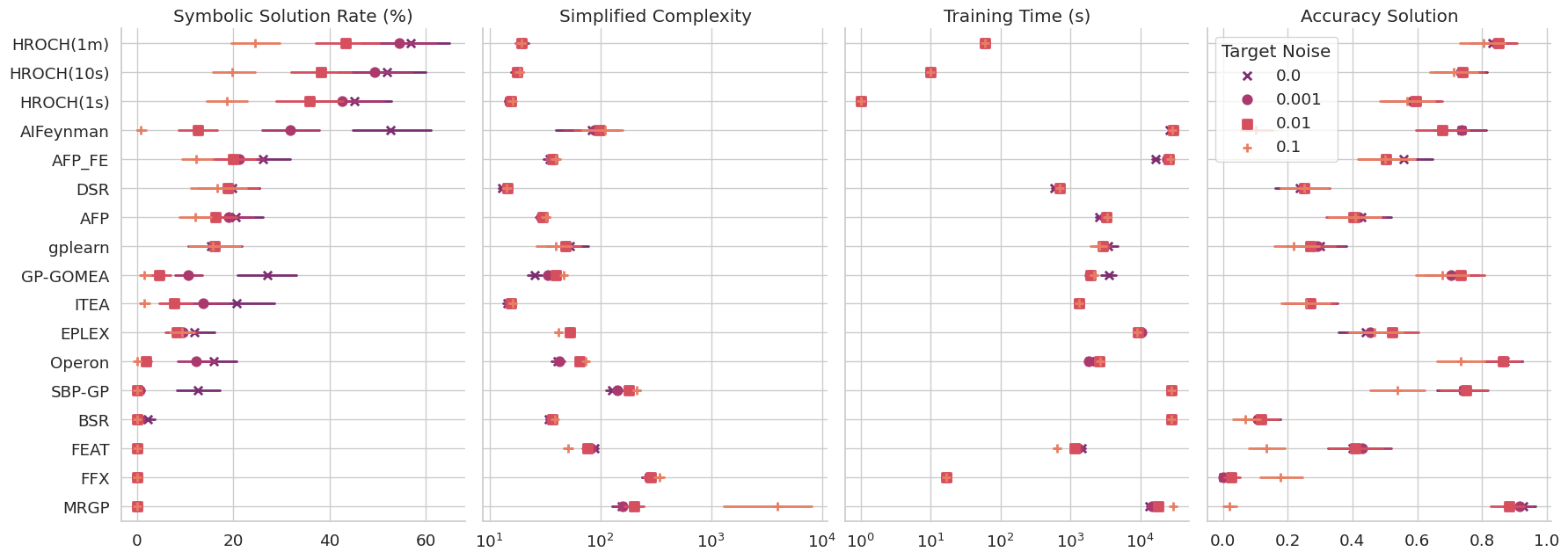
SRBench
1 maintainer

Metadata
1 maintainer
Release files for HROCH 1.4.12
For a detailed explanation of source distributions (sdists) and built distributions (wheels), please see the package formats documentation.
Source distribution (sdist)
| File | Size | Uploaded | Provenance | Actions |
|---|---|---|---|---|
| hroch-1.4.12.tar.gz | 445.9 kB | Without provenance | Details for hroch-1.4.12.tar.gz |
Built distribution (wheel)
| File | Interpreter | ABI | Platform | Actions Reset |
|---|---|---|---|---|
| HROCH-1.4.12-py3-none-any.whl | Python 3 | none | any | Details for HROCH-1.4.12-py3-none-any.whl |
Total release size: 900.4 kB
Release files / hroch-1.4.12.tar.gz
| Download URL | hroch-1.4.12.tar.gz |
|---|---|
| Size | 445.9 kB |
| Tags | Source |
|
SHA-256 checksum How to use checksums |
a7e934bdb4df9314df3328d15ae48552ee8ffc4aa7ec2006e6f7f49300c38f74
|
|
BLAKE2b-256 checksum How to use checksums |
a084d2b2983718f966a6420885c5e241032361010460cba865fcea0da2dc7164
|
| Upload date | |
|
Uploaded using Trusted Publishing? What is trusted publishing? |
Yes |
| Uploaded via |
twine/5.1.0 CPython/3.12.5
|
Release files / HROCH-1.4.12-py3-none-any.whl
| Download URL | HROCH-1.4.12-py3-none-any.whl |
|---|---|
| Size | 454.5 kB |
| Tags | Python 3 |
|
SHA-256 checksum How to use checksums |
f6d3fe40804908bc6535779c82a473e96944c4c0c6e1339bea344763b5f88f68
|
|
BLAKE2b-256 checksum How to use checksums |
ba4b70d399b1cb6301a93a1892e563b392fb64f70b667cc4d7562187051395ca
|
| Upload date | |
|
Uploaded using Trusted Publishing? What is trusted publishing? |
Yes |
| Uploaded via |
twine/5.1.0 CPython/3.12.5
|
Security for HROCH 1.4.12
Provenance
Provenance describes where a file came from. On PyPI, provenance is shared via attestations, which provide a verifiable record of the build or publishing details. View details, limitations and caveats.
No provenance found
None of the files in this release were uploaded with provenance metadata.
A note on package security
PyPI is a repository for distributing packages, not a service for auditing them. While third-party security researchers and our staff do their best to detect and remove malicious packages, PyPI cannot guarantee the quality, security or suitability of any given package.
To learn more about protecting yourself from malicious actors, visit our package security documentation.














