











Open-Source Python SDK for Healthcare AI
Agents read clinical data fine — writing it back correctly is the hard part, and generic agent frameworks don't check it. HealthChain gives any model or agent typed, validated FHIR tools they can trust: the right code from the right system, on the right patient, with a valid status. Plus real-time EHR connectivity and production deployment — so what you build holds up outside the demo.
Installation
pip install healthchain
Quick Start
# Scaffold a FHIR Gateway project
healthchain new my-app -t fhir-gateway
cd my-app

# Run locally
healthchain serve

Edit app.py to add your model, and healthchain.yaml to configure deployment settings.
See the CLI reference for all commands.
Core Features
The quickest way for AI developers and researchers to ship healthcare AI — everything you need out of the box, built to scale with you.
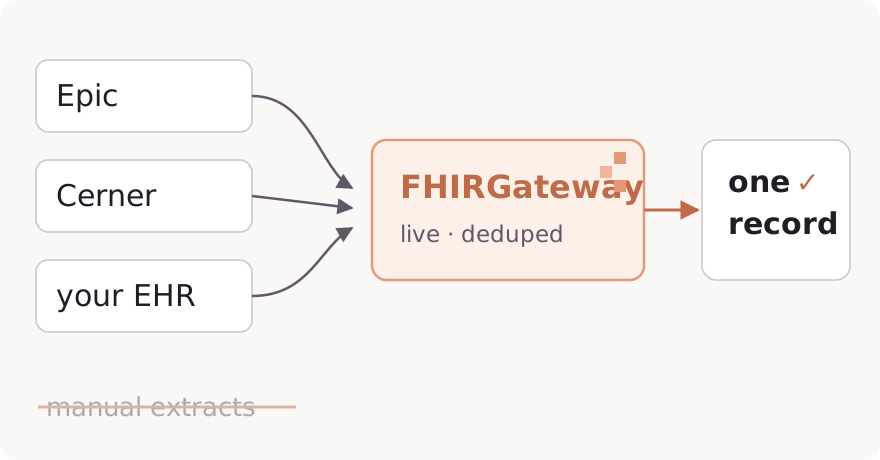
🔌 Multi-EHR Data Aggregation Connect to live FHIR APIs across Epic, Cerner, and more — and move research pipelines off manual database extracts onto data infrastructure that scales past one site Getting Started → |
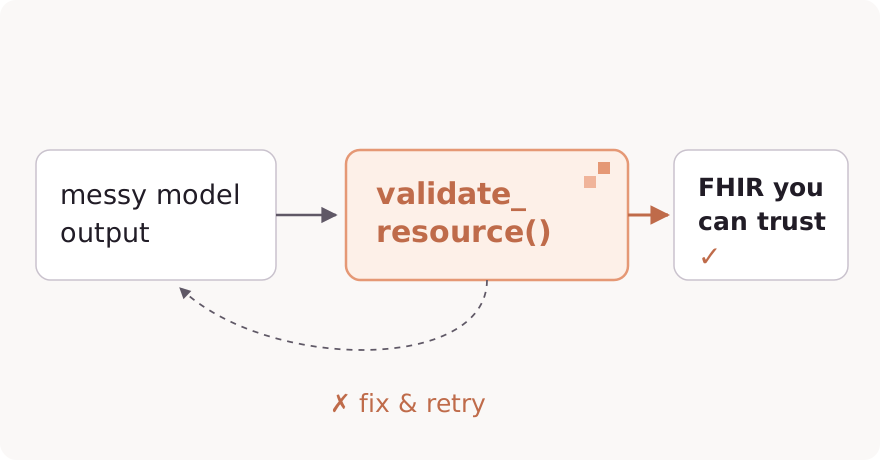
🔥 FHIR as a Superpower Type-safe FHIR resources, validation that catches broken data before it ships, and terminology lookups — the strict schema that turns healthcare data into a built-in unit test Getting Started → |
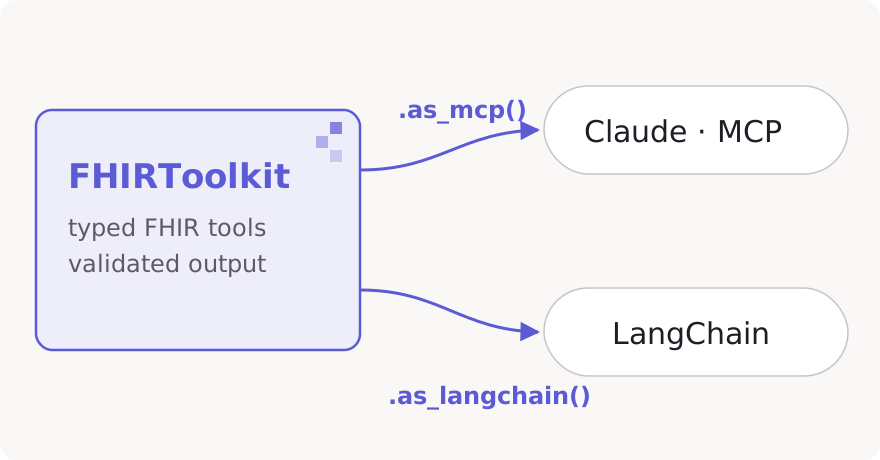
🤖 Tools Your Agents Can Trust Hand any agent typed, validated FHIR tools from one toolkit — served to Claude over MCP or dropped into LangChain, so what your agent writes is valid and correctly coded Getting Started → |
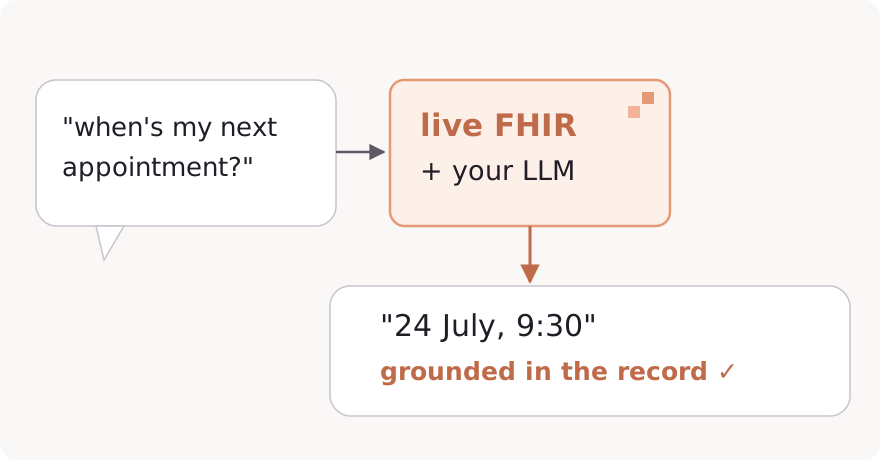
💬 FHIR-Grounded Patient Q&A Answer patient questions from their live clinical record — the foundational pattern for portal chatbots and care-plan assistants, with a schema for truth Getting Started → |
Why HealthChain?
Every serious healthcare AI project builds the same integration infrastructure from scratch. Whether you're deploying a logistic regression, a 70B-parameter model, or an agentic workflow, the wall between a trained model and a live clinical system is the same: real FHIR APIs, validated writes, multi-site deployments, auditable governance. No off-the-shelf solution exists, and engineers who understand both AI and healthcare protocols are scarce and hard to retain.
HealthChain handles that complexity so you can focus on what actually matters: the model and the patient.
- Optimized for real-time - Connect to live FHIR APIs and integration points instead of stale data exports
- Validation built in - Type-safe FHIR resources and validation reports that catch broken data before it ships — including spec-invalid clinical codes that type checks alone let through
- No invented facts - Helpers never add clinical claims you didn't pass: no auto-generated timestamps, no guessed statuses — what enters the record is exactly what your model produced
- Bring any model or agent - LLMs, agents, or classical ML — and output validated FHIR
- Works with your existing stack - Integrates with FastAPI, MCP, and LangChain
- Production-ready foundations - Dockerized deployment, configurable security, and an architecture built for NHS and HIPAA environments
🏆 Recognition & Community
Featured & Presented:
- Featured in TLDR AI Newsletter (900K+ developers)
- Featured by Medplum for open source integration with Epic
- Presented at NHS Python Open Source Conference (watch talk)
- Built from NHS AI deployment experience – read the origin story
🤝 Partnerships & Production Use
Exploring HealthChain for your product or organization? Get in touch to discuss integrations, pilots, or collaborations, or join our Discord to connect with the community.
Usage Examples
Creating a Gateway [Docs]
from healthchain.gateway import HealthChainAPI, FHIRGateway
from healthchain.fhir.r4b import Patient

# Create healthcare application
app = HealthChainAPI(title="Multi-EHR Patient Data")

# Connect to multiple FHIR sources
fhir = FHIRGateway()
fhir.add_source("epic", "fhir://fhir.epic.com/r4?client_id=epic_client_id")
fhir.add_source("cerner", "fhir://fhir.cerner.com/r4?client_id=cerner_client_id")

@fhir.aggregate(Patient)
def enrich_patient_data(id: str, source: str) -> Patient:
    """Get patient data from any connected EHR and add AI enhancements"""
    bundle = fhir.search(
        Patient,
        {"_id": id},
        source,
        add_provenance=True,
        provenance_tag="ai-enhanced",
    )
    return bundle

app.register_gateway(fhir)

# Available at: GET /fhir/transform/Patient/123?source=epic
# Available at: GET /fhir/transform/Patient/123?source=cerner

if __name__ == "__main__":
    app.run(port=8888)
Giving an Agent FHIR Tools [Docs]
from healthchain.tools import FHIRToolkit

# One toolkit: build, validate, read, and code FHIR — as typed agent tools
kit = FHIRToolkit(bundle="patient_bundle.json")

kit.as_mcp().run()          # serve to Claude or any MCP client
tools = kit.as_langchain()  # or drop into a LangChain agent
Or straight from the terminal, no code:
healthchain mcp --bundle patient_bundle.json
Building with an AI assistant
Install the HealthChain plugin to give Claude Code or Codex the current API, CLI, and recipes:
# Claude Code
/plugin marketplace add healthchainai/HealthChain
/plugin install healthchain@healthchain

# Codex
codex plugin marketplace add healthchainai/HealthChain
codex plugin add healthchain@healthchain
Or point any assistant at llms.txt for a map of the current API docs.
🛣️ What we're building towards
- 🔒 Security foundations — API-key authentication, audit logging, and TLS, configured via
healthchain.yamland enforced by the gateway middleware - 📋 Governance as config — clinical safety, data access agreements, and compliance standards for NHS/HIPAA deployments as a first-class deployment artifact in
healthchain.yaml - 🔌 Deeper EHR connectivity — more FHIR sources, live data patterns, and real-world integration examples from pilot deployments
- 📊 Observability — deployment telemetry and audit trails for healthcare systems
- 🤖 A toolkit for clinical AI agents — typed FHIR tools with validation and terminology built in, served over MCP and LangChain
🤝 Contributing
HealthChain is built by and for the next generation of healthcare developers — researchers moving models from retrospective data into live systems, AI developers who don't want to spend months learning FHIR before they can ship anything. The best contributions come from people who have hit a real problem and have something specific to say about it.
Get started:
- Working with healthcare or research data? Contribute a cookbook — bring your use case, I'll personally support you through it
- Read CONTRIBUTING.md for guidelines
- Technical questions and ideas → GitHub Discussions
- Pilots and partnerships → email
🤗 Acknowledgements
This project builds on fhir.resources and CDS Hooks standards developed by HL7 and Boston Children's Hospital.
See also groundeval — the open-source eval harness for healthcare AI agents.
© 2024–2026 dotimplement ai. HealthChain is an open source project maintained by dotimplement ai.
2 maintainers


Metadata
2 maintainers
Release files for healthchain 0.16.1
For a detailed explanation of source distributions (sdists) and built distributions (wheels), please see the package formats documentation.
Source distribution (sdist)
| File | Size | Uploaded | Provenance | |
|---|---|---|---|---|
| healthchain-0.16.1.tar.gz | 3.5 MB | With provenance | Details |
Built distribution (wheel)
| File | Interpreter | ABI | Platform | Reset |
|---|---|---|---|---|
| healthchain-0.16.1-py3-none-any.whl | Python 3 | none | any | Details |
Total release size: 3.8 MB
Release files / healthchain-0.16.1.tar.gz
| Download URL | healthchain-0.16.1.tar.gz |
|---|---|
| Size | 3.5 MB |
| Tags | Source |
|
SHA-256 checksum How to use checksums |
7347037df615ee698f65a7661790bed809a08354f03be6107d7dafeb84e0e33a
|
|
BLAKE2b-256 checksum How to use checksums |
8c203617264232f76664c1c08b259ec1c17b279fe8fce5d272389cae3dd80fbe
|
| Upload date | |
|
Uploaded using Trusted Publishing? What is trusted publishing? |
Yes |
| Uploaded via |
twine/7.0.0 CPython/3.13.14
|
Provenance
Provenance describes where a file came from. On PyPI, provenance is shared via attestations, which provide a verifiable record of the build or publishing details. View details, limitations and caveats.


PyPI Publish Attestation
PyPI verified that this artifact, at this checksum, originated from the publisher listed below.
Signed by GitHub Actions, verified by PyPI on Aug 14, 2026.
Transparency logRelease files / healthchain-0.16.1-py3-none-any.whl
| Download URL | healthchain-0.16.1-py3-none-any.whl |
|---|---|
| Size | 258.9 kB |
| Tags | Python 3 |
|
SHA-256 checksum How to use checksums |
8d849fca6ef21baaa6936ccd1a2b3f4a2ba490c0b99180361a0382c38f588a38
|
|
BLAKE2b-256 checksum How to use checksums |
c7239b9cf239305f84da91d26e5de12b7a21980fab139d5274ac4241457edb37
|
| Upload date | |
|
Uploaded using Trusted Publishing? What is trusted publishing? |
Yes |
| Uploaded via |
twine/7.0.0 CPython/3.13.14
|
Provenance
Provenance describes where a file came from. On PyPI, provenance is shared via attestations, which provide a verifiable record of the build or publishing details. View details, limitations and caveats.
PyPI Publish Attestation
PyPI verified that this artifact, at this checksum, originated from the publisher listed below.
Signed by GitHub Actions, verified by PyPI on Aug 14, 2026.
Transparency logSecurity for healthchain 0.16.1
Provenance
Provenance describes where a file came from. On PyPI, provenance is shared via attestations, which provide a verifiable record of the build or publishing details. View details, limitations and caveats.
Full provenance
All 2 files in this release have been uploaded with provenance metadata.
Attestation for healthchain-0.16.1.tar.gz
PyPI Publish Attestation
PyPI verified that this artifact, at this checksum, originated from the publisher listed below.
Signed by GitHub Actions, verified by PyPI on Aug 14, 2026.
Transparency logA note on package security
PyPI is a repository for distributing packages, not a service for auditing them. While third-party security researchers and our staff do their best to detect and remove malicious packages, PyPI cannot guarantee the quality, security or suitability of any given package.
To learn more about protecting yourself from malicious actors, visit our package security documentation.














