
This release is a pre-release and may not be stable for production use.


nPerlinNoise
indexed on PyPI - nPerlinNoise
repo on GitHub - nPerlinNoise
docs on ReadTheDocs -
A robust open source implementation of Perlin Noise Algorithm for N-Dimensions in Python.
- A powerful and fast API for n-dimensional noise.
- Easy hyper-parameters selection of octaves, lacunarity and persistence as well as complex and customizable hyper-parameters for n-dimension frequency, waveLength, warp(interpolation) and range.
- Includes various helpful tools for noise generation and for procedural generation tasks such as customizable Gradient, Color Gradients, Warp classes.
- Implements custom PRNG generator for n-dimension and can be easily tuned.
Details:
- Technology stack:
Status:
v0.1.4-alphafocusing on all issues Getting Involved, follows PEP440
All Packages: releases
CHANGELOGTested on Python 3.10, Windows 10
- Future work:
optimization for octave noise
writing unit tests
writing API docs
writing pending docs
writing ReadTheDocs
blogging
finishing left in-code docs
dimensional octaves
Screenshots:

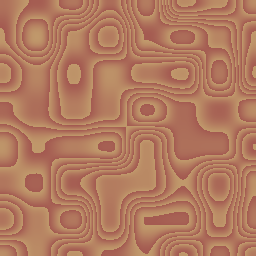
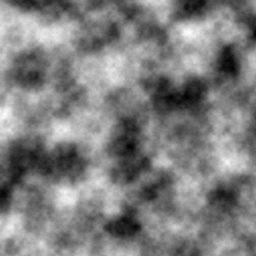
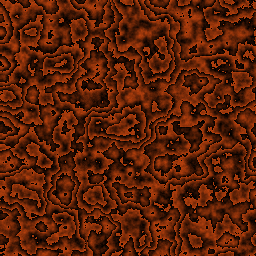


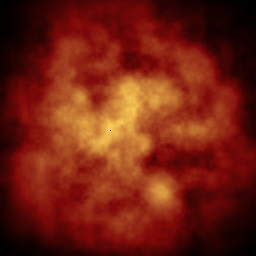
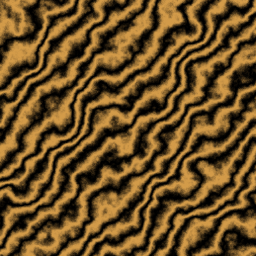
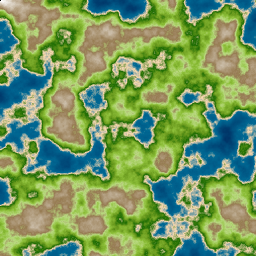
Dependencies
Python>=3.10.0
for production dependencies see Requirements
for development dependencies see Dev-Requirements
Installation
$ pip install nPerlinNoise
for detailed instruction on installation see INSTALLATION.
Usage
Setup
>>> import nPerlinNoise as nPN
>>> noise = nPN.Noise(seed=69420)
Basic usage
Get noise values at given n-dimensional coordinates by calling noise(...),
coordinates can be single value, or an iterable
-
single value
noise(..., l, m, n, ...)
where l, m, n, ..., are single values>>> noise(73) array(0.5207113, dtype=float32) >>> noise(73, 11, 7) array(0.5700986, dtype=float32) >>> noise(0, 73, 7, 11, 0, 3) array(0.5222712, dtype=float32)
-
iterable
noise(...., [l1, l2, ..., lx], [m1, m2, ..., mx], [n1, n2, ..., nx], ....)
where ...., are iterable of homogeneous-dimensions and lx, mx, nx, ..., are single values the output will be of same shape of input homogeneous-dimensions>>> noise([73, 49]) array([0.52071124, 0.6402224 ], dtype=float32) >>> noise([73, 49], [2, 2]) array([0.4563121 , 0.63378346], dtype=float32) >>> noise([[73], [49], [0]], ... [[2 ], [2 ], [2]], ... [[0 ], [1 ], [2]]) array([[0.4563121 ], [0.6571784 ], [0.16369209]], dtype=float32) >>> noise([[1, 2], [2, 3]], ... [[1, 1], [1, 1]], ... [[2, 2], [2, 2]]) array([[0.08666219, 0.09778494], [0.09778494, 0.14886124]], dtype=float32)
noise(..., l, m, n, ...) has same values with trailing dimensions having zero as coordinate
-
n-dimensionality
noise(..., l, m, n) = noise(..., l, m, n, 0) = noise(..., l, m, n, 0, 0) = noise(..., l, m, n, 0, 0, ...)
>>> noise(73)
array(0.5207113, dtype=float32)
>>> noise(73, 0)
array(0.5207113, dtype=float32)
>>> noise(73, 0, 0)
array(0.5207113, dtype=float32)
>>> noise(73, 0, 0, 0, 0)
array(0.5207113, dtype=float32)
grid mode allows for computing noise for every combination of coords
use noise(..., gridMode=True) gridMode is key-word only argument, default=False
the output will be of shape equal to the length(s) of coords in that order
-
gridMode
>>> noise([73, 49], [2, 2], [0, 1], gridMode=True)
array([[[0.4563121 , 0.63378346],
        [0.4563121 , 0.63378346]],

       [[0.44594935, 0.6571784 ],
        [0.44594935, 0.6571784 ]]], dtype=float32)
>>> noise([1, 20, 32, 64], [1, 1, 2], 0, [1, 2], gridMode=True)
array([[[[0.06459193, 0.5110498 , 0.669962  , 0.47636804],
         [0.06459193, 0.5110498 , 0.669962  , 0.47636804],
         [0.09864856, 0.5013973 , 0.62935597, 0.47954425]]],


       [[[0.07678645, 0.50853723, 0.6778991 , 0.4679888 ],
         [0.07678645, 0.50853723, 0.6778991 , 0.4679888 ],
         [0.14069612, 0.47582665, 0.6663638 , 0.48764956]]]],
      dtype=float32)
for detailed usage see EXAMPLE
API
- docs pending
How to test the software
- To test Logical consistency run testLogic
- To test Profile Benchmarking run testProfile
- To test Visuals run testVisuals
- To test Colors run testCol
to see all tests see Tests
Known issues
No Known BugsNPerlin.findBounds is bottlenecknoise(a, b, c, d, e, f, ...) is slow for single value coordinates
Getting help
If you have questions, concerns, bug reports, etc. please file an issue in this repository's Issue Tracker or open a discussion in this repository's Discussion section.
Getting involved
Looking for Contributors for feature additionsLooking for Contributors for optimization#11Looking for Contributors for unit testing#12Looking for Contributors for ReadTheDocs#13Looking for Contributors for WebApp#14Looking for Contributors for API docs#15- Fork the repository and issue a PR to contribute
General instructions on how to contribute CONTRIBUTING and CODE OF CONDUCT
Open source licensing info
Credits and references
- Inspired from The Coding Train -> perlin noise
- hash function by xxhash inspired the rand3 algo and ultimately helped for O(1) time complexity n-dimensional random generator NPrng
- StackOverflow for helping on various occasions throughout the development
- vnoise and opensimplex for ideas for README.md
- docs derivative from open-source-project-template
- packaging help from realpython
Maintainer:
 |
|---|
| Amith M |
 |
1 maintainer

Metadata
1 maintainer
Release files for nPerlinNoise 0.1.4a0
For a detailed explanation of source distributions (sdists) and built distributions (wheels), please see the package formats documentation.
Source distribution (sdist)
| File | Size | Uploaded | Provenance | |
|---|---|---|---|---|
| nPerlinNoise-0.1.4a0.tar.gz | 886.1 kB | Without provenance | Details |
Built distribution (wheel)
| File | Interpreter | ABI | Platform | Reset |
|---|---|---|---|---|
| nPerlinNoise-0.1.4a0-py3-none-any.whl | Python 3 | none | any | Details |
Total release size: 902.0 kB
Release files / nPerlinNoise-0.1.4a0.tar.gz
| Download URL | nPerlinNoise-0.1.4a0.tar.gz |
|---|---|
| Size | 886.1 kB |
| Tags | Source |
|
SHA-256 checksum How to use checksums |
7a439e991a1a8bc7f57efb63d9092dfece0fa48caeddc8a52c8dc57fd40f4032
|
|
BLAKE2b-256 checksum How to use checksums |
8a1ad5a1823240f27056daab7b5af35a58024677cf875a5c607ab7b1b0003d3f
|
| Upload date | |
|
Uploaded using Trusted Publishing? What is trusted publishing? |
No |
| Uploaded via |
twine/4.0.1 CPython/3.10.4
|
Release files / nPerlinNoise-0.1.4a0-py3-none-any.whl
| Download URL | nPerlinNoise-0.1.4a0-py3-none-any.whl |
|---|---|
| Size | 15.9 kB |
| Tags | Python 3 |
|
SHA-256 checksum How to use checksums |
54a0dca607f287dc673532a0d764d9cdb3805b2d16e1254f6da86f3fdfe1c2dc
|
|
BLAKE2b-256 checksum How to use checksums |
886de9c8fb43cd8b28838d58e1592de3acac9c8eb58f1dbe182e973b80f8df78
|
| Upload date | |
|
Uploaded using Trusted Publishing? What is trusted publishing? |
No |
| Uploaded via |
twine/4.0.1 CPython/3.10.4
|
Security for nPerlinNoise 0.1.4a0
Provenance
Provenance describes where a file came from. On PyPI, provenance is shared via attestations, which provide a verifiable record of the build or publishing details. View details, limitations and caveats.
No provenance found
None of the files in this release were uploaded with provenance metadata.
A note on package security
PyPI is a repository for distributing packages, not a service for auditing them. While third-party security researchers and our staff do their best to detect and remove malicious packages, PyPI cannot guarantee the quality, security or suitability of any given package.
To learn more about protecting yourself from malicious actors, visit our package security documentation.














