
Synaptipy










Abstract
Synaptipy is a cross-platform application for the visualization and analysis of electrophysiological recordings. The software implements a modular architecture supporting interactive single-recording analysis, batch processing, and integration of user-written analysis routines via a plugin interface. The primary experimental focus is whole-cell patch-clamp and intracellular recordings; file I/O is handled via the Neo library, enabling import of any supported electrophysiology format including extracellular, sharp-electrode, and multi-channel data.
Full documentation: synaptipy.readthedocs.io
Installation
WARNING: PySide6 must remain pinned to version 6.7.3 due to QTBUG-130070.
Default Install (PyPI)
The recommended approach for most users is to install Synaptipy directly via pip into a standard Python environment (Python 3.10-3.12).
pip install synaptipy
# Optional: include pyabf fallback reader alongside Neo
pip install "synaptipy[formats]"
Standalone Application
Pre-compiled binaries for Windows, macOS, and Linux are available on the Releases page. Download the asset matching your operating system and CPU architecture from the latest release:
- Windows (x64):
Synaptipy_Setup_<version>.exe- run the setup wizard - macOS (Apple Silicon
arm64):Synaptipy_<version>_macOS_arm64.dmg- open the disk image and dragSynaptipy.apptoApplications(if Gatekeeper blocks the unsigned/ad-hoc signed bundle on first launch, runxattr -cr /Applications/Synaptipy.appor allow it under System Settings > Privacy & Security) - macOS (Intel
x86_64):Synaptipy_<version>_macOS_x86_64.dmg- open the disk image and dragSynaptipy.apptoApplications(runxattr -cr /Applications/Synaptipy.appif prompted by Gatekeeper) - Linux (x86_64):
Synaptipy-<version>-x86_64.AppImage- mark as executable (chmod +x) and run (on Ubuntu 24.04+ or distros without FUSE 2, installlibfuse2t64/libfuse2or pass--appimage-extract-and-run)
Advanced: From Source
For developers and users who want to modify the application, you can install directly from the source repository using Conda/Miniconda:
git clone https://github.com/anzalks/synaptipy.git
cd synaptipy
conda env create -f environment.yml
conda activate synaptipy
pip install -e ".[dev]"
synaptipy  # launch the application
For detailed installation instructions, system requirements, and troubleshooting, see the full documentation.
Usage
Graphical interface
To launch the graphical user interface:
synaptipy  # launch the application

# or equivalently:
python -m synaptipy
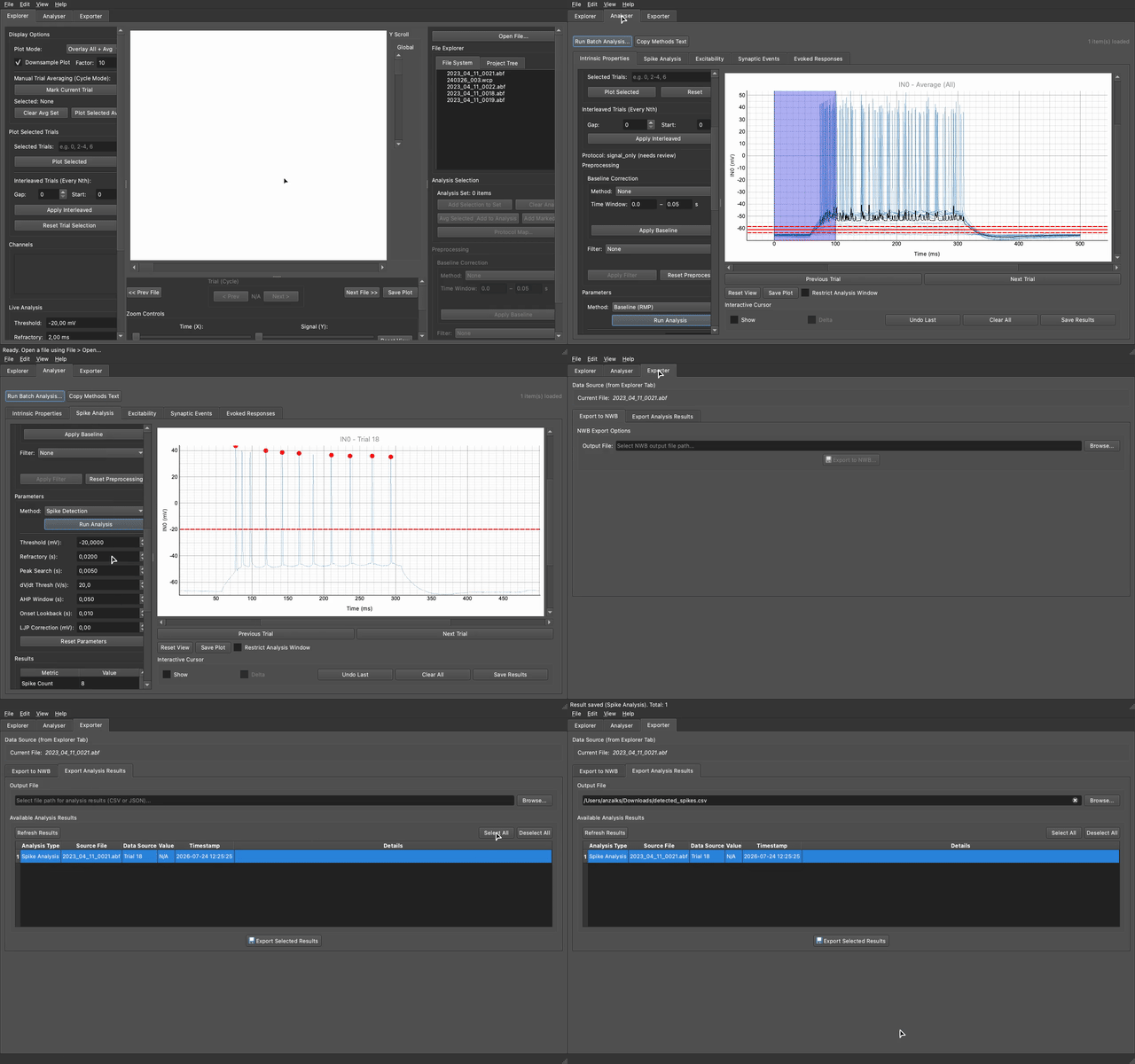
Load a recording by dragging a file into the Explorer tab, then navigate to the Analyser tab to select a channel and run an analysis. Results are displayed in a table and can be exported to CSV.
Programmatic (headless) use
The batch engine operates independently of the graphical interface:
from synaptipy.core.analysis.batch_engine import BatchAnalysisEngine
from pathlib import Path

engine = BatchAnalysisEngine()
pipeline = [
    {
        "analysis": "spike_detection",
        "scope": "all_trials",
        "params": {"threshold": -20.0, "refractory_period": 0.002},
    }
]
results = engine.run_batch([Path("recording.abf")], pipeline)
print(results)
The same batch engine is available from the command line for reproducible methods workflows:
synaptipy-batch run \
  --pipeline pipeline.json \
  --output results.csv \
  recording.abf
The CLI writes results.csv plus a companion results_provenance.json file
containing the software version, input files, and full pipeline configuration.
Analysis Capabilities
Synaptipy provides 16 built-in analysis routines covering passive membrane properties, action potential characterisation, firing dynamics, synaptic event detection, and evoked responses - organised into five core module tabs alongside 7 registered signal-preprocessing stages for batch and CLI parity. Each routine is available interactively in the graphical interface and as a composable unit in the batch processing pipeline.
Tab 1: Intrinsic Properties
- Baseline (RMP) - mean membrane potential measured over a user-defined quiescent window; reports mean, standard deviation, and an estimate of linear drift
- Input Resistance - delta-V / delta-I from a voltage response to a hyperpolarising current step; returns mean, peak, and steady-state Rin separately to distinguish Ih-sag contributions
- Tau (Time Constant) - single-exponential or bi-exponential fit to the voltage decay after a current step; fit quality is gated by R² >= 0.80 and NaN is returned with an explicit flag when the gate is not met
- Sag Ratio (Ih) - peak-to-steady-state voltage ratio during a hyperpolarising step; includes rebound depolarisation measured after stimulus offset
- I-V Curve - current-voltage relationship across a multi-trial step protocol; fits an aggregate Rin from a linear regression and computes a dynamic rectification index
- Capacitance - membrane capacitance derived from Tau / Rin in current-clamp, or from capacitive-transient integration and mono-exponential fit in voltage-clamp
Tab 2: Spike Analysis
- Spike Detection - threshold-crossing action-potential detection with refractory-period filtering; extracts per-spike amplitude, half-width, rise time, decay time, threshold voltage, after-hyperpolarisation (AHP), and afterdepolarisation amplitude (adp_amplitude; NaN when absent)
- Phase Plane - dV/dt vs. voltage trajectory for action-potential initiation dynamics; threshold voltage is detected via a kink-slope criterion; reports mean threshold voltage and maximum dV/dt
Tab 3: Excitability
- Excitability (F-I Curve) - multi-trial rheobase, F-I slope, maximum firing frequency, and spike-frequency adaptation ratio; generates a popup F-I scatter plot
- Burst Analysis - max-ISI burst detection; reports burst count, mean spikes per burst, mean burst duration, and intra-burst frequency
- Spike Train Dynamics - inter-spike interval statistics including mean ISI, coefficient of variation (CV), local variation (LV), and CV2; generates a popup ISI plot
Tab 4: Synaptic Events
- Event (Amplitude) - prominence-based detection that accommodates baseline drift and overlapping events; interactive event markers can be individually accepted or rejected
- Event (Template) - matched-filter cross-correlation using a bi-exponential kernel with user-defined rise and decay time constants; three kernel scales (1x, 2x, 3x the decay constant) are evaluated to accommodate dendritic-filtering variability
Tab 5: Evoked Responses
- Evoked Sync - extracts TTL or digital stimulus pulses from a secondary channel and correlates them with detected spikes or synaptic events; reports optical latency, response probability, and trial-to-trial jitter
- Paired-Pulse Ratio - stimulus-evoked PPR with residual decay correction: measures R1 and R2 amplitudes, fits a mono- or bi-exponential decay to the R1 tail, and subtracts the residual at the time of the second stimulus before computing the ratio. This is the GUI-accessible PPR analysis (Tab 5); there is no standalone PPR in Tab 4 (Synaptic Events).
- Stimulus Train - measures response amplitudes across a multi-pulse stimulus train, normalises each pulse to R1, computes the steady-state ratio (
steady_state_ratio), and classifies short-term plasticity asfacilitation,depression, orbiphasic
Visualization
Trace rendering is implemented via PyQtGraph's CPU-vectorized native raster engine by default for cross-platform stability; optional hardware-accelerated OpenGL rendering can be enabled under Edit > Preferences > Performance. The interface comprises a tree-based multi-file explorer with synchronized trial navigation and per-channel amplitude scaling. View-range management, zooming, and panning are performed explicitly via mouse interactions. Popup plots are generated for I-V curves, F-I curves, phase planes, and inter-spike interval distributions.
Cross-file trial averaging
The Explorer tab implements grand-average construction across multiple files and trials. In Cycle Single Trial mode, the user captures individual trials via Add Current Trial to Avg Set. Trials from different files may be accumulated; the selection persists across the session. Activation of Plot Selected Avg overlays the mean trace. When recordings of different durations are selected, shorter trials are padded with NaN up to the maximum array length. This allows the application to produce a grand average that preserves the full length of the longest recording, smoothly dropping the statistical N at the tails rather than truncating data.
Batch Processing
The batch processing engine implements a composable pipeline architecture in which registered analysis routines are chained sequentially. Analysis operations execute in a background worker thread; the graphical interface remains responsive during execution. Recording metadata (sampling rate, gain, acquisition datetime) are extracted automatically. Results are exported to CSV in wide format (scalar metrics) or long format (event arrays); both formats are compatible with Python/Pandas, R, and MATLAB. NWB 2.x export includes icephys sweep tables, a three-step stimulus reconstruction fallback, and a discrete-event ProcessingModule for FAIR-compliant data archival.
Plugin Interface
The software architecture comprises a central AnalysisRegistry that maps named analysis functions to the graphical interface and batch engine via a decorator pattern. Python scripts placed in ~/.synaptipy/plugins/ that use the @AnalysisRegistry.register decorator are discovered at startup and integrated into both the interactive analyser and batch pipeline without modification to the core package.
A documented template at src/synaptipy/templates/plugin_template.py defines the required function signature and return schema.
@AnalysisRegistry.register(
    name="my_analysis",
    label="My Analysis",
    ui_params=[{"name": "threshold", "type": "float", "default": -20.0}],
    plots=[{"type": "hlines", "data": ["threshold_mv"], "color": "b", "styles": ["dash"]}],
)
def my_analysis_wrapper(data, time, sampling_rate, **kwargs):
    ...
    return {"threshold_mv": float(kwargs.get("threshold", -20.0))}
Wrappers return a flat dictionary of scalar metrics (automatically normalised into the versioned AnalysisResult schema by AnalysisRegistry.execute). Keys prefixed with _ pass arrays to plot overlays without appearing in the results table. The full specification is in docs/extending_synaptipy.md.
Plugin discovery always includes ~/.synaptipy/plugins/ (user additions). Example plugins can be downloaded on demand from Help > Download Example Plugins...; source checkouts and desktop bundles also include them for development and demonstration use. A user copy with an identical filename takes precedence. Toggling Enable Custom Plugins in Edit > Preferences reloads all plugins and regenerates the Analyser tab UI within the running process. If one or more optional plugins cannot load, Synaptipy continues normally and shows one concise report after startup.
NWB Export and FAIR Compliance
Synaptipy exports raw traces and analysis results to Neurodata Without Borders (NWB) 2.x:
- Raw electrophysiology traces pre-scaled to SI base units (
volts/amperes,conversion=1.0) and stored asCurrentClampSeries/VoltageClampSeries - Sweep-level organisation via
IntracellularRecordingsTable,SimultaneousRecordingsTable, andSequentialRecordingsTable(NWB 2.x icephys hierarchy) - Stimulus waveform reconstruction from ABF step and linear ramp (
nEpochType == 2) epoch metadata when the command channel is absent; a three-step fallback (raw channel -> synthetic reconstruction ->stimulus=Nonewith a warning) preserves NWB conformance - Scalar analysis metrics written as a
scalar_metricsDynamicTablealongside discrete eventDynamicTableobjects inside/processing/analysis, plus preprocessing provenance in/processing/preprocessing - Electrode metadata and session provenance fields (including temperature, liquid junction potential offset, and digital filter provenance in session
notes)
Supported File Formats
File I/O is handled through the Neo library:
| Format | Extension(s) | Acquisition System |
|---|---|---|
| Axon Binary Format | .abf |
Axon / Molecular Devices |
| WinWCP | .wcp |
Strathclyde Electrophysiology Software |
| CED / Spike2 | .smr, .smrx |
Cambridge Electronic Design |
| Igor Pro | .ibw, .pxp |
WaveMetrics |
| Intan | .rhd, .rhs |
Intan Technologies |
| Neurodata Without Borders | .nwb |
NWB standard |
| BrainVision | .vhdr |
Brain Products |
| European Data Format | .edf |
EDF/EDF+ |
| Plexon | .plx, .pl2 |
Plexon |
| Open Ephys | .continuous, .oebin |
Open Ephys |
| Tucker Davis Technologies | .tev, .tbk |
TDT |
| Neuralynx | .ncs, .nse, .nev |
Neuralynx |
| NeuroExplorer | .nex |
NeuroExplorer |
| MATLAB | .mat |
- |
| ASCII / CSV | .txt, .csv, .tsv |
- |
Additional formats supported by Neo can be made available by adding the corresponding entry to the IODict in the infrastructure layer.
Technical Architecture
Synaptipy follows a separation-of-concerns design with three layers:
- Core layer - pure Python analysis logic, fully decoupled from the graphical interface and independently testable
- Application layer - PySide6 (Qt6) user interface and plugin manager
- Infrastructure layer - file I/O via Neo and PyNWB; NWB export
| Component | Technology | Version |
|---|---|---|
| Language | Python | 3.10 - 3.12 (3.11 recommended) |
| GUI Framework | PySide6 | 6.7.3 (pinned) |
| Plotting Engine | PyQtGraph | 0.13.3+ |
| Electrophysiology I/O | Neo | 0.14.0+ |
| NWB Export | PyNWB | 3.1.0+ |
| Numerical Computation | SciPy / NumPy | 1.14.0+ / 2.0.0+ |
PySide6 is pinned to 6.7.3 on all platforms. PySide6 6.8.0 contains a known crash on Windows (QTBUG-130070) and 6.10.x introduced internal signal-connection changes that produce segmentation faults in the pyqtgraph rendering path under the offscreen platform plugin. The pin will be reviewed when an upstream fix is available.
Documentation
Contributing
Contributions are welcome. The preferred contribution pathway for new analysis routines is the plugin interface, which requires no modification to the core package. For changes to the core, infrastructure, or application layers, refer to CONTRIBUTING.md and the developer guide for project conventions, coding standards, and the contribution workflow.
Dependencies and Citations
Synaptipy builds on the following open-source libraries. When using Synaptipy in published research, please consider citing the relevant upstream packages alongside the Synaptipy repository.
| Library | Role | Citation |
|---|---|---|
| Neo | Electrophysiology file I/O | Garcia S et al. (2014). Front. Neuroinformatics 8:10. doi:10.3389/fninf.2014.00010 |
| PyNWB | NWB data export | Rubel O et al. (2022). eLife 11:e78362. doi:10.7554/eLife.78362 |
| SpikeInterface | Spike sorting integration (Plugin) | Buccino AP et al. (2020). eLife 9:e61834. doi:10.7554/eLife.61834 |
| miniML | Deep learning event detection (Plugin) | O'Neill PS et al. (2025). eLife 13:RP98485. doi:10.7554/eLife.98485 |
| PySide6 | Qt6 GUI framework | Qt for Python, The Qt Company. https://doc.qt.io/qtforpython/ |
| PyQtGraph | Signal rendering | Campagnola L et al. PyQtGraph. https://www.pyqtgraph.org |
| SciPy | Signal processing and curve fitting | Virtanen P et al. (2020). Nature Methods 17:261-272. doi:10.1038/s41592-019-0686-2 |
| NumPy | Array computation | Harris CR et al. (2020). Nature 585:357-362. doi:10.1038/s41586-020-2649-2 |
| pandas | Tabular result export | McKinney W (2010). Proc. SciPy 2010, 56-61. doi:10.25080/Majora-92bf1922-00a |
Scientific Method References
The analyses implemented in Synaptipy are grounded in peer-reviewed literature. Key references are listed below; see the full references page in the documentation for a complete annotated bibliography.
Action potential detection, phase plane, and kinetics:
- Bean BP (2007). The action potential in mammalian central neurons. Nat Rev Neurosci 8:451-465. doi:10.1038/nrn2148 - dV/dt threshold default (20 V/s)
- Hodgkin AL & Huxley AF (1952). J Physiol 117:500-544. doi:10.1113/jphysiol.1952.sp004764 - foundational AP model
- Jenerick H (1963). Biophys J 3:363-377. doi:10.1016/S0006-3495(63)86827-7 - phase-plane trajectory and loop area
- Gouwens NW et al. (2019). Nat Neurosci 22:1182-1195. doi:10.1038/s41593-019-0417-0 - standardised AP & subthreshold feature extraction
- Sekerli M et al. (2004). IEEE Trans Biomed Eng 51:1665-1672. doi:10.1109/TBME.2004.827827 - threshold curvature methodology comparison
- Naundorf B et al. (2006). Nature 440:1060-1063. doi:10.1038/nature04610 - artifact ceiling (300 V/s)
Passive membrane properties and capacitance:
- Hamill OP et al. (1981). Pflugers Arch 391:85-100. doi:10.1007/BF00656997 - whole-cell patch-clamp; series resistance and capacitance
- Rall W (1969). Biophys J 9:1483-1508. doi:10.1016/S0006-3495(69)86467-2 - passive membrane time constants
- Lindau M & Neher E (1988). Pflugers Arch 411:137-146. doi:10.1007/BF00582306 - whole-cell capacitance circuit analysis
- Golowasch J et al. (2009). J Neurophysiol 102:2161-2175. doi:10.1152/jn.00160.2009 - nonisopotential neuronal capacitance estimation
- Taylor AL (2012). J Comput Neurosci 32:167-175. doi:10.1007/s10827-011-0346-8 - voltage-clamp step capacitance estimators
- Robinson RB & Siegelbaum SA (2003). Annu Rev Physiol 65:453-480. doi:10.1146/annurev.physiol.65.092101.142734 - HCN / Ih current; peak vs. steady-state Rin
After-hyperpolarisation and after-depolarisation:
- Storm JF (1987). J Physiol 385:733-759. doi:10.1113/jphysiol.1987.sp016517 - fast AHP (BK/Kv3, 1-5 ms)
- Sah P & Faber ESL (2002). Prog Neurobiol 66:345-353. doi:10.1016/S0301-0082(02)00004-7 - medium AHP (SK, 10-50 ms)
- Azouz R et al. (1996). J Physiol 492:211-223. doi:10.1113/jphysiol.1996.sp021302 - spike afterdepolarisation (ADP)
Excitability and spike-train statistics:
- Connors BW & Gutnick MJ (1990). Trends Neurosci 13:99-104. doi:10.1016/0166-2236(90)90185-D - F-I gain and spike-frequency adaptation
- Shao L-R et al. (1999). J Physiol 521:135-146. doi:10.1111/j.1469-7793.1999.00135.x - repetitive spike broadening
- Holt GR et al. (1996). J Neurophysiol 75:1806-1814. doi:10.1152/jn.1996.75.5.1806 - CV and CV2
- Shinomoto S et al. (2003). Neural Comput 15:2823-2842. doi:10.1162/089976603322518759 - Local Variation (LV)
Burst detection:
- Grace AA & Bunney BS (1984). J Neurosci 4:2877-2890. doi:10.1523/JNEUROSCI.04-11-02877.1984 - ISI burst criterion
- Harris KD et al. (2001). Neuron 32:141-149. doi:10.1016/S0896-6273(01)00447-0 - dynamic ISI fraction (30%)
Synaptic event detection and kinetics:
- Clements JD & Bekkers JM (1997). Biophys J 73:220-229. doi:10.1016/S0006-3495(97)78062-7 - zero-mean template event detection
- Pernia-Andrade AJ et al. (2012). Biophys J 103:1429-1439. doi:10.1016/j.bpj.2012.08.039 - bi-exponential synaptic kernel detection
- Jonas P et al. (1993). J Physiol 472:615-663. doi:10.1113/jphysiol.1993.sp019965 - bi-exponential EPSC decay and charge integration
- Rall W (1967). J Neurophysiol 30:1138-1168. doi:10.1152/jn.1967.30.5.1138 - cable theory; dendritic filtering (2-3x tau)
- Hampel FR (1974). J Am Stat Assoc 69:383-393. doi:10.1080/01621459.1974.10482962 - MAD noise estimator (1.4826 factor)
Evoked synchronisation, optogenetics, and short-term plasticity:
- Sabatini BL & Regehr WG (1999). Annu Rev Physiol 61:521-542. doi:10.1146/annurev.physiol.61.1.521 - synaptic latency and jitter
- Boyden ES et al. (2005). Nat Neurosci 8:1263-1268. doi:10.1038/nn1525 - optogenetic spike latency and fidelity
- Kim J & Alger BE (2001). J Neurosci 21:9608-9618. doi:10.1523/JNEUROSCI.21-24-09608.2001 - paired-pulse ratio fluctuation bias
- Zucker RS & Regehr WG (2002). Annu Rev Physiol 64:355-405. doi:10.1146/annurev.physiol.64.092501.114547 - short-term synaptic plasticity
- Thanawala MS & Regehr WG (2013). J Neurosci 33:4625-4633. doi:10.1523/JNEUROSCI.4031-12.2013 - iterative N-pulse residual decay subtraction
- Regehr WG (2012). Cold Spring Harb Perspect Biol 4:a005702. doi:10.1101/cshperspect.a005702 - PPR facilitation/depression classification
Signal filtering:
- Colquhoun D & Sigworth FJ (1995). In Single-Channel Recording (2nd ed., Ch. 19). doi:10.1007/978-1-4419-1229-9_19 - -3 dB Gaussian and Bessel patch-clamp filtering
- Gustafsson F (1996). IEEE Trans Signal Process 44:988-992. doi:10.1109/78.492552 - forward-backward IIR steady-state initial conditions
- Widmann A et al. (2015). J Neurosci Methods 250:34-46. doi:10.1016/j.jneumeth.2014.08.002 - electrophysiological digital filter design
- Savitzky A & Golay MJE (1964). Anal Chem 36:1627-1639. doi:10.1021/ac60214a047 - Savitzky-Golay smoothing
- Welch PD (1967). IEEE Trans Audio Electroacoust 15:70-73. doi:10.1109/TAU.1967.1161901 - Welch PSD / line noise detection
Electrode corrections:
- Barry PH & Lynch JW (1991). J Membr Biol 121:101-117. doi:10.1007/BF01870526 - liquid junction potential correction
- Armstrong CM & Bezanilla F (1977). J Gen Physiol 70:567-590. doi:10.1085/jgp.70.5.567 - P/N leak subtraction protocol
License
Synaptipy is free and open-source software licensed under the GNU Affero General Public License v3 (AGPLv3). See the LICENSE file for full terms.
1 maintainer

Metadata
1 maintainer
Release files for synaptipy 0.1.9
For a detailed explanation of source distributions (sdists) and built distributions (wheels), please see the package formats documentation.
Source distribution (sdist)
| File | Size | Uploaded | Provenance | Actions |
|---|---|---|---|---|
| synaptipy-0.1.9.tar.gz | 37.5 MB | With provenance | Details for synaptipy-0.1.9.tar.gz |
Built distribution (wheel)
| File | Interpreter | ABI | Platform | Actions Reset |
|---|---|---|---|---|
| synaptipy-0.1.9-py3-none-any.whl | Python 3 | none | any | Details for synaptipy-0.1.9-py3-none-any.whl |
Total release size: 52.5 MB
Release files / synaptipy-0.1.9.tar.gz
| Download URL | synaptipy-0.1.9.tar.gz |
|---|---|
| Size | 37.5 MB |
| Tags | Source |
|
SHA-256 checksum How to use checksums |
d35522ab0ba38cd1d299536012a574ffaa2cb7335fd8df6561b7f2f262db6f68
|
|
BLAKE2b-256 checksum How to use checksums |
8cff261242e5d5b3fd1ff76f9b700389fdbe7bfb464dfe2112fcd4d413c9fee0
|
| Upload date | |
|
Uploaded using Trusted Publishing? What is trusted publishing? |
Yes |
| Uploaded via |
twine/7.0.0 CPython/3.13.16
|
Provenance
Provenance describes where a file came from. On PyPI, provenance is shared via attestations, which provide a verifiable record of the build or publishing details. View details, limitations and caveats.


PyPI Publish Attestation
PyPI verified that this artifact, at this checksum, originated from the publisher listed below.
Signed by GitHub Actions, verified by PyPI on Nov 24, 2026.
Transparency logRelease files / synaptipy-0.1.9-py3-none-any.whl
| Download URL | synaptipy-0.1.9-py3-none-any.whl |
|---|---|
| Size | 15.0 MB |
| Tags | Python 3 |
|
SHA-256 checksum How to use checksums |
1bb2d63cafbbc3194154776ec6a74a58ed7a49931bc052775d9b35f647cc1261
|
|
BLAKE2b-256 checksum How to use checksums |
f566bd4219c75086062bdc96a27e88f7a538fdb0e8e704d4c65d0ddf0fee1961
|
| Upload date | |
|
Uploaded using Trusted Publishing? What is trusted publishing? |
Yes |
| Uploaded via |
twine/7.0.0 CPython/3.13.16
|
Provenance
Provenance describes where a file came from. On PyPI, provenance is shared via attestations, which provide a verifiable record of the build or publishing details. View details, limitations and caveats.
PyPI Publish Attestation
PyPI verified that this artifact, at this checksum, originated from the publisher listed below.
Signed by GitHub Actions, verified by PyPI on Nov 24, 2026.
Transparency logSecurity for synaptipy 0.1.9
Provenance
Provenance describes where a file came from. On PyPI, provenance is shared via attestations, which provide a verifiable record of the build or publishing details. View details, limitations and caveats.
Full provenance
Both files in this release have been uploaded with provenance metadata.
Attestation for synaptipy-0.1.9.tar.gz
PyPI Publish Attestation
PyPI verified that this artifact, at this checksum, originated from the publisher listed below.
Signed by GitHub Actions, verified by PyPI on Nov 24, 2026.
Transparency logA note on package security
PyPI is a repository for distributing packages, not a service for auditing them. While third-party security researchers and our staff do their best to detect and remove malicious packages, PyPI cannot guarantee the quality, security or suitability of any given package.
To learn more about protecting yourself from malicious actors, visit our package security documentation.














