
XBNet - Xtremely Boosted Network
Boosted neural network for tabular data






XBNET that is built on PyTorch combines tree-based models with neural networks to create a robust architecture that is trained by using a novel optimization technique, Boosted Gradient Descent for Tabular Data which increases its interpretability and performance. Boosted Gradient Descent is initialized with the feature importance of a gradient boosted tree, and it updates the weights of each layer in the neural network in two steps:
- Update weights by gradient descent.
- Update weights by using feature importance of a gradient boosted tree in every intermediate layer.
Features
- Better performance, training stability and interpretability for tabular data.
- Easy to implement with rapid prototyping capabilities
- Minimum Code requirements for creating any neural network with or without boosting
Comparison with XGBOOST
XBNET VS XGBOOST testing accuracy on different datasets with no hyperparameter tuning
| Dataset | XBNET | XGBOOST |
|---|---|---|
| Iris | 100 | 97.7 |
| Breast Cancer | 96.49 | 96.47 |
| Diabetes | 78.78 | 77.48 |
| Titanic | 79.85 | 80.5 |
| German Credit | 71.33 | 77.66 |
Installation :
pip install --upgrade git+https://github.com/tusharsarkar3/XBNet.git
Example for using
import torch
import numpy as np
import pandas as pd
from sklearn.preprocessing import LabelEncoder
from sklearn.model_selection import train_test_split
from XBNet.training_utils import training,predict
from XBNet.models import XBNETClassifier
from XBNet.run import run_XBNET

data = pd.read_csv('test\Iris (1).csv')
print(data.shape)
x_data = data[data.columns[:-1]]
print(x_data.shape)
y_data = data[data.columns[-1]]
le = LabelEncoder()
y_data = np.array(le.fit_transform(y_data))
print(le.classes_)

X_train,X_test,y_train,y_test = train_test_split(x_data.to_numpy(),y_data,test_size = 0.3,random_state = 0)
model = XBNETClassifier(X_train,y_train,2)

criterion = torch.nn.CrossEntropyLoss()
optimizer = torch.optim.Adam(model.parameters(), lr=0.01)

m,acc, lo, val_ac, val_lo = run_XBNET(X_train,X_test,y_train,y_test,model,criterion,optimizer,32,300)
print(predict(m,x_data.to_numpy()[0,:]))
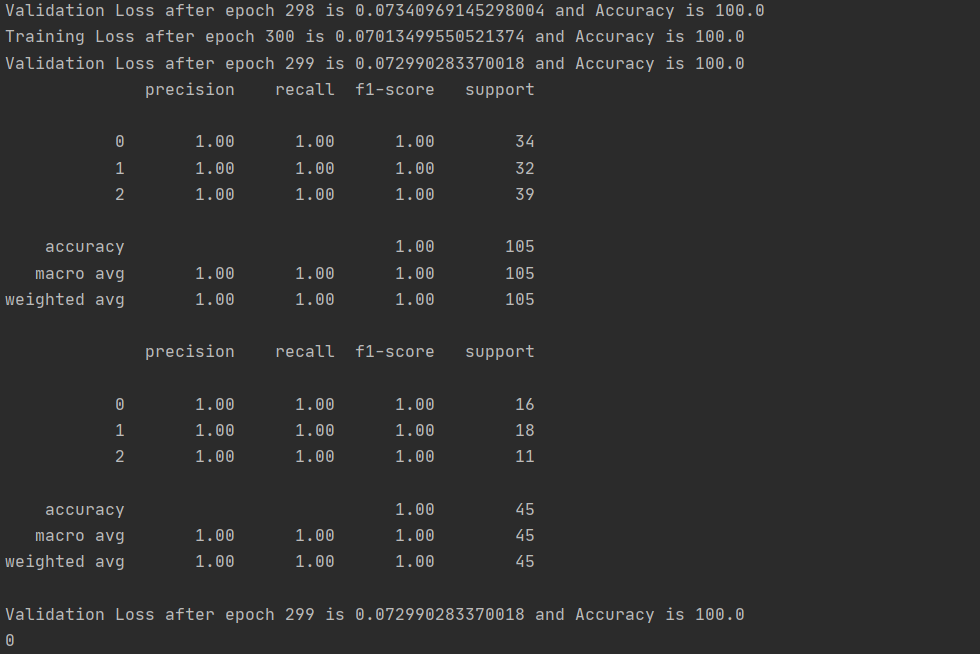
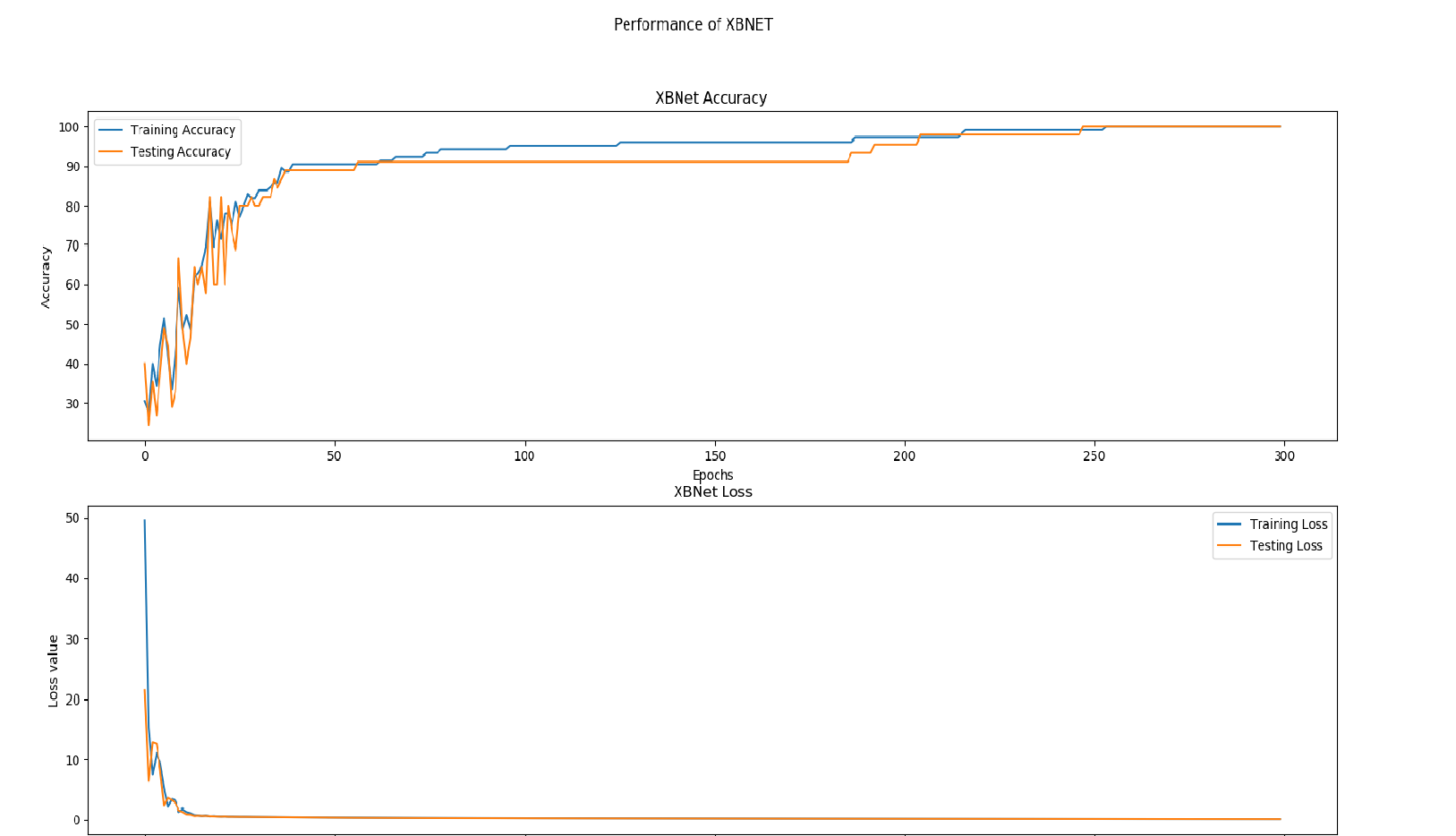
Output images
Reference
If you make use of this software for your work, we would appreciate it if you would cite us:
@misc{sarkar2021xbnet,
      title={XBNet : An Extremely Boosted Neural Network},
      author={Tushar Sarkar},
      year={2021},
      eprint={2106.05239},
      archivePrefix={arXiv},
      primaryClass={cs.LG}
}
Features to be added :
- Metrics for different requirements
- Addition of some other types of layers
1 maintainer

Metadata
1 maintainer
Release files for XBNet 1.4.6
For a detailed explanation of source distributions (sdists) and built distributions (wheels), please see the package formats documentation.
Built distribution (wheel)
| File | Interpreter | ABI | Platform | Reset |
|---|---|---|---|---|
| XBNet-1.4.6-py3-none-any.whl | Python 3 | none | any | Details |
Release files / XBNet-1.4.6-py3-none-any.whl
| Download URL | XBNet-1.4.6-py3-none-any.whl |
|---|---|
| Size | 13.3 kB |
| Tags | Python 3 |
|
SHA-256 checksum How to use checksums |
aa2cd34323c7c223fa29ae385817ef124aab4a579f4da07bebaa368512ed4c69
|
|
BLAKE2b-256 checksum How to use checksums |
640e8db85580488fc6a3ab7275e4284edf67b3166c001b004e3a05753410bda1
|
| Upload date | |
|
Uploaded using Trusted Publishing? What is trusted publishing? |
No |
| Uploaded via |
twine/3.4.1 importlib_metadata/3.3.0 pkginfo/1.5.0.1 requests/2.26.0 requests-toolbelt/0.9.1 tqdm/4.62.2 CPython/3.7.6
|














