
bouncer
A policy enforcement point for agent spending.


Your agent has your card. Agents get stuck in loops, misread prices, and retry forever. bouncer checks every payment against rules you wrote and refuses the ones that break them — then signs a record of what it decided.
What it does
Wrap wherever your code spends money. A refusal raises, so the payment line never runs:
from bouncer import Client, SpendDenied

client = Client.from_policy(POLICY, agent_id="shopping-agent")

try:
    with client.spend(merchant="api.scraper.example", amount="40.00"):
        charge_the_card()          # does not run if the rules say no
except SpendDenied as refused:
    log.warning("blocked: %s", refused.decision.reason)
The rules are two lines of YAML:
agents:
  shopping-agent:
    per_transaction_cap: 50.00      # never more than $50 at once
    rolling_windows:
      - amount: 100.00              # never more than $100
        window: 30d                 # in any 30-day period
Here is the same stuck agent run twice — once without bouncer, once with it.
Nothing else differs (examples/with_and_without.py):
RUN 1  -  the agent holds the card. no policy layer.
  agent: I need web scraping credits, buying $40.00
      CHARGED $40.00. balance now $960.00
  ... six more times, unopposed ...
  RESULT: spent $320.00 in a single loop.
  Nothing refused it. You find out when the statement arrives.

RUN 2  -  same agent, same bug. bouncer checks each payment.
  agent: I need web scraping credits, buying $40.00
      CHARGED $40.00. balance now $960.00
  agent: I need web scraping credits, buying $40.00
      CHARGED $40.00. balance now $920.00
  agent: I need web scraping credits, buying $40.00
      REFUSED. would bring spend over the last 30d to 120.00,
               above the 100.00 ceiling (already spent 80.00)
      the charge never happened. balance still $920.00
  RESULT: spent $80.00, then stopped.
  chain intact: 3 entries verified, head 0ed7b520b9de3d8c...
$240 the agent could not spend. That difference is the entire product.
pip install agent-bouncer
bouncer demo
flowchart LR
    A["AI agent"] -->|"payment intent"| B{"bouncer<br/>policy engine"}

    B -->|"ALLOW"| M["signed mandate<br/>Ed25519, scoped, TTL"]
    B -->|"DENY"| X["blocked<br/>403"]
    B -->|"REQUIRE_APPROVAL"| H["approval queue<br/>tagged by role"]

    H -->|"human approves"| M
    H -->|"denied or timed out"| X
    M --> R["payment rail<br/>Stripe, x402, ..."]

    B -.->|"every decision, always"| L[("hash-chained audit log<br/>Ed25519-signed, append-only")]

    style L stroke-width:2px
Every path through that diagram ends in an audit entry — including the ones that fail. A denial, an unparseable request and an approval that timed out are all logged outcomes, never silent pass-throughs.
See it work
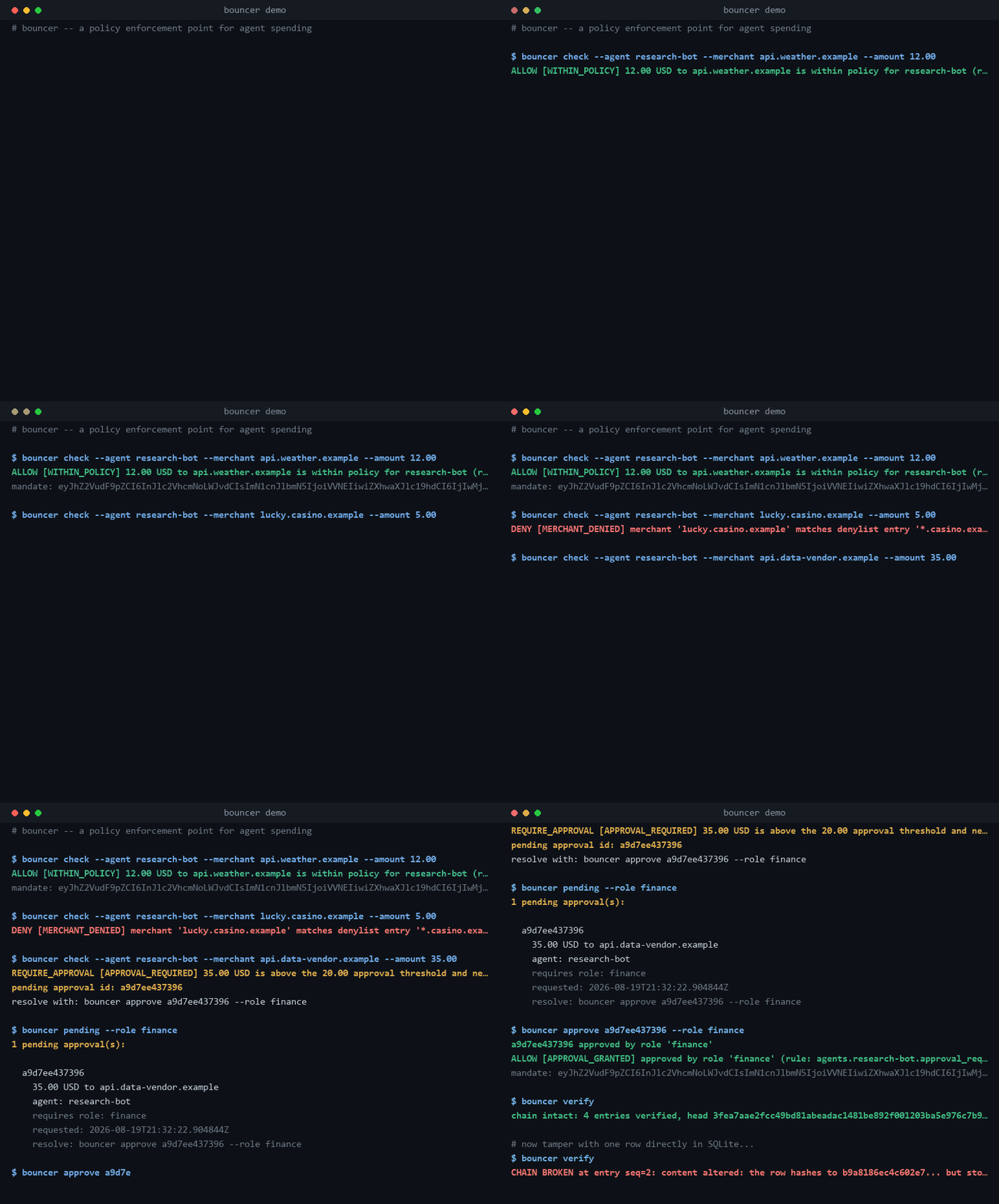
Every line in that recording is real CLI output, captured by
scripts/record_demo.py.
Trust boundary
Read this before deciding bouncer is a control you can rely on.
bouncer is the policy decision point. Your network is the enforcement point. Three limits follow, and none of them are bugs:
- It never custodies funds. bouncer emits a signed authorization; something else settles the payment. It cannot freeze, claw back or reverse anything. This is deliberate — holding money means needing a money transmitter licence.
- It cannot stop an agent that bypasses it. An agent with unrestricted network egress can ignore the proxy and connect directly. Real containment requires firewall or container rules that make bouncer the only route out.
- It does not replace your payment provider's controls. Keep your card limits, processor-side fraud rules and provider spending caps configured independently. bouncer is a layer in front of them, not a substitute.
Nothing here has been security audited. See SECURITY.md and the full threat model below.
Install
pip install agent-bouncer
The distribution is agent-bouncer; the import is bouncer. (bouncer on PyPI
is an unrelated 2014 authorization library.)
Quickstart
Copy and paste the whole block. Every line runs as written, against the starter
policy bouncer init generates — no editing required to see it work.
pip install agent-bouncer

bouncer init                  # operator key + starter policy in ~/.bouncer
bouncer policy                # show exactly what will be enforced

# Allowed: inside the cap and on the allowlist
bouncer check --agent research-bot --merchant api.openai.com --amount 5.00

# Blocked: over the 25.00 per-transaction cap
bouncer check --agent research-bot --merchant api.openai.com --amount 500.00

# Blocked: merchant is on the denylist
bouncer check --agent research-bot --merchant lucky.casino.example --amount 1.00

# Needs a human: above the 10.00 approval threshold
bouncer check --agent research-bot --merchant api.openai.com --amount 15.00
bouncer pending --role finance

# Every decision above, hash-chained and signed
bouncer verify
bouncer check exits 0 when the payment is allowed, 2 when it is not —
denied or held for a human — and 3 when the audit chain is broken, so it
drops straight into a shell pipeline.
From there, edit ~/.bouncer/policy.yaml to write your own rules, and run
bouncer serve to expose the same decisions as a local API on :8080. With the
server up, http://127.0.0.1:8080/docs is a full interactive console for
POST /authorize — the quickest way to show someone the enforcement working.
To watch the whole thing work — six purchases judged, an approval routed to a human, then the audit chain verified and caught after tampering:
bouncer demo
It builds its own key, policy and database in a temporary directory and removes
them afterwards, so it never touches or spends against your ~/.bouncer.
More examples live in the repository:
git clone https://github.com/nmaltese13/bouncer.git && cd bouncer

python examples/with_and_without.py  # the two runs quoted at the top of this file
python examples/agent.py             # a toy agent spending through a $50 budget
python examples/stripe_agent.py      # bouncer in front of Stripe, reading its wire format
stripe_agent.py is the reference integration. The agent builds the exact form
body the Stripe SDK sends, the stripe adapter reads the amount out of it, and
only an allowed payment is forwarded — one approved, one blocked over the cap,
and one refused outright for carrying a live-mode key. Set
STRIPE_API_KEY=sk_test_... and the approved one is really created in your
Stripe test account; without a key it runs every decision and skips the network
call. Test mode only — the adapter refuses live keys on purpose.
Threat model
Build to this. This section is the contract; nothing else in these docs claims more than it does.
bouncer guarantees:
- An agent whose traffic reaches bouncer cannot obtain a valid mandate for a transaction the policy denies.
- Every decision is logged. Tampering with the log after the fact is detectable via the hash chain and operator signature.
- Mandates are scoped to one merchant and amount, expire, and cannot be replayed.
bouncer does NOT guarantee:
- It is not a sandbox. An agent with unrestricted network egress can ignore the proxy entirely. Actual containment requires egress control at the network or container layer — firewall rules that make bouncer the only route out. bouncer is the policy decision point; the network is the enforcement point.
- CLI roles are not authenticated.
--role financeis an assertion by whoever has shell access, not a login. v1 assumes a single trusted operator on a trusted machine. Anyone who can run the CLI can approve anything. - The writer holds the signing key. The process that appends the audit log
is the same process that signs it, so a signature proves a row came from
something holding the key — not that the row is honest. Anyone who can read
operator.pemcan author a complete, correctly-signed history that never happened, andbouncer verifywill call it intact, because it is. The log defends against later tampering, not against a bad writer at write time. Anchoring the head hash externally is the only mitigation that reaches past this; SECURITY.md sets out the paths out and why none are built yet. - Nothing here has been security audited.
Three limits the implementation adds
Building v1 surfaced three more boundaries. They narrow the claims above; they never widen them.
Tail truncation is not detectable from the log alone. The hash chain catches
edits, insertions, and deletions from the middle. An attacker who deletes the
most recent N rows leaves a chain that is internally perfect. bouncer verify
prints the head hash — record it somewhere bouncer cannot reach, and pass it
back to close the gap:
bouncer verify --expect-head 6b38557b4efae22e...
CONNECT tunnels cannot be policed, so they are denied by default. Inside a
TLS tunnel bouncer sees a hostname and nothing else — no amount, no category, no
intent. Caps, rolling windows and approval thresholds cannot apply. Running the
proxy with --allow-connect permits tunnels to explicitly allowlisted hosts
only, and the traffic inside them is unenforced. Full enforcement of HTTPS
payment traffic needs TLS termination, which v1 does not do (see
ROADMAP.md).
The API authenticates nobody. The agent_id in a request is an assertion by
the caller. An agent that can reach /authorize can claim to be any agent in
the policy. Bind to loopback and treat network reachability as the boundary.
x402 over the proxy is not fully enforceable. The adapter reads a 402
challenge, which is a response. An agent's follow-up payment carries an
X-PAYMENT header whose payload names an amount in atomic units but no asset
decimals, so its true value cannot be determined without an off-chain lookup the
engine is not allowed to make. bouncer denies what it cannot price. Send x402
intents to /authorize explicitly, where the challenge supplies the scale.
What this is not
- Not custody. bouncer never holds, moves, or touches funds. It emits a signed authorization; something else settles the payment. This is deliberate: the moment it holds money it needs a money transmitter licence.
- Not a standard. The agent-payment standards war (ACP, MPP, UCP, AP2, x402, Visa TAP) is unsettled. bouncer is invariant to which one wins — it is an adapter plus a policy layer, not a fifth protocol.
- Not a sandbox. See the threat model. Without egress control, an agent can route around it.
- Not audited. No security review has been performed. The Stripe adapter refuses live-mode keys for exactly this reason.
- Not multi-tenant. One operator, one machine, one local process. No auth, no billing, no dashboard.
Writing a policy
Everything is deny-by-default. An agent that is not named cannot spend at all.
version: 1
currency: USD

agents:
  research-bot:
    per_transaction_cap: 50.00

    rolling_windows:
      - amount: 100.00
        window: 30d

    merchants:
      allow: ["api.weather.example", "*.trusted-vendor.example"]
      deny: ["*.casino.example"]

    categories:
      deny: ["gambling"]

    time_windows:
      - days: [mon, tue, wed, thu, fri]
        start: "09:00"
        end: "18:00"
        timezone: "America/New_York"

    approval_required_above:
      amount: 20.00
      approver_role: finance
The choices behind the schema, all of which fail closed:
| Rule | Behavior |
|---|---|
| Unknown agent | Denied. "*" is a valid catch-all key, but you must write it. |
| Misspelled rule name | Load error. It never reads as a missing restriction. |
per_transaction_cap |
Mandatory. There is no unlimited rule set. |
| Denylist vs allowlist | Denylist always wins. |
| Missing allowlist | Not a constraint; any merchant not denied passes. |
Empty allowlist ([]) |
Nothing passes. A usable way to freeze an agent. |
| Uncategorized request | Denied whenever categories.allow is set. |
| Currency mismatch | Denied. bouncer never converts — that needs a live rate. |
| Amounts in YAML | Parsed as decimals, never binary floats. 100.10 is exact. |
| Approval threshold ≥ cap | Load error. It could never fire, so it is a typo. |
| Empty or malformed policy | Denies everything. |
Prohibitions are evaluated before the approval threshold, so a forbidden transaction is never offered to a human. Approvers exercise judgment inside policy, not over it.
Using it
Three ways in, listed in the order you should reach for them.
As a library — start here
Guard the spend where your agent makes it. One call to build the client, and a context manager around the payment:
from bouncer import Client, SpendDenied

client = Client.from_policy(POLICY_YAML, agent_id="research-bot")

try:
    with client.spend(merchant="api.weather.example", amount="12.00") as ok:
        charge_the_card(mandate=ok.mandate)   # only runs if bouncer allowed it
except SpendDenied as refused:
    log.warning("blocked: %s", refused.decision.reason)
A denial raises, and the guarded block never runs. That is the whole reason this is a context manager rather than a function returning a verdict — a returned decision can be ignored by forgetting to check it, and an ignored denial is an unenforced policy.
from_policy takes YAML source, a Path to a policy file (watched, so edits
apply without a restart), or a Policy object. It creates the operator key on
first use and keeps the audit log in state_dir, defaulting to ~/.bouncer.
Pass wait=True to block until a human resolves an approval; the wait times
out into a deny. Agents on an event loop use async with client.aspend(...).
See examples/agent.py for a runnable agent that spends
until its budget stops it.
As a local API
For agents that aren't Python. Run bouncer serve, then:
curl -X POST localhost:8080/authorize \
  -H 'content-type: application/json' \
  -d '{"agent_id":"research-bot","merchant":"api.weather.example","amount":"12.00","currency":"USD"}'
200 allowed (with a mandate), 403 denied, 202 awaiting a human. Add
?wait=true to long-poll for an approval; the wait times out into a deny.
Resolve a queued approval over the same API:
curl -X POST localhost:8080/approvals/<id>/resolve -H 'content-type: application/json' -d '{"role":"finance","approve":true}'
403 for the wrong role or an item already resolved, 404 for an unknown id.
This endpoint authenticates nobody — role is an assertion, and unlike the
CLI it needs only reachability rather than shell access, so anyone who can open
a socket to this port can approve any queued payment. Bind to loopback.
http://127.0.0.1:8080/docs is an interactive console for all of it.
As a proxy — plaintext HTTP only
bouncer proxy --port 8081
export HTTP_PROXY=http://127.0.0.1:8081
Plaintext HTTP is parsed, judged, and either forwarded or blocked with a 403.
An authorized request is forwarded with an X-Bouncer-Mandate header the
upstream service can verify. Traffic no adapter can parse is denied and logged —
never forwarded unexamined.
Know the limit before relying on this. bouncer cannot see inside TLS, so CONNECT tunnels are denied by default and unenforced when you allow them. Since real payment APIs are HTTPS, the proxy does not police them today — that needs TLS termination, which this version does not do. Use the library or the API for enforcement you can count on.
Spend counts against rolling windows at authorization time, not settlement, so an authorized payment you then abandon still consumes budget. That is the conservative direction: under-counting would let a retry loop outspend its ceiling.
To evaluate without any I/O at all, call the pure engine directly:
from datetime import datetime, timezone
from bouncer import LocalFileSource, PaymentIntent, evaluate

decision = evaluate(
    PaymentIntent(agent_id="research-bot", merchant="api.weather.example",
                  amount="12.00", currency="USD"),
    LocalFileSource("policy.yaml").load(),
    spend_history,
    now=datetime.now(timezone.utc),
)
evaluate is pure: no network, no disk, no clock reads, no model calls. The
same inputs always produce the same decision.
The audit log
Every decision is one hash-chained, Ed25519-signed SQLite row.
bouncer verify                  # walk the chain, name the first broken row
bouncer export -o audit.jsonl   # line-delimited JSON for SIEM ingestion
Export is a first-class library function, not a script:
from bouncer.audit import AuditLog, export_jsonl, verify_exported
export_jsonl(log, "audit.jsonl")
An exported file re-verifies standalone from the operator's public key, so an auditor can check a log you hand them without database access or your signing key.
Spent mandate nonces accumulate in the same database. bouncer purge drops the
ones whose mandates have expired — safe by construction, since an expired
mandate is already rejected on the expiry check. It never touches the
append-only audit log. Run it from cron if you are issuing a lot of mandates.
Keeping the signing key out of the process
By default the operator key sits in ~/.bouncer/operator.pem and this process
signs with it. That means the process that writes the audit log is the process
that signs it — a signature proves a row came from something holding the key,
not that the row is honest.
To put the key behind a TPM, an HSM or a hardware token instead:
export BOUNCER_SIGNER_COMMAND="/usr/local/bin/sign-with-yubikey"
export BOUNCER_PUBLIC_KEY="$HOME/.bouncer/operator.pub"
bouncer serve
The command reads the message to sign on stdin and writes a detached Ed25519
signature to stdout, as 64 raw bytes or base64 — small enough to wrap
pkcs11-tool, a TPM helper, or an agent on a socket. Every signature is
verified before it is recorded, so a broken signer fails loudly on the first
attempt rather than filling the log with rows that never verify.
This narrows the exposure; it does not close it. An attacker with code execution can still use the signer as an oracle while they keep that access — they just cannot take the key with them. SECURITY.md has the full picture.
Trying a policy change before you make it
Tightening a cap is easy. Knowing it would have blocked six legitimate purchases last month is the part that stops you doing it blind.
bouncer simulate tighter-policy.yaml
It replays every payment already in the audit log against the candidate policy and reports what would change:
replayed 47 payment(s): 6 newly blocked, 1 newly allowed, 40 unchanged

would now be BLOCKED (412.00 total):
  2026-08-04 11:22       75.00 USD to api.vendor.example
      OVER_PER_TXN_CAP: 75.00 USD exceeds the per-transaction cap of 50.00 USD

Nothing was written. This was a simulation.
It writes nothing — no audit rows, no mandates, no queue entries. Scope it
with --agent, or use --json to feed the result to something else.
One detail that makes the answer trustworthy: the replay keeps its own running spend total, built from the payments the candidate policy would have allowed. If the new rules block the third payment, the fourth is judged against a total that never included it. Replaying against the recorded history instead would report three casualties where the true answer is one, and would mis-answer every rolling-window rule — the rule most likely to be under review in the first place.
Approvals
bouncer pending --role finance
bouncer approve <id> --role finance
bouncer deny    <id> --role finance
Approve and deny run the identical role check — there is no asymmetric authority where vetoing is easier than approving. Resolution is once-only.
An approval is re-checked against the policy in force when it is granted,
not the one that queued it. If the budget was consumed while the request waited,
or the merchant was denylisted, or the policy stopped loading, the grant is
refused and logged. Approvers exercise judgment inside policy, never over it.
Set BOUNCER_WEBHOOK_URL to get a POST when something lands in the queue; a
webhook failure never changes an outcome.
The role check is a workflow guardrail, not a security control. See the threat model.
Adding a payment rail
Write one file in bouncer/adapters/ that turns the rail's traffic into a
PaymentIntent, and add it to DEFAULT_ADAPTERS. Nothing else changes.
Shipped: x402 (HTTP 402 challenges), stripe (PaymentIntent creates, test
mode only), generic (explicit JSON).
Adapters never decide anything — they extract fields and hand them to the engine. An adapter that cannot confidently parse a request raises, and that becomes a logged deny. Refusing beats guessing: the x402 adapter will not assume an unknown asset's decimal scale, because guessing wrong is a factor-of-a-million error.
Development
uv venv --python 3.12 && uv pip install -e ".[dev]"
.venv/bin/python -m pytest          # 322 tests, ~9s
.venv/bin/python -m mypy            # strict, clean
The coverage badge is a static number, not a live service reading — but CI runs
--cov-fail-under=89, so the build fails the moment coverage drops below what
the badge claims. It is an enforced floor rather than decoration.
On Windows the interpreter is .venv\Scripts\python.exe, and one test skips:
key file permissions are POSIX mode bits, which Windows does not honour. The
key is left under the inherited directory ACL there — see the note in
bouncer/keys.py.
Standards: type hints everywhere, mypy --strict clean, no TODO in committed
code (it goes in ROADMAP.md), tests under 10 seconds, and a
docstring stating the threat model on every security-relevant function.
License
MIT — see LICENSE.
1 maintainer

Metadata
1 maintainer
Release files for agent-bouncer 0.1.2
For a detailed explanation of source distributions (sdists) and built distributions (wheels), please see the package formats documentation.
Source distribution (sdist)
| File | Size | Uploaded | |
|---|---|---|---|
| agent_bouncer-0.1.2.tar.gz | 137.0 kB | Details |
Built distribution (wheel)
| File | Interpreter | ABI | Platform | Reset |
|---|---|---|---|---|
| agent_bouncer-0.1.2-py3-none-any.whl | Python 3 | none | any | Details |
Total release size: 232.3 kB
Release files / agent_bouncer-0.1.2.tar.gz
| Download URL | agent_bouncer-0.1.2.tar.gz |
|---|---|
| Size | 137.0 kB |
| Tags | Source |
|
SHA-256 checksum How to use checksums |
c6da31fa3db343363721c951a294cc3c087f3dfe6e51001257cf7b8d4861d350
|
|
BLAKE2b-256 checksum How to use checksums |
5a0c5e357a9fd9761987189894cb3870d3cb0870dff4aa80c29917c4cc8a7450
|
| Upload date | |
|
Uploaded using Trusted Publishing? What is trusted publishing? |
No |
| Uploaded via |
twine/7.0.0 CPython/3.12.3
|
Release files / agent_bouncer-0.1.2-py3-none-any.whl
| Download URL | agent_bouncer-0.1.2-py3-none-any.whl |
|---|---|
| Size | 95.3 kB |
| Tags | Python 3 |
|
SHA-256 checksum How to use checksums |
8a90bc31a0723497c6a24ce20905a9dc7dfc786a98b2b7380fcd75d71b03a723
|
|
BLAKE2b-256 checksum How to use checksums |
6c4663cb04cc37c985a344dabdac6845f0df3c2ce59be84d61d12a24338255db
|
| Upload date | |
|
Uploaded using Trusted Publishing? What is trusted publishing? |
No |
| Uploaded via |
twine/7.0.0 CPython/3.12.3
|














