
AI Powered Photoswitchable Screen (AIPyS) Version 2
Introduction
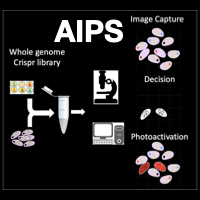
AIPyS V2 is an AI-driven platform enhancing the capabilities of photoswitchable genetic CRISPR screen technology. Utilizing advanced algorithms like U-net and cGAN for segmentation and employing Bayesian inference for differential sgRNA abundance analysis, AIPyS offers precise detection of single cells and subcellular phenotypes in microscopy images. It integrates Numpy, scikit-image, and scipy for parametric object detection and leverages the PyMC3 library for statistical modeling. For interactive data exploration and visualization, the platform is deployed online via Plotly-Dash.
For detailed insights, visit the Documentation.
Quick Installation Guide
AIPyS supports Windows environments and necessitates Python 3.8. For seamless operation with machine learning components like PyTorch and Cellpose, please align CUDA and cuDNN versions meticulously.
-
Conda Installation: Conveniently install using the provided
environment.ymlto configure both Python and CUDA/cuDNN dependencies accurately.conda env create -f environment.yml conda activate aipys_env
-
PIP Installation: For environments where Conda is unavailable, use pip while ensuring correct CUDA/cuDNN configurations.
pip install AIPySPro
Check installation:
aipys --version
Highlighted Features
Segmentation and Analysis
- Parametric Segmentation: Enhances R-based code for effective segmentation using scikit-image.
- Deep Learning Segmentation: Incorporates U-net and cGAN models for cutting-edge segmentation accuracy.
- Granularity Analysis and Classification: Utilizes logistic regression and CNN classifiers trained on meticulously segmented cell images for precise phenotype classification.
Deployment and Integration
- Nikon-nis Elements Integration: Employs AIPyS for advanced image processing, offering streamlined deployment capabilities for Nikon-nis Elements jobs module.
- Interactive Data Visualization: Leverages Plotly-Dash for an immersive data visualization experience, allowing users to interactively explore analysis outcomes.
Bayesian Model Training for Granularity Analysis
- Utilizes Bayesian inference to train models capable of discerning intricate subcellular phenotypes, contributing significantly to the understanding and characterization of genetic modifications impacting cell morphology.
1 maintainer

Metadata
1 maintainer
Release files for AIPyS 0.1.3
For a detailed explanation of source distributions (sdists) and built distributions (wheels), please see the package formats documentation.
Source distribution (sdist)
| File | Size | Uploaded | Provenance | Actions |
|---|---|---|---|---|
| AIPyS-0.1.3.tar.gz | 60.0 kB | Without provenance | Details for AIPyS-0.1.3.tar.gz |
Built distribution (wheel)
| File | Interpreter | ABI | Platform | Actions Reset |
|---|---|---|---|---|
| AIPyS-0.1.3-py3-none-any.whl | Python 3 | none | any | Details for AIPyS-0.1.3-py3-none-any.whl |
Total release size: 142.9 kB
Release files / AIPyS-0.1.3.tar.gz
| Download URL | AIPyS-0.1.3.tar.gz |
|---|---|
| Size | 60.0 kB |
| Tags | Source |
|
SHA-256 checksum How to use checksums |
b3d57bafa875fd152ac22ea512d110afb68007ffdd91d92e32b1e3e349dadce0
|
|
BLAKE2b-256 checksum How to use checksums |
39aaee8a9bb303bef4f3b1ba267c8073d6d2f51281b90b9ff2ce3acc5734c3c8
|
| Upload date | |
|
Uploaded using Trusted Publishing? What is trusted publishing? |
No |
| Uploaded via |
twine/5.0.0 CPython/3.8.10
|
Release files / AIPyS-0.1.3-py3-none-any.whl
| Download URL | AIPyS-0.1.3-py3-none-any.whl |
|---|---|
| Size | 82.9 kB |
| Tags | Python 3 |
|
SHA-256 checksum How to use checksums |
4d5fa3b1a8506039083303361b7c5932975c41f94f147b7f6e851520acb80a43
|
|
BLAKE2b-256 checksum How to use checksums |
6805129e7a558b968c5d11137e48d0ec25c698c7817bde911ca163fc6cb6fc23
|
| Upload date | |
|
Uploaded using Trusted Publishing? What is trusted publishing? |
No |
| Uploaded via |
twine/5.0.0 CPython/3.8.10
|
Security for AIPyS 0.1.3
Provenance
Provenance describes where a file came from. On PyPI, provenance is shared via attestations, which provide a verifiable record of the build or publishing details. View details, limitations and caveats.
No provenance found
None of the files in this release were uploaded with provenance metadata.
A note on package security
PyPI is a repository for distributing packages, not a service for auditing them. While third-party security researchers and our staff do their best to detect and remove malicious packages, PyPI cannot guarantee the quality, security or suitability of any given package.
To learn more about protecting yourself from malicious actors, visit our package security documentation.














