
Analytic Tableau Proof Assistant (ANITA)
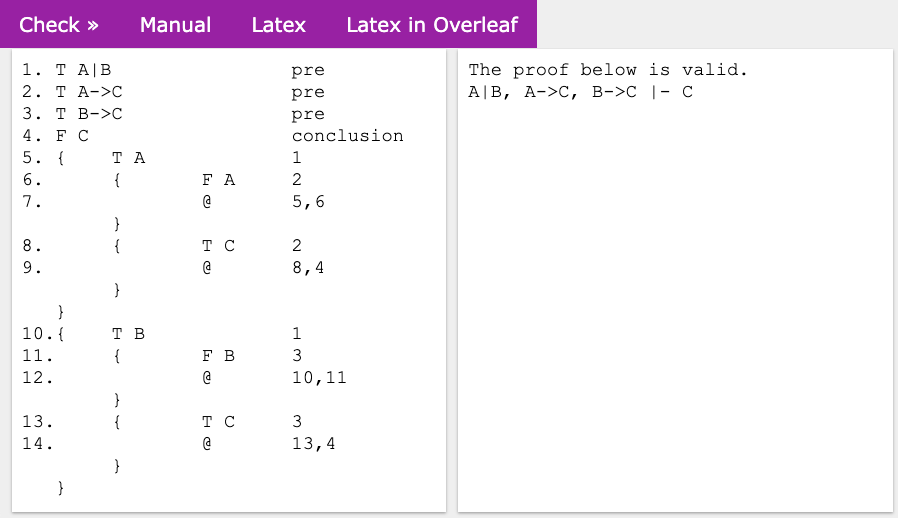
The ANITA is a tool written in Python that can be used as a desktop application, or in a web platform. There is a Jupyter Notebook (in Portuguese) that presents the Analytic Tableaux and ANITA concepts. The main idea is that the students can write their proofs as similar as possible to what is available in the textbooks and to what the students would usually write on paper. ANITA allows the students to automatically check whether a proof in the analytic tableaux is valid. If the proof is not correct, ANITA will display the errors of the proof. So, the students may make mistakes and learn from the errors. The web interface is very easy-to-use and has:
- An area for editing the proof in plain text. The students should write a proof in Fitch-style (see AT Rules).
- A message area to display whether the proof is valid, the countermodel, or the errors on the proof.
- And the following links:
- Check, to check the correctness of the proof;
- Manual, to view a document with the inference rules and examples;
- LaTeX, to generate the LaTeX code of the trees from a valid proof. Use the
qtreepackage in your LaTeX code; - LaTeX in Overleaf, to open the proof source code directly in Overleaf that is a collaborative platform for editing LaTeX
To facilitate the writing of the proofs, we made the following conventions in ANITA:
- The Atoms are written in capital letters (e.g.
A, B, H(x)); - Variables are written with the first letter in lowercase, followed by letters and numbers (e.g.
x, x0, xP0); - Formulas with $\forall x$ and $\exists x$ are represented by $Ax$ and $Ex$ ('A' and 'E' followed by the variable x). For instance,
Ax(H(x)->M(x))represents $\forall x~(H(x)\rightarrow M(x))$. - Table below shows the equivalence of logic symbols and those used in ANITA.
- The order of precedence of quantifiers and logical connectives is defined by $\lnot,\forall,\exists,\wedge,\vee,\rightarrow$ with right alignment. For example:
- Formula
~A&B -> Crepresents formula $(((\lnot A)\land B)\rightarrow C)$; - The theorem
~A|B |- A->Crepresents $((\lnot A)\vee B)\vdash (A\rightarrow B)$.
- Formula
- Each inference rule will be named by its respective connective and the truth value of the signed formula. For example,
&Trepresents the conjunction rule when the formula is true. Optionally, the rule name can be omitted. - The justifications for the premises and the conclusion use the reserved words
preandconclusion, respectively.
| Symbol | $\lnot$ | $\land$ | $\lor$ | $\rightarrow$ | $\forall x$ | $\exists x$ | $\bot$ | branch | $\vdash$ |
|---|---|---|---|---|---|---|---|---|---|
| LaTeX | $\backslash\textrm{lnot}$ | $\backslash\textrm{land}$ | $\backslash\textrm{lor}$ | $\backslash\textrm{rightarrow}$ | $\backslash\textrm{forall x}$ | $\backslash\textrm{exists x}$ | $\backslash\textrm{bot}$ | $[.~]$ | $\backslash\textrm{vdash}$ |
| ANITA | ~ | & | $\mid$ | -> | Ax | Ex | @ | { } | |- |
License
ANITA is available by MIT License.
Requirements:
- You must install rply 0.7.8 package
- ipywidgets
Install
To install ANITA from Github, run the following command:
pip install git+https://github.com/daviromero/anita.git
To install ANITA from PyPi repository, run the following command:
pip install anita
ANITA
You can run ANITA with the command line:
anita -l "en" -i [input_file]
ANITA in Jupyter Nootebook
You can run ANITA in Jupyter Nootebook:
from anita.anita_en_gui import anita
anita()
ANITA in Voila
You can run ANITA in a Voilà
voila anita_en.ipynb
ANITA in your code
You can import ANITA in your code (basic usage)
from anita.anita_en_fo import check_proof

print(check_proof('''1. T A|B		pre
2. T A->C		pre
3. T B->C		pre
4. F C			conclusion
5. {	T A		1
6.	{	F A	    2
7.		@	    5,6
	}
8.	{	T C	    2
9.		@	    8,4
	}
   }
10.{	T B		1
11.	{	F B	    3
12.		@	    10,11
	}
13.	{	T C 	3
14.		@	    13,4
	}
   }
'''))
A Portuguese Version
We have a portuguese version. In the portuguese ANITA syntax, use conclusao instead of conclusion.
- Run ANITA with
anita -i [input_file]
- Jupyter Nootebook with
from anita.anita_pt_gui import anita
anita()
- Voilà with
voila anita_pt.ipynb
- You can import ANITA in your code (basic usage)
from anita.anita_pt_fo import check_proof

print(check_proof('''1. T A|B		pre
2. T A->C		pre
3. T B->C		pre
4. F C			conclusao
5. {	T A		1
6.	{	F A	    2
7.		@	    5,6
	}
8.	{	T C	    2
9.		@	    8,4
	}
   }
10.{	T B		1
11.	{	F B	    3
12.		@	    10,11
	}
13.	{	T C 	3
14.		@	    13,4
	}
   }
'''))
1 maintainer

Release files for anita 0.1.13
For a detailed explanation of source distributions (sdists) and built distributions (wheels), please see the package formats documentation.
Source distribution (sdist)
| File | Size | Uploaded | |
|---|---|---|---|
| anita-0.1.13.tar.gz | 45.0 kB | Details |
Release files / anita-0.1.13.tar.gz
| Download URL | anita-0.1.13.tar.gz |
|---|---|
| Size | 45.0 kB |
| Tags | Source |
|
SHA-256 checksum How to use checksums |
3d4aa7cdb6f6ccf9da89e04b285a417cd450f87dad4b4a0552831c27c2037f4f
|
|
BLAKE2b-256 checksum How to use checksums |
0b31109cb9ad98c36b1b141e6fc4a429f388d0f9540d6d29e9b49b518be5bf52
|
| Upload date | |
|
Uploaded using Trusted Publishing? What is trusted publishing? |
No |
| Uploaded via |
twine/4.0.2 CPython/3.9.7
|














