
api_stats tool
api_stats is a Python tool aimed at recording statistics from an API endpoint. For example, the GitHub API gives out a single number of downloads for each release; by running this tool, you can easily graph rolling averages and historical figures.
Quickstart
api_stats loads a “configuration file” that tells it what to fetch and which fields to record. This file is a Python script that will be loaded by api_stats, with a single global stats that acts as the interface with the program. This interface currently offers two functions: record(key, value), and get_json(url).
Here is an example configuration file, that records the number of downloads of each file from GitHub releases:
releases = stats.get_json(
    "https://api.github.com/repos/remram44/api_stats/releases")
for release in releases:
    relname = release.get('tag_name') or release['name']
    for asset in release['assets']:
        stats.record('%s/%s' % (relname, asset['name']),
                     asset['download_count'])
Then you can plot the data, for example using matplotlib:
python -m api_stats.plot -m '^(.+)$' 'api_stats:\g<1>' data.jsonlA more complex example
You might want to use functions to factor the retrieval of data points from a specific source:
def github(repo):
    releases = stats.get_json(
        "https://api.github.com/repos/%s/releases" % repo)
    for release in releases:
        if release['draft']:
            continue
        relname = release.get('tag_name') or release['name']
        for asset in release['assets']:
            stats.record('github/%s/%s/%s' % (repo, relname, asset['name']),
                         asset['download_count'])


github('VisTrails/VisTrails')
github('remram44/api_stats')


def pypi(pkg):
    releases = stats.get_json(
        "https://pypi.python.org/pypi/%s/json" % pkg)['releases']
    for relname, release in releases.items():
        for asset in release:
            stats.record('pypi/%s/%s/%s' % (pkg, relname, asset['filename']),
                         asset['downloads'])


pypi('VisTrails')
pypi('api_stats')
This will record data under pypi/<pkg_name>/<version>/<filename> and github/<owner>/<repo>/<version>/<filename>. You can then plot the data, one figure per project, aggregated by version but adding PyPI and GitHub together, using:
python -m api_stats.plot \
    -m '^pypi/([^/]+)/([^/]+)/.+$' '\g<1>:\g<2>' \
    -m '^github/[^/]+/([^/]+)/v([^/]+)/.+$' '\g<1>:\g<2>' \
    releases.jsonl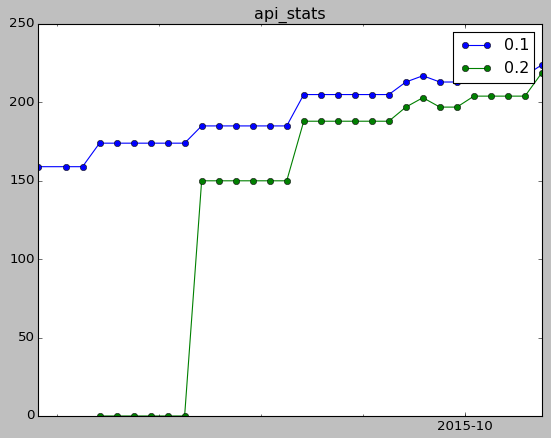
1 maintainer

Metadata
1 maintainer
Release files for api_stats 0.3
For a detailed explanation of source distributions (sdists) and built distributions (wheels), please see the package formats documentation.
Source distribution (sdist)
| File | Size | Uploaded | Provenance | Actions |
|---|---|---|---|---|
| api_stats-0.3-1.tar.gz | 6.4 kB | Without provenance | Details for api_stats-0.3-1.tar.gz |
Built distribution (wheel)
| File | Interpreter | ABI | Platform | Actions Reset |
|---|---|---|---|---|
| api_stats-0.3-py2.py3-none-any.whl | Python 2, Python 3 | none | any | Details for api_stats-0.3-py2.py3-none-any.whl |
Total release size: 17.7 kB
Release files / api_stats-0.3-1.tar.gz
| Download URL | api_stats-0.3-1.tar.gz |
|---|---|
| Size | 6.4 kB |
| Tags | Source |
|
SHA-256 checksum How to use checksums |
4eed1d6f1ad686615392c13564299966e564a800cf9b6f8c7042e6943aeb399d
|
|
BLAKE2b-256 checksum How to use checksums |
a1a884ce1d59361109fc5bdd1c0469848d6e5cc3eb762cde7f52e56efc2184d2
|
| Upload date | |
|
Uploaded using Trusted Publishing? What is trusted publishing? |
No |
Release files / api_stats-0.3-py2.py3-none-any.whl
| Download URL | api_stats-0.3-py2.py3-none-any.whl |
|---|---|
| Size | 11.3 kB |
| Tags | Python 2 Python 3 |
|
SHA-256 checksum How to use checksums |
4d655960e94e696bfa75a462460c9bc74364d8404145fd2843f261e993bdf255
|
|
BLAKE2b-256 checksum How to use checksums |
c32e3db2f118e5d1b3f93706186a00b028860392b5786bf049af4b6d22eb87c2
|
| Upload date | |
|
Uploaded using Trusted Publishing? What is trusted publishing? |
No |
Security for api_stats 0.3
Provenance
Provenance describes where a file came from. On PyPI, provenance is shared via attestations, which provide a verifiable record of the build or publishing details. View details, limitations and caveats.
No provenance found
None of the files in this release were uploaded with provenance metadata.
A note on package security
PyPI is a repository for distributing packages, not a service for auditing them. While third-party security researchers and our staff do their best to detect and remove malicious packages, PyPI cannot guarantee the quality, security or suitability of any given package.
To learn more about protecting yourself from malicious actors, visit our package security documentation.














